





Options assignment is one of the most misunderstood concepts in retail options trading.
For many beginners, and even some intermediate traders, it carries an air of danger and unpredictability that stops them from using certain strategies altogether.
That fear is understandable.
Assignment does carry real risk in some situations.
But in others, it’s a completely routine event that changes nothing about your P&L and requires no action at all.
The key is knowing the difference.
This article walks through three real trade scenarios — a naked short call gone wrong, a defined-risk bear call spread, and a gap risk situation at expiration — to show exactly when assignment is dangerous, when it’s manageable, and what to do in each case.
By the end, you’ll understand the two fundamental truths about assignment that remove most of the fear permanently.
Contents
- Fundamental Concept Of Options Assignment
- Early Assignment
- Possible Option Assignment Scenarios
- Naked Short Call Is The Most Dangerous Option Assignment
- Example Of Short Call Assignment
- Defined Risk Spreads
- Example Gap Risk
- FAQ
- The Main Takeaway
Fundamental Concept Of Options Assignment
A long option is an option that is bought.
A short option is an option that is sold.
A long call option gives the owner the right, but not the obligation, to buy the underlying asset at the strike price.
A short call option obligates the seller to sell the underlying asset at the strike price if assigned.
A long put option gives the owner the right, but not the obligation, to sell the underlying asset at the strike price.
A short put option obligates the seller to buy the underlying asset at the strike price if assigned.
An option is exercised by the person who bought the option.
The person who sold that option will have that option assigned.
Therefore, you can only be assigned when you sell options.
Options assignment occurs only for short options.
In a multi-leg trade, it is the short options that you have to be mindful of, as those are the options that are subject to assignment.
Early Assignment
American-style options can be assigned early.
That means that assignment can occur before expiration.
European-style options cannot be assigned early.
Assignment only occurs at expiration.
Options on stocks and ETFs are American-style options and can be assigned early.
Owners of short options can end up with long or short stock before expiration.
Index options like SPX, RUT, NDX, VIX, and XSP cannot be assigned early.
Assignments occur only at expiration and are cash-settled because the index itself is not a tradable security.
Only options on them can be bought or sold.
Possible Option Assignment Scenarios
Traders often fear assignment as something random, but early assignment is almost always driven by logic, specifically whether there is a financial incentive for the option holder to exercise early.
A put option is in-the-money (ITM) when the underlying price is below the strike price.
A call option is in the money when the underlying price is above the strike price.
Short options are more likely to be assigned when ITM and/or with little extrinsic value left.
The deeper in the money a short option is, the greater the likelihood of assignment.
Likewise, the closer a short option is to expiration, the higher the probability that it will be assigned.
In both cases, the extrinsic value, or “time value,” of the option is lower.
Hence, there is a greater incentive for the option holder to exercise it.
There is also the incentive for the owner of call options to exercise prior to the ex-dividend date of the stock because they want to obtain shares in order to receive the dividend.
Naked Short Call Is The Most Dangerous Option Assignment
A solo short call (also called a naked short call) is one of the riskiest option positions, and assignment can create a very unfavorable situation.
If a trader is assigned on a short call, they are obligated to sell 100 shares at the strike price.
But since they do not own the shares, their broker will short-sell 100 shares on their behalf.
Short stock has unlimited upside risk.
If the stock keeps rising, the short stock loses more and more money.
In theory, it can lose an unlimited amount.
Example Of Short Call Assignment
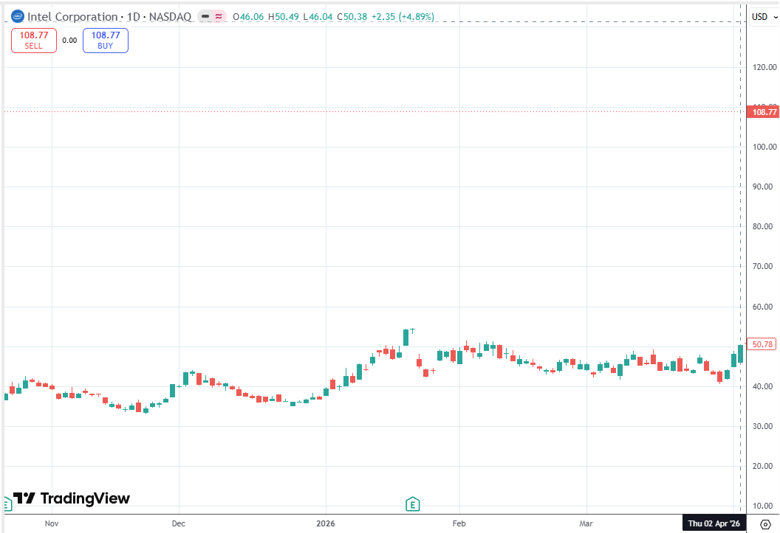
On April 2nd, 2026, Intel (INTC) was trading at $50.35.
The trader sells a $55-strike call option on INTC expiring on May 1st because he thinks Intel is a boring, non-moving stock and it has not reached $55 in years.
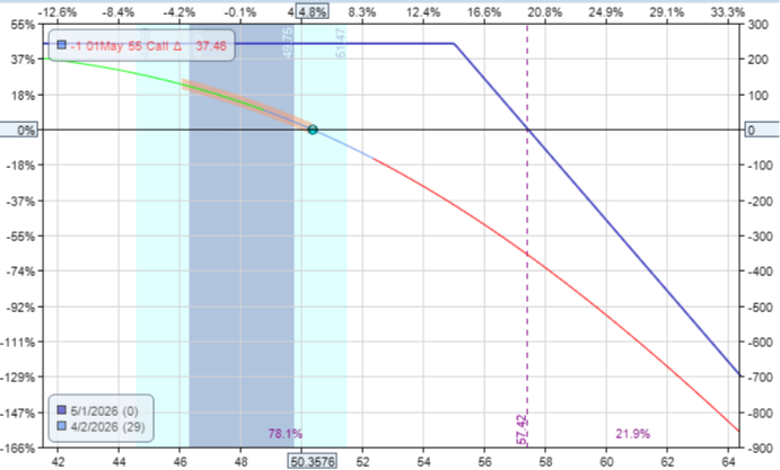
The trader collected a net credit of $242 for a one-contract sale and expected to keep the full amount when the option expires.
From the risk graph, we see unlimited upside risk if the INTC price rises…
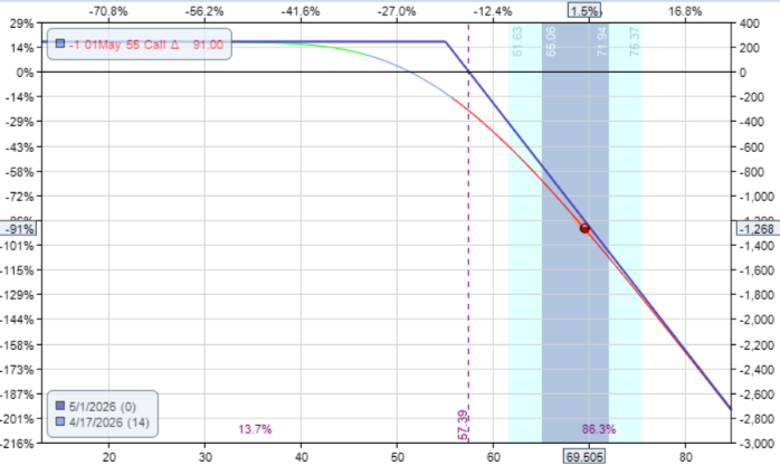
On Friday, April 17th, INTC climbed to $69.50 per share.
The position is at a loss of -$1267.
A week later, on April 24th, INTC gapped up to $82.37 after its positive earnings announcement.
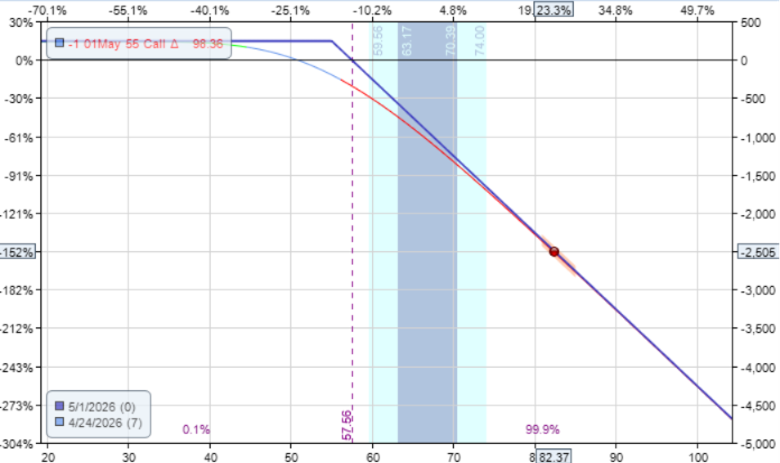
The loss in the option position is now at -$2505.
The short call option is deep ITM, with very little extrinsic value remaining at $0.10 per share.
The short call option is assigned early.
The trader is forced to sell 100 shares of INTC at $55 per share.
He now has 100 short-stock of INTC.
One hundred shares of INTC have a market value of $8237.
But he got only $5500 from the sale.
That is a loss of $2737 from the assignment.
Accounting for the $242 initial credit, the net P&L is $2495, which is the same as the P&L of the option position prior to expiration (aside from potential pricing or rounding differences).
The risk graph of short 100 shares now looks like this…
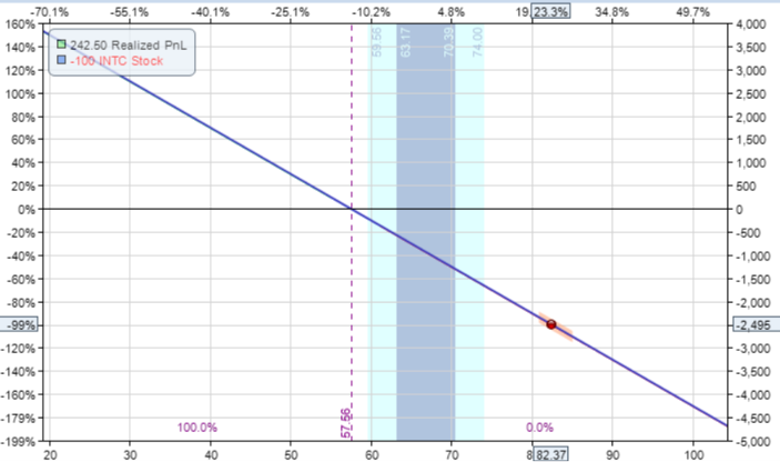
There is no more short call.
On May 11th, INTC’s price reached $129…
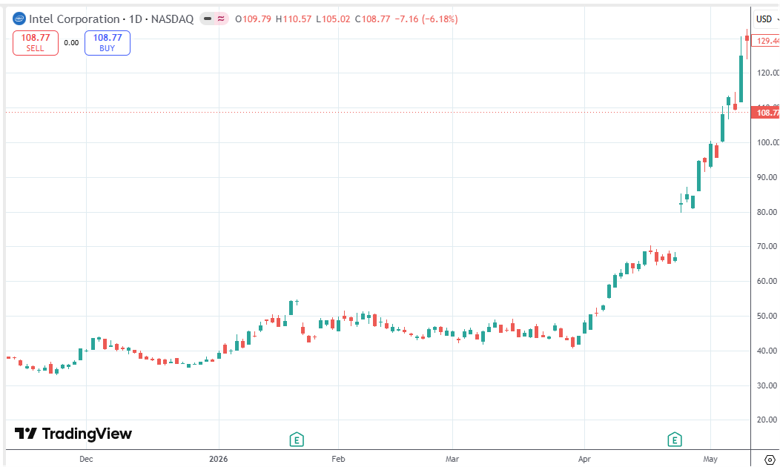
At this point, the total loss in the position is -$7152.
This is what can happen in an undefined-risk trade.
Next, we will look at a defined-risk vertical spread.
Defined Risk Spreads
Cisco (CSCO) stock experienced a similar bull run and gap up on earnings.
Furthermore, it had an ex-dividend date.
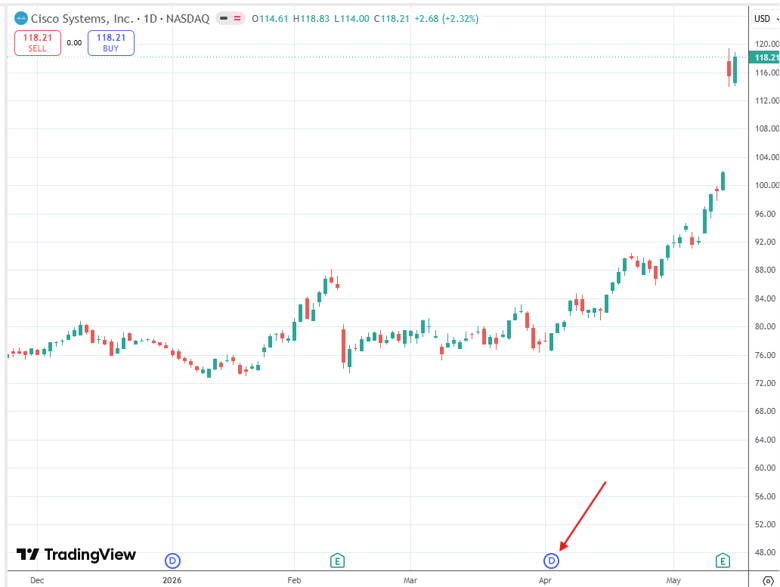
This time, the trader uses a bear call spread.
Date: April 1st, 2026
Price: CSCO @ $78.62
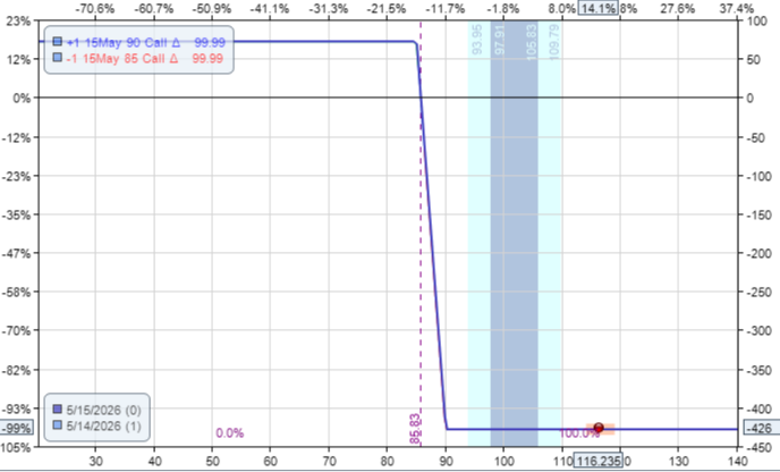
Sell to open one contract May 15th CSCO $85 call @ $1.18
Buy to open one contract May 15th CSCO $90 call @ $0.46
Net Credit: $72
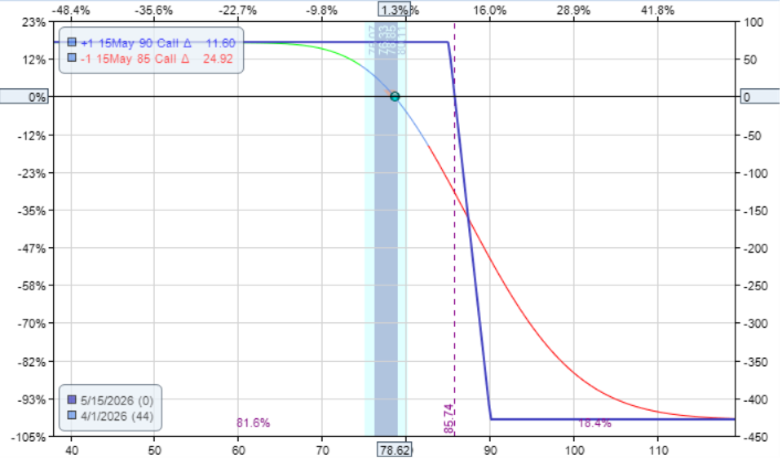
Note that this position has a maximum defined risk of $428, derived from $500 – $72.
After the gap-up on earnings on May 14th, CSCO is at $116.23, and the P&L for the trade is -$426.
Now, suppose that the short call option is early assigned.
The trader is forced to sell 100 shares of CSCO at $85 per share, and the short option disappears.
The risk graph of the short stock with the long call is…
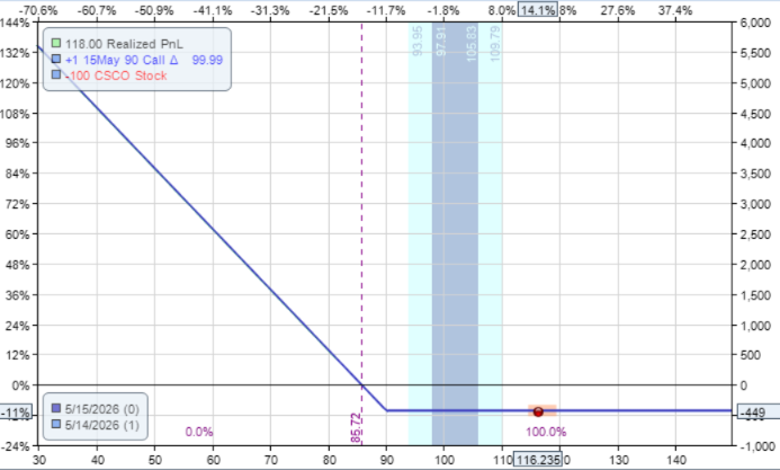
The existing long call options continue to cap the risk on the trade.
However, this long call option expires the next day.
The trader can close out the position now by…
Buy to close 100 short-shares at market price: -$11,623
Sell to close the long call: $2602
So the final P&L at this point would be…
Initial credit: $72
Assigned 100 short-shares: $8500
Buy to cover 100 shares: -$11,623
Sell to close long call: $2602
Net P&L: -$449
The position is effectively at its maximum loss, or very close to it, depending on bid/ask spreads and pricing discrepancies.
This is similar to, or roughly unchanged from, the loss level prior to assignment.
If the trader did not know about the assignment or did nothing, the long call would expire at the end of the session on May 15th, when CSCO closed at $118.21.
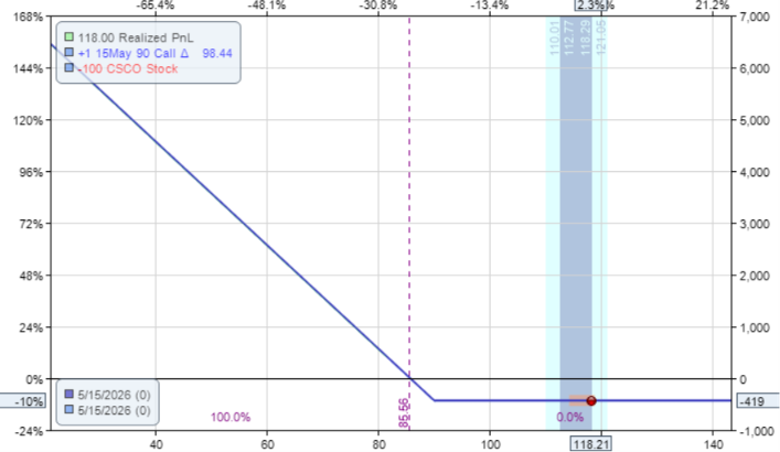
Because the long call’s strike price is $90 and it is ITM, it is auto-exercised at expiration, enabling the trader to buy 100 shares at $90/share.
The P&L would be…
Initial credit: $72
Assigned 100 short-shares: $8500
Exercise long option to buy 100 shares: -$9000
Net P&L: -$428
This highlights the benefit of using a defined-risk trade.
It continues to cap the risk after assignment and up till expiration.
However, there is an overnight gap risk at expiration when the long option is not automatically exercised.
This can occur when the long option finishes out of the money or outside the auto-exercise threshold.
If the underlying stock gaps dramatically after the market closes, the market may move against the unprotected stock position (as we shall see next).
Example Gap Risk
Let’s look at the example bull put credit spread on Robinhood (HOOD).
Date: Jan 5, 2026
Price: HOOD @ $120.12
Buy one contract Jan 30 HOOD $95 put @ $0.60
Sell one contract Jan 30 HOOD $100 put @ $1.02
Net Credit: $42
Max risk: $500 – $42 = $458
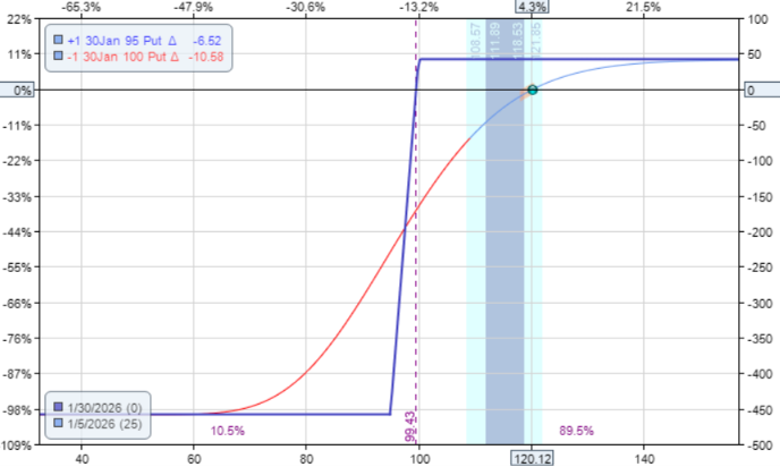
On Friday, expiration on January 30th, HOOD closes at $99.48 per share.
The short put option is ITM and is assigned.
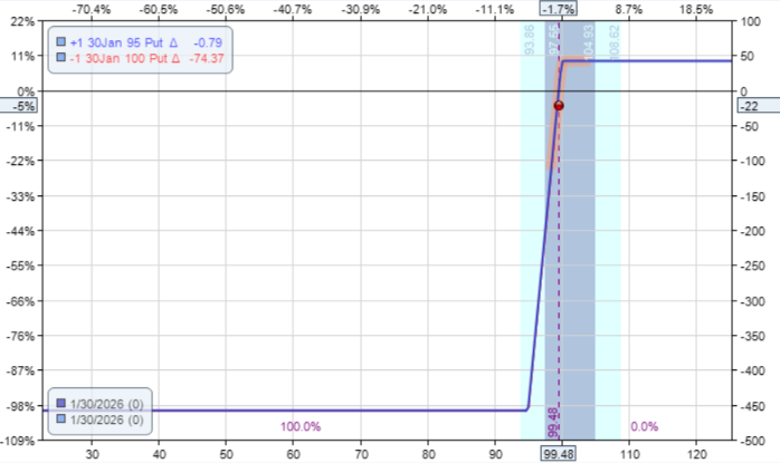
The long put option is out of the money (OTM) and is not auto-exercised.
It expires worthless.
The trader is left with 100 shares of HOOD and a P&L of -$10 at the time of assignment:
Initial credit: $42
Assigned 100 shares: -$10000
Current value of stock: $9948
Current P&L: -$10
The market is closed over the weekend.
On Monday morning, when the market opened, HOOD gapped down to $95.88.
So the resulting P&L is now…
Initial credit: $42
Assigned 100 shares: -$10000
Current value of stock: $9588
Current P&L: -$370
If the trader did nothing, then the P&L by the end of the day, when HOOD drops to $89.91, would be -$967.
Defined-risk trades are no longer defined-risk after expiration when assignment leaves the trader with a stock position.
This shows how a position that was nearly breakeven at Friday’s close turned into a -$370 loss at Monday’s open, and a -$967 loss by the end of the day, more than double the original maximum defined risk of $458.
But at least, it was still better than the undefined risk of a short naked call.
FAQ
When Can I Be Assigned On A Short Option?
You can be assigned at any time on American-style options — those on stocks and ETFs — from the moment you sell the option until expiration.
In practice, early assignment is rare and almost always occurs when the short option is deep in-the-money with little or no extrinsic value remaining, or in the case of short calls, just before an ex-dividend date.
European-style index options like SPX and RUT can only be assigned at expiration.
Does Assignment Change My P&L?
No — this is one of the most important things to understand about assignment.
At the moment of assignment, your P&L does not change.
The option position converts to a stock position at equivalent value.
The risk is not in the assignment itself but in what happens to the stock position after assignment, particularly if it moves adversely during non-trading hours near expiration.
What Happens If I’m Assigned On A Covered Call?
If you’re assigned on a covered call, your 100 shares are sold at the strike price and you keep the premium collected.
This is the intended outcome of the strategy — your shares are called away at the price you agreed to when selling the call.
There is no additional risk created by this assignment.
Simply collect your profit and decide whether to reinvest in the stock or move to a new position.
What Happens If I’m Assigned On A Cash-Secured Put?
If assigned on a cash-secured put, you are obligated to buy 100 shares of the stock at the strike price.
Your cash is used to purchase the shares and you now own 100 shares at an effective cost basis of the strike price minus the premium received.
This is generally a routine event — particularly in the wheel strategy — and simply transitions the trade to its next phase of selling covered calls against the acquired shares.
How Do I Avoid Assignment?
The simplest way to avoid assignment is to close the short option before expiration when it has moved significantly in-the-money.
If you don’t want to own the stock and your short put is being tested, close the position before the extrinsic value approaches zero.
For short calls, check ex-dividend dates — if a short call is in-the-money and an ex-dividend date is approaching, early assignment risk increases significantly.
Is Assignment Different For Index Options?
Yes — index options like SPX, RUT, NDX, and XSP are European-style and cash-settled.
They cannot be assigned early and there is no stock position created at expiration.
Instead, the difference between the strike price and the settlement value is paid or received in cash.
This eliminates overnight gap risk at expiration and makes index options more predictable from an assignment perspective.
Want to Trade Options With Confidence?
Understanding assignment is one of the foundations of disciplined options trading.
Options Income Mastery covers the complete income trading framework — including exactly how to manage assignment, roll positions, and build a systematic approach to generating monthly income with defined risk.
The Main Takeaway
There are two fundamental truths about option assignment that, once understood, remove much of the fear:
- The P&L does not change at the moment of assignment.
- If an early assignment happens, a defined-risk structure continues to define your maximum risk up until expiration.
The only caveat is that if you wait until expiration, any assignment at that time can result in a stock position that may move adversely during non-trading hours, which, in some cases, can exceed the intended max risk of the trade.
By using defined-risk trades and closing them out completely prior to expiration, you cannot lose more than their max risk regardless of early-assignment, as long as you close out the position as a whole and not in pieces.
While we didn’t cover defined-risk time spreads here, the same principle still applies, up to the near-term short option expiration.
By understanding how assignment works, staying aware of ex-dividend, earnings, and expiration dates, and acting proactively when any of those events approach, option assignment can be managed rather than feared.
We hope you enjoyed this article on options assignment.
If you have any questions, please send an email or leave a comment below.
Trade safe!
Disclaimer: The information above is for educational purposes only and should not be treated as investment advice. The strategy presented would not be suitable for investors who are not familiar with exchange traded options. Any readers interested in this strategy should do their own research and seek advice from a licensed financial adviser.