






It’s 10 pm.
Futures are moving hard against your iron condor.
The short strike that looked comfortably out of the money when you entered is suddenly very much in play.
Your mind starts racing through options.
Roll the untested side in?
Roll the tested side out?
Convert to a butterfly?
Buy a protective put?
Or just close the whole thing and be done with it?
This is the moment most iron condor traders get wrong, not because they don’t know the mechanics of adjusting, but because they haven’t made the decision before they needed to make it.
Under stress, with money on the line, the brain reaches for hope instead of process.
This article is about building the decision framework in advance, so that when the moment comes, you already know what you’re going to do.
Contents
- The Core Problem: Adjusting To Avoid Loss Vs Adjusting To Manage Risk
- The Variables That Drive The Decision
- When Adjusting Makes Sense
- When Closing Is The Right Call
- The “Fighting The Trade” Trap
- A Pre-Trade Decision Checklist
- Two Common Exit Frameworks Compared
- After You Close: What The Loss Is Actually Telling You
- FAQ
- Summary
The Core Problem: Adjusting To Avoid Loss Vs Adjusting To Manage Risk
There are two completely different reasons a trader might adjust an iron condor, and mixing them is the root of most iron condor disasters.
Adjusting to manage risk is a pre-planned, mechanical response to a position reaching a defined trigger point.
The delta of the short strike has hit 25.
The position has reached a 1x loss.
DTE is still sufficient to recover.
You roll the tested spread or bring in the untested side, as your trading plan specifies.
Emotion doesn’t enter into it because the decision was already made.
Adjusting to avoid loss is entirely different.
The trade is going against you.
Closing now means crystallising a loss you don’t want to take.
So you adjust, not because your plan says to, but because adjusting feels like doing something, like fighting back.
And if the adjustment doesn’t work, you adjust again.
And again.
Each adjustment typically adds risk to the position.
You’re widening your exposure, accepting more margin, or extending your time in a deteriorating trade.
What starts as a manageable loss can compound into a significant one, all while you tell yourself you’re “managing” the trade.
The key question to ask before any adjustment is brutally simple: Am I doing this because my plan says to, or because I don’t want to take the loss?
If it’s the latter, close the trade.
The Variables That Drive The Decision
Before you can build a framework, you need to understand which variables actually matter at the moment of decision.
Days to expiration (DTE) remaining. This is arguably the most important variable.
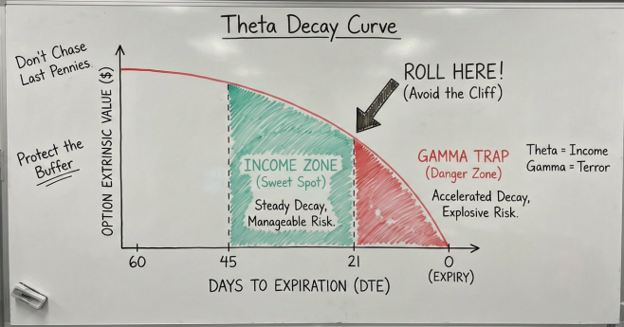
With 30+ DTE remaining, there is time for the underlying to revert, for theta to work, for an adjustment to bear fruit. With fewer than 14 DTE, you are deep in negative gamma territory.
A position that continues to move against you in the final two weeks can accelerate losses very quickly, and adjustments in this window often don’t provide enough benefit to justify the added risk.
Delta of the short strike. When you entered the trade, your short strikes were likely at 10-15 delta, meaning roughly a 10-15% chance of expiring in the money.
As the underlying moves toward a short strike, that delta rises.
Most systematic iron condor traders use a delta trigger of 25-30 as the adjustment point.
By the time a short strike reaches 30 delta, you have a meaningful directional problem that warrants action.
Cost of the adjustment relative to remaining premium. Every adjustment costs something, either a direct debit to roll a spread, or reduced maximum profit from bringing in the untested side.
If the cost of adjusting consumes most of the remaining profit potential on the trade, the risk/reward of staying in the trade has deteriorated significantly.
At that point, closing and redeploying capital elsewhere is often the better mathematical decision.
Whether the underlying is trending or reverting. A condor that is being tested because the underlying made a single sharp move in a generally ranging market is a different situation from a condor being tested by a market that has broken structure and is now trending.
In the former, patience or a modest adjustment may be appropriate. In the latter, you are fighting the tape, and the probability math that justified entering the trade no longer applies.
How many adjustments have you already made? If you have already adjusted once and the trade is still moving against you, the market is telling you something.
A second adjustment is sometimes warranted.
A third is almost always a sign that you are in the wrong trade for the current market regime.
When Adjusting Makes Sense
Adjustments are most justified when all of the following conditions are met, not just one or two.
Sufficient DTE remains. As a rule of thumb, if the trade has more than 21 days left, there is enough time for an adjustment to work.
Inside 21 DTE, the gamma profile makes adjustments progressively less effective.
The short strike delta is at your trigger, but not catastrophically beyond it. An adjustment when the short strike has moved from 15 delta to 25 delta is reasonable.
An adjustment when it has already moved to 40 delta and is deep in the money is likely to be expensive and ineffective; closing is usually better at that point.
The cost of the adjustment is modest. If rolling the tested side costs 25-30% of the original credit received, that’s a reasonable price for extending the trade.
If it costs more than the remaining profit potential, the maths no longer make sense.
Your view on the underlying is that the move is likely temporary. This requires honest assessment, not wishful thinking.
Is there a concrete reason, a technical support level, a mean-reversion pattern, or a known catalyst passing to believe the underlying will reverse?
Or are you just hoping?
You have a clear, defined action. “I’ll roll the put spread down to the 15-delta level” is a defined adjustment.
“I’ll do something” is not.
If you can’t articulate exactly what you’re going to do and what the resulting position looks like, don’t adjust.
The mechanics of adjusting iron condors, rolling, widening, and defensive adjustments are covered in detail once you’ve decided to act.
When Closing Is The Right Call
There are specific situations where closing the entire position, taking the defined loss, and moving on is clearly the better decision.
You are inside 14 DTE, and the trade has been significantly tested. Gamma risk accelerates dramatically in the final two weeks of an option’s life. A short strike that is being tested with 30 DTE can be managed.
The same situation with 10 DTE is dangerous, small moves in the underlying produce large P&L swings, and adjustments provide diminishing returns.
Close, take the loss, and reset.
The underlying has broken structure and is trending. Iron condors are range-bound strategies.
They are built on the assumption that the underlying will stay within a defined range.
If that assumption is no longer valid, if the underlying has broken a key technical level and is trending with momentum, the foundational premise of the trade is gone.
Adjusting a condor in a trending market is trying to fit a neutral strategy into a directional market. It rarely ends well.
The loss has reached your pre-defined maximum. You set a stop loss when you entered the trade.
It might be 1x premium received, 2x premium received, or a fixed dollar amount when that level is reached, close.
The entire purpose of a pre-defined stop is to remove the decision from the emotion of the moment.
If you override your own stop loss because “it’ll probably come back,” you’ve negated the risk management framework entirely.
The cost of adjusting exceeds the benefit. If rolling the tested spread costs more than the remaining premium in the trade, you are paying to extend a bad position. Close it.
You’ve already adjusted twice. Two adjustments on a single condor is a signal that the trade is fundamentally broken.
Each adjustment has added risk or reduced reward. A third adjustment is often just delaying an inevitable, larger loss.
You entered the trade wrong for the conditions. If you look at the current market environment and realise the trade should never have been entered, wrong IV environment, wrong underlying for a condor, earnings you missed, close it.
The sunk cost of the current loss is irrelevant to the decision of what to do now.
The hidden dangers of iron condors cover the structural risks that most often lead traders into the over-adjustment trap.
The “Fighting The Trade” Trap
This deserves its own section because it is the single most common way iron condor traders turn manageable losses into serious ones.
The pattern looks like this.
A condor comes under pressure.
Rather than closing at a 1x loss as the plan specified, the trader adjusts the position.
The adjustment doesn’t resolve the pressure.
The trader adjusts again.
Now the position has been modified so many times that it barely resembles the original trade, the maximum loss has expanded, and the trader is deeply psychologically committed to the position recovering.
At this point, closing feels like admitting failure.
So the trader holds, adjusts again, and waits.
What started as a $400 loss on a $200 premium trade has become a $900 loss, far beyond the original maximum risk, because each adjustment quietly expanded the position’s downside.
Accepting a defined loss when the rules say to is not failure.
It is the process working exactly as designed.
Over-adjusting to avoid that loss is the actual failure, not of the market, but of discipline.
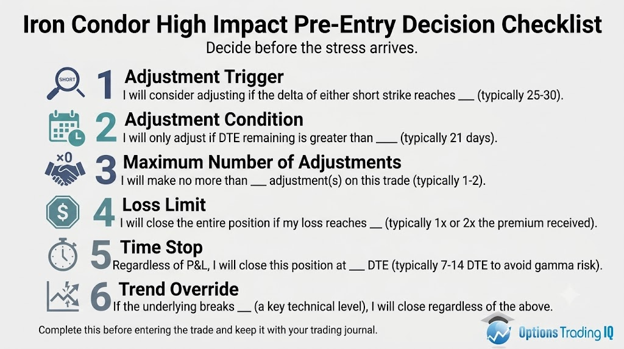
A Pre-Trade Decision Checklist
The best time to decide what you will do when a condor is tested is before you enter the trade.
Here is a simple checklist to complete at entry:
Adjustment trigger: I will consider adjusting if the delta of either short strike reaches ___ (typically 25-30).
Adjustment condition: I will only adjust if DTE remaining is greater than ___ (typically 21 days).
Maximum number of adjustments: I will make no more than ___ adjustment(s) on this trade (typically 1-2).
Loss limit: I will close the entire position if my loss reaches ___ (typically 1x or 2x the premium received).
Time stop: Regardless of P&L, I will close this position at ___ DTE (typically 7-14 DTE to avoid gamma risk).
Trend override: If the underlying breaks ___ (a key technical level), I will close regardless of the above.
Complete this before entering the trade and keep it with your trading journal.
When the moment of stress arrives, the decision has already been made.
Two Common Exit Frameworks Compared
There are two widely used frameworks for managing iron condor exits.
Both have merit, and understanding them helps you choose which fits your style.
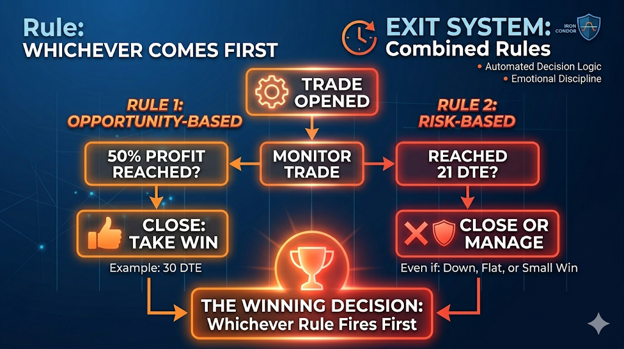
The 2x premium stop / 50% profit target
This is probably the most commonly taught iron condor management rule.
You close the trade for a profit when you’ve captured 50% of the maximum premium.
You close for a loss when the trade has lost 2x the original premium received.
Example: You sell a condor for $200 credit.
You take profit at $100 gain.
You take a loss if the position reaches $400 loss.
The logic is straightforward: the 50% profit target captures the most efficiently earned theta while avoiding the high-gamma final weeks.
The 2x stop prevents any single loss from wiping out multiple winners.
The limitation is that it doesn’t account for DTE or delta, a condor that has lost 2x premium with 35 DTE still remaining in a calm market may be worth adjusting rather than closing outright.
The Delta Trigger Framework
Rather than monitoring P&L, this approach watches the delta of the short strikes.
When either short strike reaches a pre-defined delta (commonly 25-30), an adjustment is triggered.
The trade is closed entirely if an adjustment has already been made and the delta trigger is reached again, or if DTE drops below the time stop.
This approach is more responsive to actual market conditions than the P&L-based stop.
A sharp intraday spike might briefly push a short strike to 30 delta without the P&L reaching 2x premium; the delta trigger catches this in real time.
The limitation is that it requires more active monitoring.
P&L-based stops can be set as GTC orders with your broker.
Delta triggers require you to watch the position or set price alerts at the underlying levels where your short strikes reach critical delta values.
Most systematic income traders combine both: the delta trigger for adjustment decisions, and the 2x premium stop as a backstop maximum loss.
Disciplined use of adjustment triggers alongside defined stops lifted real-world win rates significantly above the theoretical baseline.
For a deeper look at specific adjustment mechanics, see the guides on adjustment strategies and adjusting the wings of an iron condor.
After You Close: What The Loss Is Actually Telling You
Closing a condor for a loss is not the end of the process, it’s the beginning of a review.
Every losing trade contains information.
The question is whether you extract it or just move on.
A few questions worth asking after any closed loss:
Was the entry valid? Check the IV Rank at entry, the term structure, and whether any known binary events were approaching.
If the entry conditions were met, the loss is simply the expected variance of a high-probability strategy. If the entry conditions weren’t met, that’s a process failure worth noting.
Did I follow my plan? If the loss was taken at the pre-defined stop, the plan worked. If you overrode the stop or adjusted when you shouldn’t have, identify why.
Emotion? Overconfidence? Distraction?
These are the real risks to fix.
What did the underlying do? A loss caused by a single sharp spike in a generally range-bound market is different from a loss caused by a sustained directional trend.
The former is the expected variance.
The latter may indicate you were in the wrong underlying for a condor at that time.
Was position sizing appropriate? Risking no more than 2% of the portfolio on any single trade is a sound guideline.
A loss that feels devastating is usually as much a position-sizing problem as a trade-selection problem.
The traders who build consistent long-term income from iron condors are not the ones who never lose.
They are the ones who lose defined, planned amounts when the market moves against them, extract the learning, and get back to executing the process.
The volatility risk premium that makes option selling work is only accessible to traders who are still in the game long enough for the edge to compound.
FAQ
What Is The Best Rule Of Thumb For When To Close An Iron Condor?
Two triggers work well in combination.
First, a P&L stop: close the entire position if you’ve lost 2x the original premium received.
Second, a time stop: close any open position at 7-14 DTE regardless of P&L to avoid gamma risk in the final week.
These two rules alone eliminate most of the catastrophic losses that come from holding too long or hoping for a recovery.
Is It Ever Okay To Adjust An Iron Condor More Than Once?
It can be, but it should be the exception rather than the rule.
A second adjustment is sometimes warranted if DTE remains ample and the adjustment is low-cost.
A third adjustment almost always indicates the trade is in the wrong market environment and should be closed.
Every adjustment you make beyond the first should face a higher burden of justification.
What If I Close For A Loss And Then The Market Reverses?
This will happen.
It is unavoidable and irrelevant to the question of whether the decision was correct.
Decisions are evaluated based on the information available at the time they are made, not on what happens afterward.
If your stop loss was reached and you closed, you followed your plan correctly, regardless of where the market went next.
Judging a risk management decision by its outcome rather than by the quality of the process is called “resulting,” and it is one of the most corrosive thinking patterns in trading.
Should I Use The Same Adjustment Rules For Index Condors And Individual Stock Condors?
Broadly, yes, but individual stock condors carry additional event risk, particularly earnings, that index condors don’t.
For individual stocks, be even more conservative about adjusting near earnings dates and more willing to close outright if an earnings announcement is approaching within your DTE window.
Index condors on SPX, RUT, and their ETF equivalents generally allow for more mechanical, rule-based management.
See the guide on the best ETFs for iron condors for more on choosing appropriate underlyings.
My Condor Is At Breakeven With 10 DTE. Should I Close Or Hold?
Close.
With 10 DTE remaining, the remaining theta gain is modest, but the gamma risk is significant.
You are holding a nearly zero-profit position while carrying meaningful risk that a single bad day could wipe out everything and then some.
Take the breakeven, free up the capital, and put it to work in a new trade with better risk/reward.
The best condor traders are ruthless about closing low-value, high-risk positions in the final week.
What’s The Difference Between An Attacking Adjustment And A Defensive Adjustment?
An attacking adjustment, such as rolling the untested side closer to collect more premium, improves the position’s premium and delta balance but increases risk by bringing strikes closer to the current price.
A defensive adjustment, such as rolling the tested spread further away, reduces risk at the cost of additional debit and reduced maximum profit.
Attacking adjustments are appropriate early in a trade when the threat is modest.
Defensive adjustments are appropriate when the trade is genuinely under pressure.
Knowing which type of adjustment you’re making, and why, is a key part of structured trade management.
Can I Convert An Iron Condor Into Another Strategy Rather Than Closing It?
Yes.
Converting a threatened condor into a butterfly by buying back the untested spread is one common approach that reduces risk while maintaining some profit potential.
Calendarizing the condor, adding a calendar to the threatened short strike, is another.
These are legitimate tools, but they should be in your pre-trade plan, not improvised under pressure.
If you haven’t thought through these conversions before entering the trade, stick to the simpler options: adjust as planned, or close.
Summary
The adjust vs. close decision comes down to one thing: whether you have a plan and follow it.
The traders who consistently lose money on iron condors are not usually making wrong entries.
They are making good entries and then mismanaging the exits, holding too long, adjusting too many times, and overriding their own rules under emotional pressure.
The traders who make consistent income from condors manage each trade against a pre-defined framework.
They close when the stop is hit; they adjust only when conditions specifically warrant it; and they accept losing trades as a normal, expected part of a strategy that wins the large majority of the time.
Before your next iron condor entry, complete the pre-trade checklist.
Write down your adjustment trigger, your loss limit, your time stop, and your maximum number of adjustments.
Put it somewhere you’ll see it when the position is moving against you at 10 pm.
That piece of paper is worth more than any adjustment technique.
Want a Systematic Iron Condor Process From Entry to Exit?
The adjust vs. close decision is one piece of a complete iron condor system.
Options Income Mastery covers the full framework — entry rules, strike selection, adjustment triggers, exit management, and position sizing — so you’re never making these decisions under pressure without a plan.
Related Articles:
- Adjusting iron condors: the ultimate guide
- Iron condor adjustment strategies
- How to manage an iron condor for profit
- Adjusting the wings of an iron condor
- Calendarizing an iron condor
- Iron condor success rate: backtest results
- The hidden dangers of iron condors
- Iron condors: the complete guide
We hope you enjoyed this article on iron condor adjust vs close decisions.
If you have any questions, please send an email or leave a comment below.
Trade safe!
Disclaimer: The information above is for educational purposes only and should not be treated as investment advice. The strategy presented would not be suitable for investors who are not familiar with exchange traded options. Any readers interested in this strategy should do their own research and seek advice from a licensed financial adviser.