








Most bearish options strategies come with an uncomfortable trade-off: you pay for the right to profit from a decline, but time decay works against you every day the stock doesn’t move.
Long puts bleed theta.
Bear put spreads do too.
The bear put diagonal is different.
It’s a bearish strategy that is simultaneously theta positive, meaning time decay works in your favour even if the stock doesn’t move.
Add positive vega into the mix, and you have a strategy that benefits from the three most common conditions in a bearish market environment: declining prices, rising volatility, and the passage of time.
That’s a rare combination, and it’s what makes the bear put diagonal worth understanding.
Contents
- Structure Of The Bear Put Diagonal
- How To Select Strikes And Expirations
- Bear Put Diagonal Vs Bear Put Spread
- Winning Scenario
- Neutral Scenario
- Losing Scenario
- Rolling The Short Put
- Best Underlyings For The Bear Put Diagonal
- FAQ
- Conclusion
Structure Of The Bear Put Diagonal
A bear put diagonal involves buying a longer-dated put option at a higher strike and selling a shorter-dated put option at a lower strike.
The combination creates a position with:
- Negative delta — profits from a decline in the underlying
- Positive theta — profits from time decay even in a sideways market
- Positive vega — profits from rising implied volatility, which often accompanies falling prices
The net cost of the trade is the maximum risk.
In the worst case — the underlying rallies above the long put strike and both options expire worthless — you lose the initial debit paid.
This makes the bear put diagonal a defined-risk strategy.
Here is an example on COIN (Coinbase).
Date: Jan 20, 2026
Price: COIN at $232
Buy one contract Feb 20 COIN $235 put @ $17.22
Sell one contract Feb 13 COIN $225 put @ $11.10
Net debit: -$613
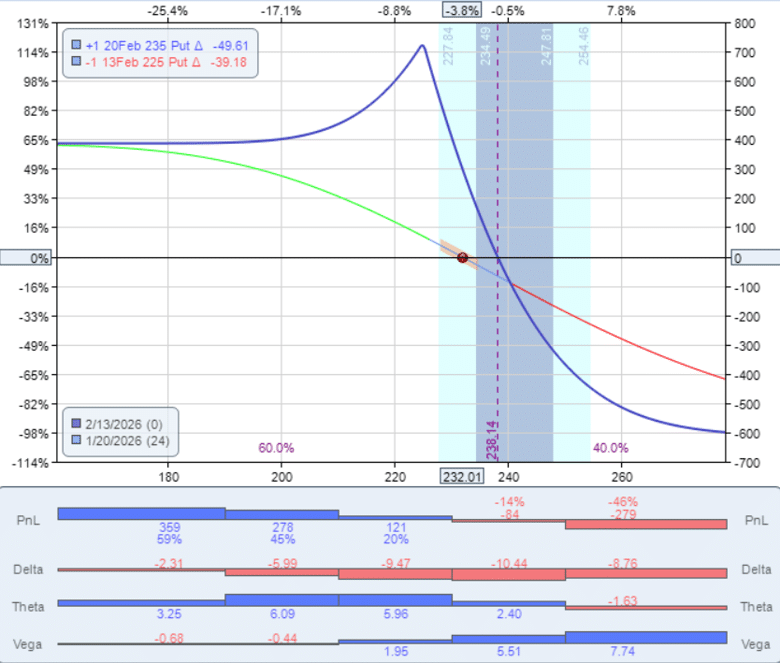
Delta: -10.42
Vega: 4.12
Theta: 4.08
The debit paid of $613 is the max risk in this trade.
Because in the worst case scenario when price of COIN goes above $235 at the longer-dated expiration of February 20th, both options expire worthless and the trader’s loss is the initial debit paid for those options.
How To Select Strikes And Expirations
Strike and expiration selection determines the character of the trade.
Here are the key guidelines:
Long put strike:
Place at or slightly in-the-money.
Typically 1–3% above the current price.
This maximises delta sensitivity to a downward move while keeping the option affordable.
Short put strike:
Place 3–7% below the current price.
This needs to be far enough OTM to avoid early expiration near the money, while close enough to collect meaningful premium.
Expiration gap:
A one-week gap between the short and long expirations is a common starting point.
Wider gaps increase vega exposure and the cost of the trade.
Tighter gaps reduce premium collected on the short put and limit theta benefit.
Ideal entry conditions:
The bear put diagonal works best when IV is moderate, but not so low that vega gains are marginal, and not so high that the debit is excessive.
A stock showing early signs of weakness with IV beginning to expand is the ideal setup.
Avoid entering into an already-elevated IV spike, as a subsequent IV crush will work against the long vega exposure.
Bear Put Diagonal Vs Bear Put Spread
The most common question about this strategy is how it differs from a standard bear put spread.
Here’s the key distinction:
A bear put spread uses two options with the same expiration.
It’s purely a directional trade.
If the stock doesn’t fall, both options decay at the same rate and theta is negative overall.
You need the stock to move to make money.
A bear put diagonal uses two options with different expirations.
The time spread creates positive theta.
The short-dated short put decays faster than the long-dated long put, generating a net theta benefit.
The position can be profitable even in a sideways market.
The trade-off:
The diagonal costs more to enter than a same-width bear put spread because the long put has more time value.
The maximum risk is also purely the debit paid rather than the spread width minus the credit.
In exchange, you get a more forgiving position that doesn’t require the stock to move immediately.
Winning Scenario
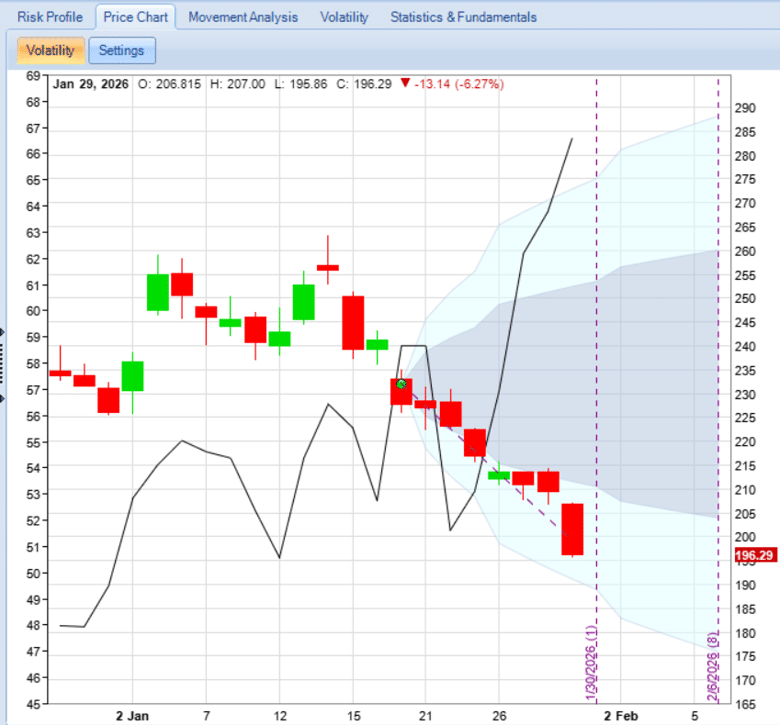
For our Coinbase example, nine days later, the trade is showing a profit of $270:
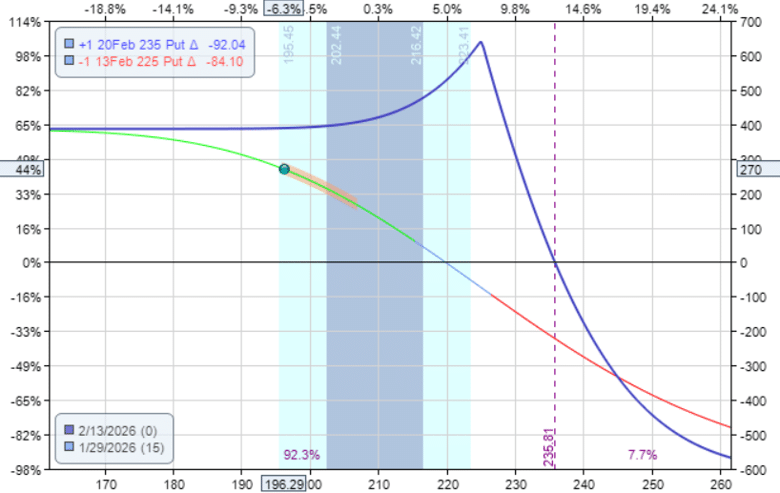
All three Greeks worked in the trader’s favour simultaneously.
As COIN declined, implied volatility expanded, which is a common pairing in individual stocks under selling pressure.
The negative delta captured the directional move, the positive vega captured the volatility expansion, and positive theta was adding value each day regardless.
This is the ideal scenario for the bear put diagonal: a stock declining with rising volatility, giving the strategy a dual tailwind.
Neutral Scenario
The second example demonstrates one of the strategy’s most useful properties — the ability to profit without a directional move.
Date: March 6, 2026
Price: JPM at $287
Buy two contract April 2nd JPM $290 put @ $11.72 ea
Sell two contract March 27th JPM $285 put @ $8.22 ea
Net debit: -$700
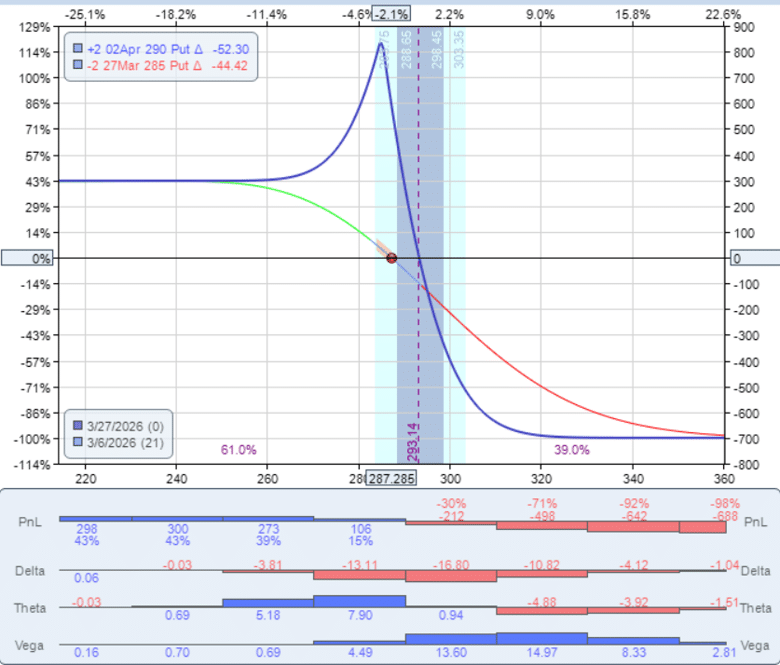
Delta: -15.76
Vega: 7.79
Theta: 6.21
Fourteen days later, JPM finished at exactly $287, the same price at which the trade was entered.
No directional move.
Despite this, the position generated a profit of $55, representing a 7% return on risk.
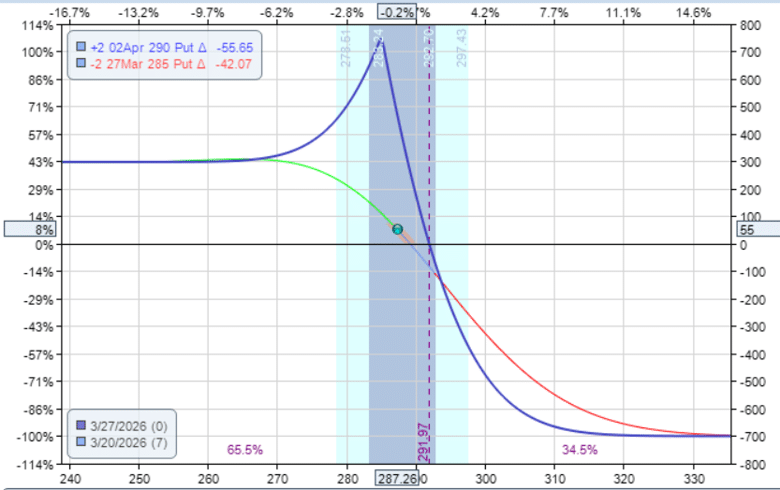
This result is entirely attributable to positive theta.
The short-dated put decayed faster than the long-dated put over those 14 days, generating a net time decay benefit.
For traders who expect a stock to weaken but aren’t sure of the timing, this characteristic is genuinely valuable.
The position doesn’t require an immediate move to start working.
Losing Scenario
No strategy guide is complete without a losing trade.
The MU example demonstrates both what can go wrong and how to manage it.
Date: March 30, 2026
Price: MU @ $344
Buy one contract May 1st MU $335 put @ $22.47
Sell one contract April 24th MU $325 put @ $15.52
Net Debit: -$695
Max Risk: $600
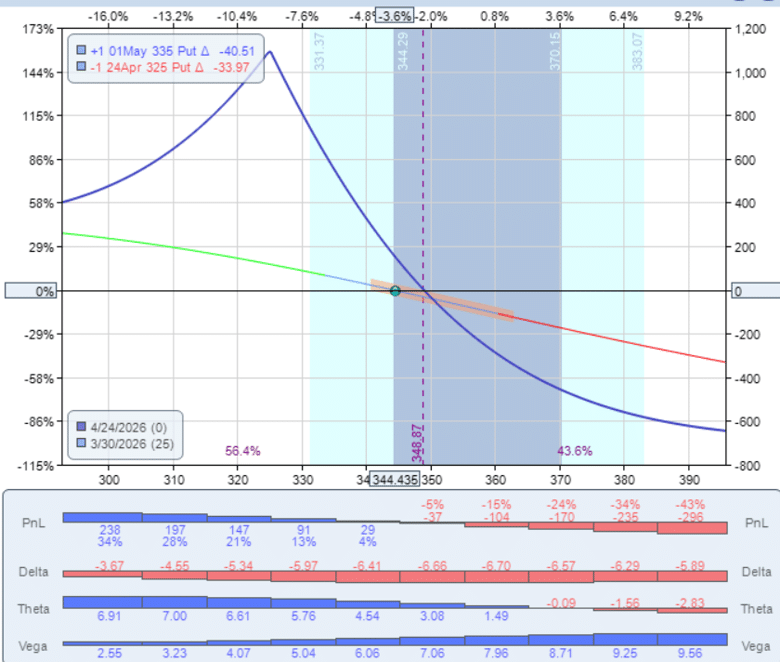
Delta: -6.54
Vega: 6.51
Theta: 3.92
A week later, MU had rallied to $379 — moving sharply against the bearish thesis.
The position was down $157 with 18 days remaining.
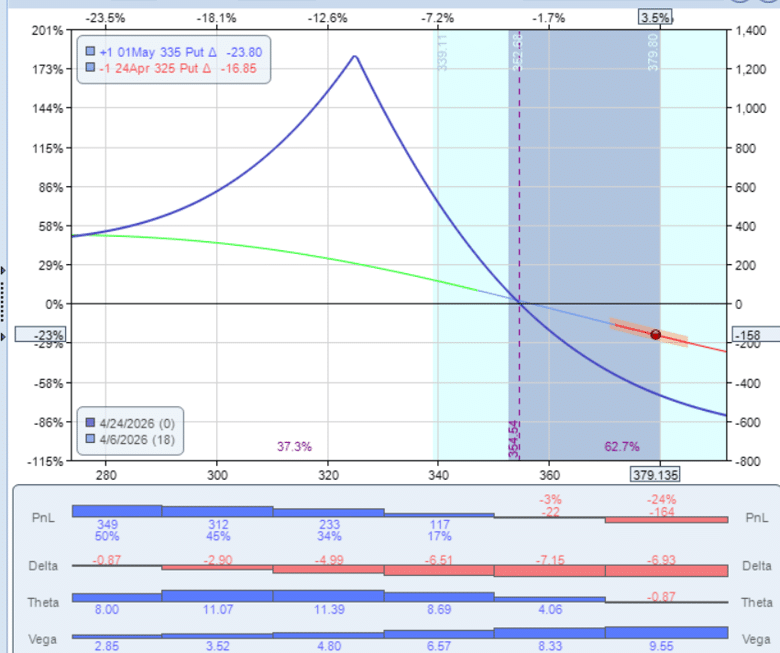
Rather than close immediately for a loss, the trader assessed whether an adjustment could improve the situation without adding risk.
With MU now at $379, a bull call diagonal was added in the opposite direction:
Date: April 6, 2026
Price: MU @ $379
Buy one contract May 1st MU $380 call @ $29.33
Sell one contract April 26th MU $390 call @ $20.12
Net Debit: -$920
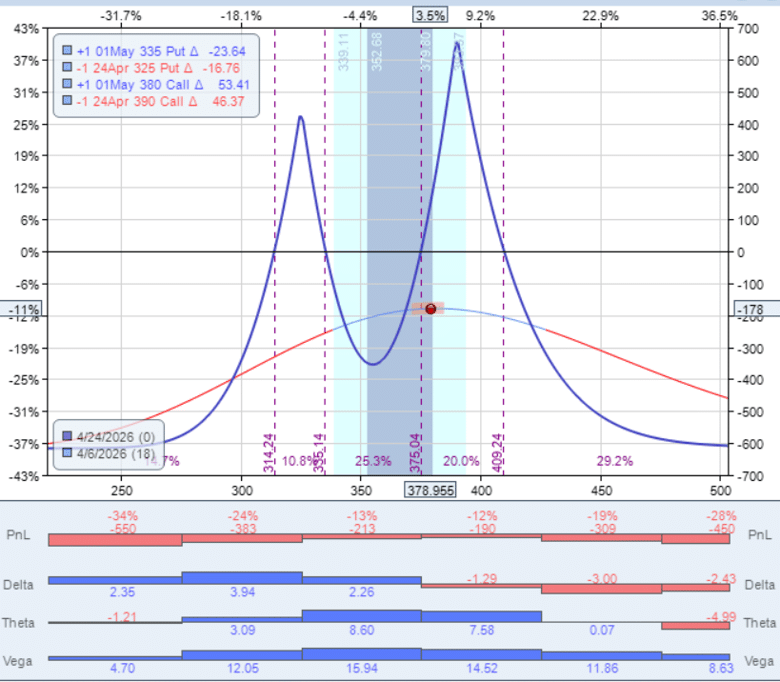
Delta: 0.16
Vega: 15.46
Theta: 9.16
The adjustment achieved three things.
First, it flattened the delta.
The position was no longer strongly directional in either direction.
Second, it significantly increased theta, with time decay now working harder for the combined position.
Third, and most importantly, it did not increase the maximum risk.
The expiration P&L graph still showed a maximum loss of $695, the same as before the adjustment.
Four days later, with MU continuing higher and outside the profit zone of the double diagonal, the trader exited for a loss of $109 — meaningfully better than the $157 loss at the time of adjustment.
The adjustment didn’t save the trade, but it reduced the damage.
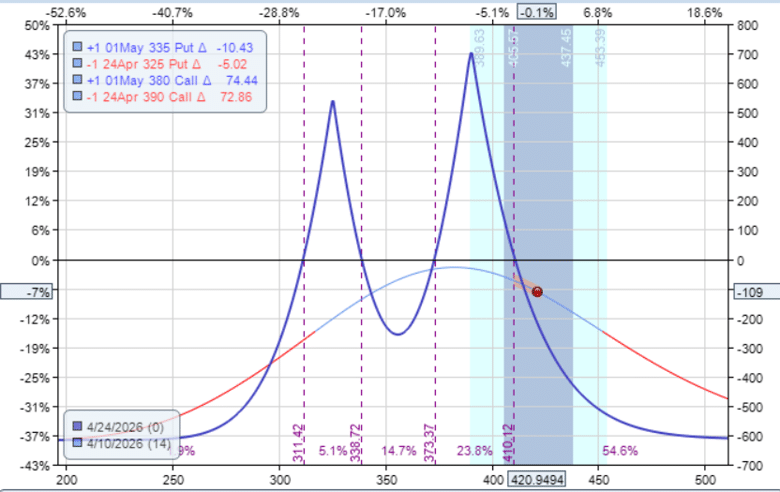
The lesson: when a directional trade goes wrong and there is still meaningful time remaining, converting to a neutral double diagonal structure is worth considering if it doesn’t add risk.
The worst case stays the same; the best case improves.
Rolling The Short Put
One of the advantages of the bear put diagonal over a simple long put is the ability to roll the short leg — selling a new short-dated put when the first one expires, against the existing long put.
If the short put expires worthless and the long put still has significant time value remaining, the trader can sell another short-dated put at a lower strike.
This collects additional premium that further reduces the net cost basis of the trade.
Over time, if the stock remains near or below the entry price, it’s possible to reduce the initial debit to near zero through successive rolls, effectively turning the long put into a nearly free option while continuing to generate short-dated premium.
This is the “campaign diagonal” approach, directly analogous to the campaign calendar spread.
The practical rule for rolling: only roll the short leg if the new premium collected is meaningful relative to the remaining risk.
If the stock has moved significantly away from your strike or IV has collapsed, the available premium may not justify maintaining the position.
Best Underlyings For The Bear Put Diagonal
The bear put diagonal works best on underlyings with these characteristics:
High liquidity.
Tight bid-ask spreads on both legs are essential.
A wide spread on a diagonal eats into the already-modest credit received from the short put.
AAPL, AMZN, MSFT, GOOGL, NVDA, and similar mega-cap stocks offer the tightest spreads and most reliable fills.
Moderate to elevated IV.
The positive vega exposure means you want some volatility in the underlying.
Extremely low-IV stocks offer thin premium on the short put and limited vega upside.
Signs of technical weakness.
This is a bearish strategy.
Enter it on stocks showing bearish signals: breaks below support, declining moving averages, or bearish candlestick patterns at resistance.
The COIN trade is a good example as a bearish day preceded entry, with the structure positioned to benefit if selling continued.
Upcoming catalysts (selectively).
Stocks with upcoming earnings or events can work well if you expect the event to be negative and IV is beginning to expand pre-announcement.
The positive vega position benefits from this pre-event IV expansion.
FAQ
What Is The Maximum Loss On A Bear Put Diagonal?
The maximum loss is the net debit paid to enter the trade.
This occurs if the underlying rallies above the long put strike at the long expiration date and both options expire worthless.
Because the maximum risk is defined and limited to the initial debit, the bear put diagonal is a defined-risk strategy regardless of how far the underlying moves against you.
How Does The Bear Put Diagonal Differ From A Long Put?
A long put is purely directional and purely theta negative.
Time decay works against it every day.
The bear put diagonal adds positive theta by selling a shorter-dated put against the long put, meaning time decay contributes to profitability even in a sideways market.
The trade-off is that the short put caps the maximum gain at lower strikes, whereas a long put has unlimited downside profit potential.
When Should I Close A Bear Put Diagonal Early?
Close early when:(1) you’ve hit your profit target — typically 25–50% of the maximum potential gain, (2) the underlying has reversed sharply and your stop loss level has been reached, (3) implied volatility has collapsed significantly and the vega tailwind has reversed, or (4) you’re approaching expiration with the short put at risk of finishing in-the-money.
Don’t hold to expiration hoping for the last few dollars.
The risk/reward of the final stretch is rarely worth it.
Can I Use The Bear Put Diagonal In A Bearish Market Environment?
Yes, and this is actually where the strategy shines.
In a broadly bearish market, declining prices are typically accompanied by rising implied volatility.
The positive vega exposure means the bear put diagonal benefits from this dual environment: the negative delta captures the price decline, and the positive vega captures the volatility expansion simultaneously.
This is the opposite of short premium strategies like credit spreads, which are hurt by rising volatility.
Is The Bear Put Diagonal Suitable For Smaller Accounts?
Yes, the defined-risk nature of the strategy (maximum loss is the net debit) makes it appropriate for smaller accounts.
The typical debit for a single-contract bear put diagonal on a mid-priced stock is $300–$700, as shown in the examples above.
Position sizing still applies.
Risk no more than 2–5% of your account on any single diagonal trade.
What Is The Difference Between A Bear Put Diagonal And A Bear Put Calendar?
A bear put calendar uses the same strike for both the long and short puts, with different expirations.
A bear put diagonal uses different strikes.
The long put at a higher strike, the short put at a lower strike.
The diagonal has more directional bias (more negative delta) than the calendar, making it better suited to a moderately bearish view.
The calendar is more neutral and purely a theta/vega play.
Conclusion
The bear put diagonal is one of the more elegant tools in the options trader’s kit.
It’s bearish when you need it to be, but it doesn’t punish you for being wrong about timing the way a long put does.
The positive theta and positive vega characteristics mean the strategy can generate returns in sideways markets and benefits naturally from the volatility expansion that typically accompanies falling prices.
The three trade examples above — a winner on COIN, a neutral profit on JPM, and a managed loss on MU — illustrate the full range of outcomes.
The losing trade is particularly instructive: the ability to adjust into a double diagonal without adding risk is a meaningful edge that most purely directional traders don’t have.
Want a Systematic Approach to Income Trading?
The bear put diagonal is one of several strategies covered in Options Income Mastery — a complete framework for generating consistent monthly income from options using defined-risk strategies, exact entry rules, and disciplined trade management.
We hope you enjoyed this article on the bear put diagonal option strategy.
If you have any questions, please send an email or leave a comment below.
Trade safe!
Disclaimer: The information above is for educational purposes only and should not be treated as investment advice. The strategy presented would not be suitable for investors who are not familiar with exchange traded options. Any readers interested in this strategy should do their own research and seek advice from a licensed financial adviser.