








Most options traders focus on short-term trades, weekly or monthly puts that expire quickly and require constant attention.
But there’s a quieter, more patient approach that experienced traders often overlook: selling long-term puts, also known as LEAPS puts, to generate income over a multi-month timeframe.
This isn’t a beginner’s strategy.
It requires a solid understanding of options mechanics, capital allocation, and the patience to let time work in your favour.
But for traders who are comfortable with cash-secured puts and want to reduce the noise of weekly management, long-term puts offer some compelling advantages.
Contents
- What Makes A Put “Long-Term”?
- Why Sell Long-Term Puts For Income?
- The NVDA Trade: Walking Through A Real Example
- The Hidden Income Stream: Interest On Reserved Cash
- How To Select The Right Strike And Expiry
- Managing A Long-Term Put Position
- Risks To Understand
- Is This Strategy Right For You?
- Want To Master Selling Long-Term Puts?
- Frequently Asked Questions
What Makes A Put “Long-Term”?
For our purposes, a long-term put is any put option with more than 90 days until expiration. LEAPS (Long-term Equity Anticipation Securities) are options with expiration dates of one year or more.
Long-dated puts behave differently from their short-term counterparts in a few important ways:
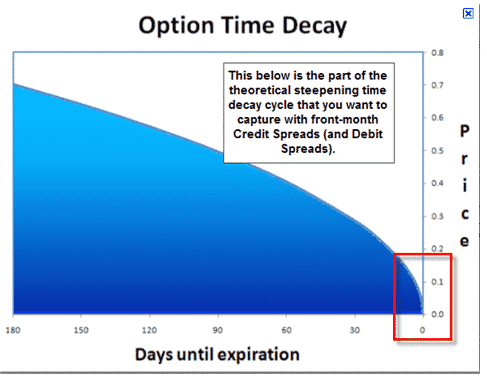
Theta (time decay) works more slowly early in the trade.
With a short-term put, you can see meaningful time decay week to week.
With a long-dated put, theta builds gradually and accelerates as expiration approaches.
This means you’re not earning premium at the same daily rate, but you’re also not grinding through 12 separate monthly trades to achieve the same result.
Vega (sensitivity to implied volatility) is higher on longer-dated options.
A move in implied volatility will have a larger dollar impact on a LEAPS put than on a near-term option at the same strike.
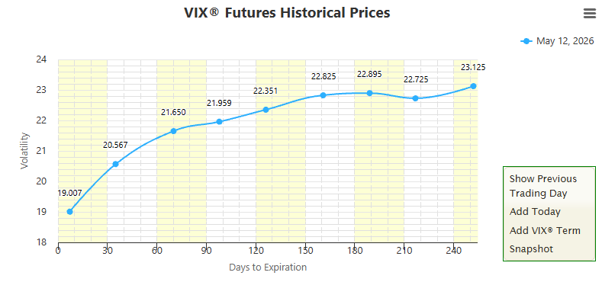
That said, IV moves tend to have a more muted effect in practice on long-dated options because those further-out expirations don’t experience the same sharp spikes as near-term options during volatility events. More on this shortly.
Bid/ask spreads are typically wider on LEAPS, which reinforces the importance of using limit orders and being patient on entry.
Why Sell Long-Term Puts For Income?
The case for long-dated put selling comes down to a few core advantages.
Fewer transactions. One well-placed LEAPS put can replace six to twelve monthly trades targeting the same capital. That means fewer commissions, fewer decisions, and less emotional wear. For traders who want to be invested in the market without being glued to their screens, this is a genuine edge.
Larger upfront premium. Collecting $7–$15 per share on a single trade feels different psychologically and practically than collecting $1.50 per month. The capital is doing real work from day one.
IV premium tends to be elevated in longer-dated options. The term structure of implied volatility often means longer-dated options carry a meaningful IV premium over realised volatility. You’re being compensated for the uncertainty that extends further into the future.
You’re getting paid to wait. This is the angle Warren Buffett has spoken about publicly. When you sell a put on a stock you genuinely want to own, you’re essentially saying: “Pay me premium now, and if the stock falls to my target price, I’ll buy it then.” If it never falls to your strike, you keep the premium. Either way, you win, provided you’ve selected the right stock at the right price.
The NVDA Trade: Walking Through A Real Example
To make this concrete, here’s a trade currently on the books: an NVDA (Nvidia) December 2026 $145 Put sold for $7.70 per share.
Let’s break down what this trade actually looks like.
The setup:
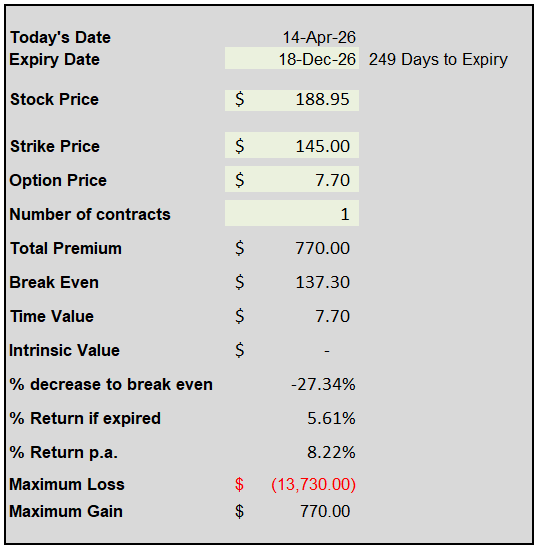
- Strike price: $145
- Premium collected: $7.70 per share ($770 per contract)
- Breakeven at expiry: $137.30 ($145 strike – $7.70 premium)
- Cash reserved (cash-secured): $14,500 per contract
- Days to expiry: ~249 days (as of mid-April 2026)
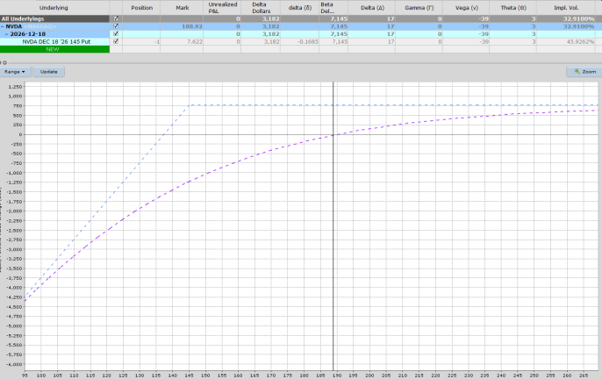
What the trade is saying: By selling this put, you’re willing to buy NVDA at $145 per share if it’s below that level at December expiry.
Your actual cost basis, if assigned, would be $137.30, about 5.3% below the strike.
You’re being paid to potentially buy a world-class AI infrastructure company at a price you’ve already decided represents fair value.
The return picture:
The Hidden Income Stream: Interest On Reserved Cash
When you sell a cash-secured put, you’re setting aside the full notional value of the obligation, in this case, $14,500 per contract.
That cash doesn’t sit idle.
In a competitive brokerage account, that money is typically earning somewhere in the range of 4–5% annually through money market funds or T-bills.
For the NVDA trade above, $14,500 held for 249 days at 4.5% generates approximately $445 in interest income.
That’s a meaningful addition to the $770 in premium, pushing the combined gross return for the trade from 5.61% to over 8%, and the annualised figure to around 12.7%.
Most traders only count the premium.
But the full picture includes both streams.
This is worth factoring into how you evaluate and compare trades.
A shorter-term put might offer a higher annualised premium rate on paper, but if the capital turns over slowly (due to wide spreads, re-entry delays, or management decisions), the combined return including interest on the long-dated trade can compare very favourably.
How To Select The Right Strike And Expiry
Strike selection comes down to where you’re comfortable owning the underlying.
A useful starting point is targeting a delta of 0.20 to 0.30, a strike that has roughly a 20–30% probability of being in-the-money at expiration.
This gives you a meaningful premium while keeping the probability of assignment manageable.
For the NVDA trade, the $145 strike sits below current prices, at a level that represents strong historical support and a compelling long-term entry point for the stock.
That’s the test: would you genuinely want to own NVDA at $137.30?
If the answer is yes, the trade makes sense.
If you’re selling the put purely for the premium and have no interest in owning the stock, you’re setting yourself up for a painful outcome if the trade moves against you.
Expiry selection for income-focused traders generally works best within the 6–12-month window.
Beyond 12 months, you’re taking on a lot of time exposure without a proportional increase in premium.
Within 6 months, you start to lose some of the structural advantages of longer-dated puts.
The 6–12 month sweet spot gives you a sizeable premium, manageable vega exposure, and enough time to course-correct if needed.
Stock selection criteria are the same as any cash-secured put strategy, but arguably more important given the longer time horizon:
- Businesses you understand and would be comfortable holding long-term
- Strong balance sheets with durable earnings
- Stocks that have clear technical support near your target strike
- Names where you’ve done the work on valuation, not just technical levels
Managing A Long-Term Put Position
Taking profit early. The 50% rule applies here as well. If the put you sold for $7.70 decays to $3.85, and you’re only a few months into a 9-month trade, closing for a 50% gain and redeploying capital is often the right move. You capture most of the available profit while freeing up capital for the next opportunity.
Rolling. For short-term puts, rolling is a common, often mechanical process. On long-dated puts, the decision is more nuanced. If the stock has declined and you want to extend the duration, rolling down and out can work, but the premium dynamics are different, and wide bid/ask spreads on LEAPS can mean the net credit is smaller than expected. Only roll if the trade thesis still holds.
If the stock drops hard, this is where conviction matters. If NVDA were to fall sharply toward your $137.30 breakeven, you have a few choices: close the position at a loss if your thesis has changed; hold and potentially take assignment (remember, this was always a price you were willing to pay); or roll the position to a lower strike at a further expiry to give yourself more time and potentially improve your breakeven. There’s no universally right answer, but having thought through the scenario before it happens is what separates disciplined traders from reactive ones.
Risks To Understand
Capital requirement. Cash-secured long-term puts are capital-intensive. The NVDA trade requires $14,500 per contract. If you’re running multiple LEAPS puts simultaneously, your exposure can concentrate quickly. Always think about portfolio-level risk, not just position-level.
Vega exposure. Longer-dated options carry higher vega, which means a spike in implied volatility will increase the theoretical value of the put you’re short, a headwind on paper. In practice, the impact on LEAPS is more muted than on near-term options. IV spikes tend to be sharpest in the front month; the back end of the curve moves less dramatically. That said, a severe market event early in the trade, when theta hasn’t yet meaningfully eroded the position, can create temporary paper losses that require composure to sit through.
Margin vs. cash-secured. It’s worth noting that brokers will allow these positions on margin, which reduces the capital tied up in the trade. Margin can improve return-on-capital metrics, but it introduces leverage risk. If the position moves against you, a margin account amplifies the pain. Trading cash-secured keeps the risk clean and the trade straightforward; you know exactly what your maximum obligation is from day one.
Concentration risk. Selling multiple long-dated puts on correlated names (e.g., several technology stocks) compounds directional exposure. A sector-wide selloff hits all positions simultaneously. Diversifying across sectors and timing your entries thoughtfully are important risk management practices.
Is This Strategy Right for You?
Selling long-term puts suits a specific type of trader. Before entering a trade like the NVDA example, work through this checklist:
- Do you have sufficient capital to hold the full cash requirement for the duration of the trade?
- Are you genuinely comfortable owning this stock at your breakeven price?
- Can you tolerate paper losses mid-trade without panic-closing at the worst moment?
- Do you have the patience for a strategy where premium accrues slowly over months, not days?
- Have you stress-tested the position against a 20–30% decline in the underlying?
If you answered yes across the board, long-term put selling may be one of the more elegant income strategies available to experienced options traders.
It’s not flashy, it doesn’t require constant monitoring, and it pays you twice, once in premium and again in interest on the capital you’ve set aside.
That combination is harder to find than it looks.
Want To Master Selling Long-Term Puts?
Selling long-term puts is one of my core income strategies, and it’s exactly the kind of approach I teach.
If you’re serious about using options to improve your portfolio’s performance, here’s where to start:
Options Income Mastery: Learn how to combine technical indicators like RSI divergence with income-generating options strategies for consistent monthly cash flow. Ideal if you’re newer to selling options and want a structured, step-by-step foundation. ($397)
The Accelerator Program, Advanced training covering technical analysis, option selection, portfolio management, and systematic approaches to options trading. Best for intermediate traders ready to run a complete, repeatable process. ($997)
Frequently Asked Questions
What’s the difference between a leaps put and a shorter-term put?
LEAPS (Long-term Equity Anticipation Securities) are simply options with an expiration date of 1 year or more; their contract mechanics are identical to those of any other put option.
The practical differences come down to behaviour: LEAPS puts decay more slowly early in the trade, carry higher vega, and tend to have wider bid/ask spreads.
For income purposes, a put is generally considered “long-term” once it has more than 90 days until expiration.
How much capital do I need to sell a cash-secured long-term put?
For a cash-secured position, you set aside the full notional value of the obligation, the strike price multiplied by 100.
The NVDA $145 example requires $14,500 per contract.
That capital stays reserved for the life of the trade, which is why long-dated puts suit traders who can comfortably commit funds for six to twelve months at a time without needing to touch them.
Is selling long-term puts better than selling monthly puts?
Neither is universally better; they suit different temperaments.
Monthly puts decay faster and allow you to adjust frequently, but they require constant management and incur commissions.
Long-dated puts trade fewer transactions for a larger upfront premium and let time work quietly in the background.
When you compare the combined return, premium plus interest on the reserved cash, the gap often narrows more than a headline annualised premium rate would suggest.
What happens if I’m assigned the stock?
If the put is in the money at expiration, you’ll be obligated to buy 100 shares per contract at the strike price.
Because you collected premium upfront, your effective cost basis is the strike minus the premium, $137.30 in the NVDA example.
Assignment should never come as a surprise: the strategy only makes sense when you genuinely want to own the stock at that price in the first place.
Can I sell long-term puts on margin instead of cash-secured?
Most brokers will allow it, and using margin reduces the capital tied up in the trade, which improves return-on-capital metrics.
The trade-off is leverage: if the position moves against you, a margin account amplifies the losses and can trigger a margin call.
Trading cash-secured keeps your maximum obligation clear from day one, which is why it remains the cleaner approach for most traders running this strategy.
How does the interest on reserved cash actually work?
When your cash sits in the brokerage account backing the put, most competitive brokers pay interest on it, typically via a sweep into money market funds or T-bills, at a rate of 4–5% annually in the current environment.
That interest accrues alongside the option premium, so a cash-secured LEAPS put effectively earns two income streams at once.
Rates vary by broker and change over time, so it’s worth confirming what your own account actually pays.
What delta should I target when selecting a strike?
A common starting point for income-focused trades is a delta of 0.20-0.30, which corresponds to roughly a 20–30% probability of finishing in the money.
That range balances a worthwhile premium against a manageable probability of assignment.
The more important question, though, is price: the strike should sit at a level where you would genuinely be happy to own the stock.
Should I hold a long-term put to expiration or close it early?
Many traders apply the 50% rule: if the put has lost half its value well before expiration, closing it captures most of the available profit and frees the capital for a new opportunity.
Holding all the way to expiration squeezes out the last of the premium, keeps capital tied up, and exposes you to late-stage price swings.
There’s no single right answer; it comes down to whether a better use for the capital is available.
We hope you enjoyed this article on selling long-term puts.
If you have any questions, please send an email or leave a comment below.
Trade safe!
Disclaimer: The information above is for educational purposes only and should not be treated as investment advice. The strategy presented would not be suitable for investors who are not familiar with exchange traded options. Any readers interested in this strategy should do their own research and seek advice from a licensed financial adviser.





The NVDA example was helpful, especially the emphasis on selecting strikes where you truly want to own the stock.
For stocks with less liquidity in long-dated options, do you adjust your selection criteria? Or is it better to stick with highly liquid underlyings for LEAPS trades?”
Generally better to stick to high liquidity stocks. That being said, if it’s just a single leg trade like a CSP, then it’s less important than say a 4-legged trade like an iron condor.
There is one more advantage of long dated CSPs which I prefer. The upfront premium is a major cushion against drastic price movements which can occur out of the blue. For long dated CSPs we often patiently wait till times of high IV which occurs during market corrections, bringing the price of underlying nearer to support prices.