








If you’re generating income from a stock portfolio, at some point you’ll face this question: Should I just sell covered calls, or should I run the full Wheel?
Both strategies involve selling options premium against stocks you own or are willing to own. Both benefit from time decay and relatively stable prices.
But they behave very differently in terms of income potential, capital requirements, and what happens when things go wrong.
This article breaks down the practical differences so you can choose the right tool for your situation.
Contents
- What Each Strategy Actually Does
- Income Comparison: The Numbers Side By Side
- Capital Requirements
- When The Wheel Beats The Covered Call
- When The Covered Call Is The Better Choice
- The Key Risk Difference
- Which Strategy Suits Which Investor
- FAQ
- Summary
What Each Strategy Actually Does
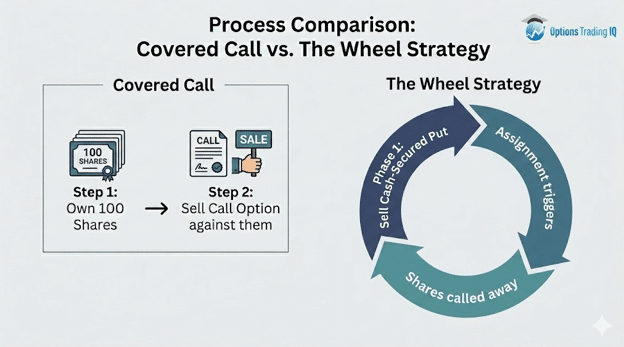
A covered call is simple: you own at least 100 shares of a stock and sell a call option against them. You collect a premium upfront.
If the stock stays below the strike at expiration, you keep the premium and the shares.
If it rises above, your shares get called away at the strike, and you keep the premium plus any gain up to that strike.
The mechanics of selling covered calls are straightforward, making this one of the most widely used income strategies.
The Wheel strategy extends this into a cycle.
You start by selling a cash-secured put on a stock you want to own.
If the put expires worthless, you collect premium and repeat.
If you’re assigned, you take ownership of 100 shares, then immediately begin selling covered calls against them.
When the shares are called away, you go back to selling puts and start the cycle again.
The full Wheel strategy cycle is designed to generate premium income continuously, regardless of whether you hold the shares or not.
The critical distinction is that covered calls require you to already own shares.
The Wheel generates income from both sides, before and after owning the shares.
Income Comparison: The Numbers Side By Side
This is where the Wheel has a clear structural advantage.
Covered call only (on a $100 stock):
- You own 100 shares ($10,000 committed)
- You sell a 30-delta call 30-45 DTE for ~$2.00 (~2% on capital per cycle)
- Annualised: approximately 12 cycles × 2% = ~20-24% on premium (gross, before accounting for stock gains/losses)
Wheel strategy (on the same $100 stock):
- Phase 1: Sell a 25-delta cash-secured put for ~$1.50 per cycle (~1.5% on $10,000 reserved)
- If assigned, Phase 2: Sell a covered call for ~$2.00 per cycle (~2% on $10,000)
- Premium from both phases in a full cycle: ~3-4% on the same capital base
In a market where price is oscillating in a range, the ideal Wheel environment, you collect put premium when you don’t own the stock and call premium when you do.
The time decay works in your favour on both legs.
Over a full year, the Wheel can generate noticeably more total premium from the same capital than covered calls alone.
However, this comparison has an important caveat.
The Wheel’s advantage depends on the stock actually oscillating and periodically triggering assignment.
In a strongly trending bull market, a covered call on a stock you’re riding up captures price appreciation.
The Wheel’s put-selling phase may expire worthless repeatedly without assignment, reducing the strategy to essentially the covered call phase anyway.
Capital Requirements
This is where covered calls have an edge for many investors.
Covered calls require capital already deployed in stock.
If you own 300 shares of a $150 stock, you have $45,000 working and can sell 3 covered calls immediately.
The capital is already committed to the equity position — the covered call is simply an overlay that generates additional income.
The Wheel requires reserving capital to cover potential assignment on the put side.
A cash-secured put on the same $150 stock requires $15,000 per contract as collateral, cash that isn’t earning returns elsewhere while the put is open.
For retirees or investors who are fully invested, this can make the Wheel awkward to run without specifically holding cash in reserve.
Those targeting retirement income need to factor this capital allocation into their planning.
For investors who hold significant cash positions, common in retirement, or for those who prefer not to be fully invested, this distinction flips: the Wheel actually puts that idle cash to work through put selling, whereas covered calls require owning stock first.
When The Wheel Beats The Covered Call
You have cash to deploy but prefer not to buy stock outright.
The put-selling phase of the Wheel lets you generate income while waiting for a better entry price. You’re effectively getting paid to set a limit buy order.
The stock is range-bound.
The Wheel thrives when a stock oscillates around a price level — you get assigned, sell calls, get called away, sell puts, and repeat the cycle.
Every transition generates premium.
You want to build a position gradually.
Selling puts on a stock you want to accumulate at lower prices is a systematic way to average in while collecting income along the way.
You’re starting from scratch on a position.
If you don’t own any shares yet, the Wheel gives you a structured entry point and premium income while waiting for assignment at a price you’ve pre-determined you’re comfortable paying.
When The Covered Call Is The Better Choice
You already own shares you’re not willing to sell at any price. Some investors hold positions they want to keep long-term, dividend aristocrats, index ETFs, and core holdings. Selling covered calls generates income on those positions without disrupting the underlying investment.
The Wheel could result in shares being called away, which you may not want.
The market is in a sustained uptrend.
In a strongly trending market, covered calls on rising stock generate both stock appreciation up to the strike and premium income.
The Wheel’s cash-secured puts expire worthless repeatedly without generating the stock gains that come with ownership.
Simplicity matters.
The covered call is one leg, one position to monitor.
The Wheel involves multiple phases, transitions, and decisions about when to transition between phases.
For less-experienced traders or those who want a simple, low-maintenance strategy, covered calls are easier to manage.
You’re in a retirement account with limited margin.
In an IRA, both strategies are permitted, but the covered call requires no cash reservation beyond owning the stock, making it easier to run at full capital efficiency in a stock-heavy retirement portfolio.
See covered calls or cash-secured puts for a side-by-side comparison of which suits different account types.
The Key Risk Difference
Both strategies share the same primary risk: the stock falls significantly, and you’re left holding a loss.
The covered call provides slightly more downside protection than the Wheel’s put phase, because you already own the stock at a known entry price, and the premium collected reduces your effective cost basis over time.
A long-held covered call position on a $100 stock bought at $100 might have $15 of accumulated premium, reducing the effective cost basis to $85 by year two.
The Wheel’s put phase carries the risk of assignment at a price that subsequently falls further.
If you’re assigned at $98 and the stock drops to $75, you’re in the covered call phase with a significant unrealised loss, forced to sell calls at or below your cost basis to generate any income.
The protected Wheel addresses this by adding a long put as a hedge, converting the undefined-risk put phase into a defined-risk bull put spread.
This reduces premium income but caps the downside, worth considering for larger positions or more volatile stocks.
One comparison worth noting: a short put vs covered call produces a nearly identical P&L profile at the moment of entry.
The Wheel’s advantage isn’t mechanical superiority; it’s the systematic cycling between the two phases that generates compounding premium income over time.
Which strategy suits which investor
Choose covered calls if:
- You already own quality stocks and ETFs and want to add an income layer
- You’re in or near retirement and want simplicity and low maintenance
- You hold core positions you won’t sell and want to generate income without disrupting them
- You’re in a trending market where stock appreciation matters
Choose the Wheel if:
- You hold meaningful cash that isn’t deployed in stocks
- You’re comfortable with the full cycle, put selling, assignment, covered calls, and back again
- You want to systematically build positions in quality stocks at controlled prices
- You’re running the strategy in a range-bound market environment
Use both together if:
- You have a mix of existing stock holdings (covered calls) and idle cash (Wheel puts)
- This is actually the most common setup for active income traders, covered calls on core holdings, cash-secured puts on watchlist stocks you’d buy on a pullback
FAQ
Q: Does the Wheel actually generate more income than covered calls?
Over a full cycle in a range-bound market, yes, because you’re collecting premium from both the put phase and the call phase on the same capital.
In a strong uptrend, the difference narrows considerably as puts expire worthless repeatedly, and the stock appreciation in covered call positions makes up much of the income difference.
Q: Can I run the Wheel in an IRA?
Yes.
Cash-secured puts and covered calls are both permitted at standard IRA approval levels.
The Wheel works well in a Roth IRA specifically, because the premium income compounds tax-free.
Q: What’s the best stock to start the Wheel on?
Blue-chip, dividend-paying stocks with moderate volatility and strong fundamentals, companies you’d genuinely hold through a downturn.
Think large-cap names in sectors like consumer staples, healthcare, and financials rather than high-growth tech stocks.
Q: What if I get assigned and the stock keeps falling?
This is the Wheel’s biggest practical risk.
You sell a covered call at or below your cost basis, the stock continues falling, and you’re generating little to no income while sitting on an unrealised loss.
The key discipline is strict stock selection upfront, only run the Wheel on stocks you’d genuinely hold for years, and having a pre-defined exit level where you cut the position rather than continuing to sell calls on a deteriorating stock.
Q: Is the Wheel better than just buying and holding the stock?
In most market environments, the Wheel generates better total return than buy-and-hold on the same stock, primarily because of the accumulated premium income.
The trade-off is capped upside.
If a stock runs 50% in a year, the Wheel’s covered call phase captures only part of that move. Over long periods in moderate markets, the premium income typically more than compensates.
Summary
Neither the Wheel nor covered calls is universally superior — the right choice depends on your starting position, capital structure, and market environment.
The Wheel generates more income per unit of capital in range-bound markets by collecting premium from both sides of the stock ownership cycle.
Covered calls are simpler, more appropriate for existing holdings, and better suited to trending markets where stock appreciation matters.
For most income traders, the answer isn’t choosing one or the other — it’s running covered calls on existing stock positions while deploying idle cash through the put-selling phase of the Wheel.
Together, they put every dollar of the portfolio to work generating income.
If you’re serious about building an income-generating options portfolio:
Options Income Mastery: Learn the complete wheel strategy including covered calls, cash-secured puts, position sizing, and adjustment techniques for consistent monthly cash flow ($397)
The Accelerator Program: Advanced training covering portfolio-level management, multiple income strategies, systematic approaches, and professional risk management techniques for serious traders ($997)
Related Articles:
- The Wheel strategy: selling puts and calls for income
- Selling covered calls: a detailed guide
- Short put vs covered call
- Best stocks for the Wheel strategy
- Top 10 ETFs for the Wheel strategy
- Wheel strategy risks: navigating the downside
- The protected Wheel strategy
- Options trading for retirement income
We hope you enjoyed this article on the Wheel strategy vs covered calls.
If you have any questions, send an email or leave a comment below.
Trade safe!
Disclaimer: The information above is for educational purposes only and should not be treated as investment advice. The strategy presented would not be suitable for investors who are not familiar with exchange traded options. Any readers interested in this strategy should do their own research and seek advice from a licensed financial adviser.