







Most options education teaches individual strategies in isolation.
You learn how to sell a covered call, how to set up an iron condor, and how to run the Wheel.
What it rarely teaches is how to combine them, how to build something that functions as a coherent portfolio rather than a collection of random trades.
This article is the sequenced guide that’s missing: how to start with nothing and build an options income portfolio step by step, in the right order, without blowing up along the way.
Contents
- Step 1: Start with one strategy only
- Step 2: Define your capital allocation rules before you trade
- Step 3: Choose your first underlyings carefully
- Step 4: Add a second strategy type after 3-6 months
- Step 5: Balance your portfolio Greeks
- Step 6: Build in a vega hedge
- Step 7: Set portfolio-level rules
- FAQ
- Summary
Step 1: Start with one strategy only
The most common mistake new income traders make is diversifying strategies too early.
They learn covered calls, the Wheel, iron condors, and calendars all at once, then try to run all of them simultaneously before they’ve mastered any.
The result is a portfolio they don’t understand, can’t manage under pressure, and can’t learn from because there are too many variables.
Start with one strategy for the first 3-6 months.
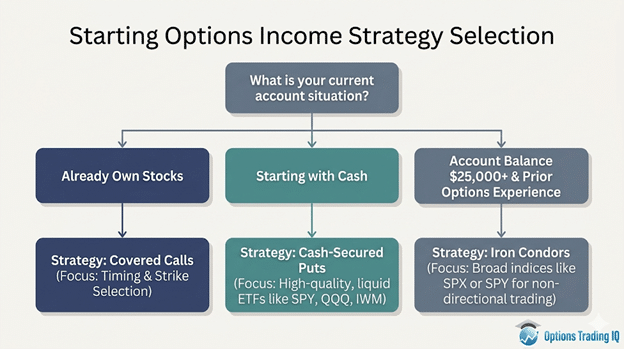
The right choice depends on what you already have:
If you own stocks, start with covered calls.
You already have the underlying, so the only new skill is timing and strike selection.
If you’re starting with cash, start with cash-secured puts on quality ETFs.
SPY, QQQ, and IWM are liquid and diversified, and they can’t gap to zero on a single earnings announcement.
If you have at least $25,000 and some options experience, start with iron condors on a broad index.
SPX or SPY iron condors are the cleanest introduction to non-directional income trading.
Master one strategy to the point where you understand not just the entry but every adjustment scenario and exit decision.
Then, and only then, consider adding a second.
Step 2: Define your capital allocation rules before you trade
Most traders set position sizing rules after they’ve had a loss that hurt too much.
Setting them in advance is what separates systematic income traders from everyone else.
The core rules:
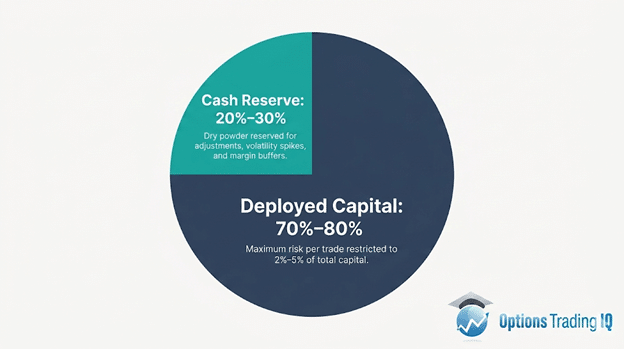
No single position should risk more than 2-5% of total trading capital.
For a $50,000 account, that’s $1,000- $2,500 in maximum risk per trade.
Keep 20-30% of trading capital in reserve.
This isn’t idle cash, it’s dry powder for adjustments, new opportunities when volatility spikes, and a buffer that means you never have to close a good position to fund margin on a bad one.
Never size positions to hit an income target. “I need $1,000 this month” leads directly to oversizing. Size based on risk tolerance, and let the income follow.
By account size, a sensible starting framework:
$25,000-$50,000: 2-3 open positions maximum, 2-3% risk per trade.
$50,000-$100,000: 4-6 open positions, 2-3% risk per trade.
$100,000+: 6-10 open positions, 1-2% risk per trade as complexity increases.
Step 3: Choose your first underlyings carefully
Underlying selection matters as much as strategy selection.
For a new income portfolio, the criteria are simple: liquid options, no near-term binary events, and stable enough that the strategy has time to work.
Indices and broad ETFs first. SPY, QQQ, IWM, and SPX are the best starting underlyings for most income strategies.
They’re highly liquid (tight bid-ask spreads), diversified (no single-stock gap risk), and have reliable options markets across all expiration dates.
Add individual stocks carefully.
Single stocks are fine once you have experience, but they carry earnings gap risk, sector event risk, and wider bid-ask spreads.
When you do add them, stick to large-cap, low-beta names, the kind you’d hold through a market downturn without concern.
Diversify across sectors from the start.
If three of your four positions are technology stocks, a tech sector selloff hits them simultaneously.
Aim for positions spread across at least three sectors, or use broad indices to get diversification built in.
Step 4: Add a second strategy type after 3-6 months
Once you’re consistently profitable with your first strategy, not just in good months, but through at least one meaningful drawdown, you’re ready to add a second strategy type.
The most natural progressions:
Covered calls to the Wheel. Once you’re comfortable selling calls on stocks you own, extend the strategy backwards by adding cash-secured puts on the same or similar stocks.
The Wheel vs covered call comparison explains when each is more appropriate.
Cash-secured puts to iron condors.
Once you’re comfortable with put selling mechanics and position sizing, iron condors add the call side for a market-neutral income position.
They require understanding both credit spreads simultaneously, which is why starting with puts first builds the right foundation.
Iron condors to calendar spreads.
Iron condors are short vega.
Adding calendar spreads (long vega) to the portfolio creates a partial natural hedge, when volatility spikes and hurts your condors, the calendars benefit.
The goal at this stage is not to maximise income, it’s to understand how the second strategy behaves under different market conditions before it represents a significant capital.
Step 5: Balance your portfolio Greeks
Once you have multiple open positions, individual trade analysis isn’t enough. You need to understand your portfolio-level risk.
The two numbers that matter most for an income portfolio:
Portfolio delta tells you how directionally exposed you are.
A portfolio with a significant positive delta makes money when markets rise and loses when they fall. An income trader generally wants delta close to zero, market-neutral.
If your portfolio has a significant directional tilt, you’re taking on risk you’re not being paid for.
Portfolio vega tells you your exposure to volatility changes.
Covered calls, cash-secured puts, and iron condors are all short vega; they lose value when volatility rises.
If every position in your portfolio is short vega, a volatility spike hurts everything simultaneously.
Measuring this at the portfolio level, including beta-weighted delta, is essential once you’re running more than three concurrent positions.
Step 6: Build in a vega hedge
This is the step most income traders skip, and it’s the one that makes portfolios genuinely resilient.
Because most income strategies are short vega, a volatility event, a Fed surprise, a geopolitical shock, or a sudden market selloff can hit multiple positions at once, the damage isn’t just from individual trades going against you; it’s from all of them going against you simultaneously.
A small allocation to a long vega strategy acts as a portfolio hedge:
Calendar spreads on indices are the most practical vega hedge for most income traders.
A calendar spread benefits from rising volatility while still generating some theta income.
Allocating 10-15% of the options portfolio to calendars means that when volatility spikes and compresses your condor and Wheel positions, the calendar gains partially offset the damage.
Long puts on the index are a simpler hedge, just buying downside protection costs premium but provides a hard floor on portfolio losses during severe drawdowns.
The cost has to be weighed against the protection provided, but for larger portfolios, it’s worth considering.
The goal isn’t to eliminate all vega risk; it’s to ensure a volatility spike doesn’t wipe out months of premium income in a single week.
Step 7: Set portfolio-level rules
A mature income portfolio runs on rules, not decisions.
The rules are set when the portfolio is calm and followed mechanically when it isn’t.
Monthly income target: Set a realistic range (not a floor). 1-2% per month on deployed capital is achievable and sustainable. More than that typically means taking on proportionally more risk.
Maximum portfolio loss per month: Define a monthly drawdown limit, typically 5-8% of options-dedicated capital, at which point you stop opening new positions and focus only on managing existing ones. This prevents a bad month from compounding into a catastrophic one.
Rebalancing triggers: Define in advance when you’ll reduce exposure, for example, if portfolio delta exceeds a set threshold, or if a single position grows beyond 8% of total portfolio value through adverse movement.
Review cadence: Weekly at minimum for an active income portfolio. Monthly for a simpler covered call/CSP setup. The review isn’t just about P&L, it’s about whether current market conditions still support the strategies you’re running.
These principles apply across each strategy type in a systematic income portfolio.
FAQ
Q: How long does it realistically take to build a functioning income portfolio?
For most traders, it takes 12-18 months to go from the first trade to a coherent multi-strategy portfolio they understand and can manage confidently.
The first 3-6 months on one strategy only.
The next 6-12 months will be spent carefully adding a second strategy and understanding the interactions.
Rushing this timeline is the most reliable way to get into trouble.
Q: Can I build an income portfolio with $25,000?
Yes, though your strategy choices are limited.
At $25,000, credit spreads and single cash-secured puts on lower-priced ETFs are the most practical starting points. Iron condors are feasible.
The Wheel on individual stocks requires $5,000-$15,000 per position, which limits diversification at this account size.
Q: Should I run all strategies simultaneously once I’ve learned them?
Not necessarily.
Running 2-3 well-chosen strategies consistently outperforms running 5-6 poorly chosen strategies.
The goal isn’t maximum complexity; it’s a portfolio you understand deeply enough to manage confidently in any market environment.
Many experienced income traders run only covered calls, CSPs, and iron condors throughout their careers and generate excellent results.
Q: How do I know if my portfolio is too concentrated?
Three warning signs: more than 30% of positions in one sector, more than one position on the same underlying, or a single trade representing more than 8% of your options-dedicated capital.
Any of these means a single bad outcome can inflict disproportionate damage.
Spread across at least 4-5 uncorrelated underlyings and 2-3 strategy types.
Summary
Building an options income portfolio is a sequenced process, not a simultaneous one.
Start with one strategy and master it.
Set allocation rules before your first trade.
Choose liquid, diversified underlyings.
Add a second strategy only after proving proficiency with the first.
Balance portfolio Greeks. Build in a vega hedge.
And run everything against a written set of portfolio-level rules.
The traders who build durable income portfolios aren’t the ones who learn the most strategies fastest.
They’re the ones who build the right habits early, position sizing, diversification, and rule-following, and layer complexity onto a solid foundation rather than learning everything at once and hoping it holds together.
If you’re serious about building an income-generating options portfolio:
Options Income Mastery: Learn the complete wheel strategy including covered calls, cash-secured puts, position sizing, and adjustment techniques for consistent monthly cash flow ($397)
The Accelerator Program: Advanced training covering portfolio-level management, multiple income strategies, systematic approaches, and professional risk management techniques for serious traders ($997)
Related Articles:
- Options income strategies: the complete guide
- Options position sizing: how big should your trades be?
- Options portfolio management
- Options trading capital requirements
- Best ETFs for iron condors
- Best stocks for the Wheel strategy
We hope you enjoyed this article on building an options income portfolio.
If you have any questions, send an email or leave a comment below.
Trade safe!
Disclaimer: The information above is for educational purposes only and should not be treated as investment advice. The strategy presented would not be suitable for investors who are not familiar with exchange traded options. Any readers interested in this strategy should do their own research and seek advice from a licensed financial adviser.