





Here’s the question I get asked more than any other from people in or approaching retirement: “Can I actually live off this?”
Not “how does the Wheel strategy work” — the real question is whether options income can replace or meaningfully supplement a retirement drawdown, and what it takes in capital and discipline to make it work.
This article answers that honestly.
No inflated return claims, no cherry-picked examples.
Contents
- The Honest Answer: What Options Income Actually Generates
- Why Options Income Suits Retirees Specifically
- Choosing The Right Strategy For Your Retirement Phase
- How Much Capital Do You Actually Need?
- A Sample $500K Retirement Income Portfolio
- Sequence Of Returns Risk: The Danger Unique To Retirees
- IRA Vs Taxable Account Considerations
- What Can Go Wrong
- FAQ
- Summary
The Honest Answer: What Options Income Actually Generates
A conservatively run options income strategy — cash-secured puts, covered calls, and the Wheel on quality stocks and ETFs — can realistically generate 10-15% annual return on deployed capital in a normal market environment.
In high-volatility years, premiums are fatter, and returns can stretch higher.
In compressed-premium environments, expect the lower end.
Here’s what that looks like in dollar terms:
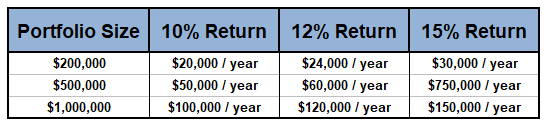
Two important caveats.
First, “deployed capital” isn’t your total portfolio — you won’t put every dollar to work in options.
A reasonable allocation is 40-60% of investable assets, with the remainder in conservative holdings.
Second, these are gross returns before taxes.
The honest takeaway: options income alone is unlikely to fund a comfortable retirement unless you have significant capital.
For most retirees, it works best as a meaningful supplement to Social Security, pension income, dividends, and bonds — not as the sole source.
Why Options Income Suits Retirees Specifically
Options income strategies align unusually well with retirement goals for several reasons.
You get paid to wait, not to predict. Cash-secured puts generate income when stocks stay flat, go up, or drop modestly. Covered calls generate income when stocks are flat or rising slowly. You don’t need to pick winners.
Premium income arrives on a schedule. Unlike quarterly dividends, option premiums are collected at the time of trade entry. A retiree running monthly options cycles has a predictable income schedule that they control.
It complements an existing stock portfolio. Most retirees already hold quality stocks and ETFs. Selling covered calls against those holdings adds a second income layer without changing the underlying exposure.
The volatility risk premium is structural. The edge in selling options comes from the consistent overpricing of implied volatility relative to realised volatility — a feature of human psychology that isn’t going away. This isn’t gambling; it’s systematically acting as the insurance company.
Choosing The Right Strategy For Your Retirement Phase
The right options income strategy depends on where you are in retirement.
Early Retirement (Ages 55-65)
With a longer runway, you can handle more complexity.
The Wheel strategy — selling cash-secured puts on quality stocks, transitioning to covered calls on assignment, and cycling the income — is ideal here.
Our ultimate Wheel strategy guide covers the full mechanics.
The non-negotiable rule: only run the Wheel on stocks you’d hold for 10+ years, because in a market downturn, you may end up owning them.
Iron condors on broad indices can provide non-directional income without the risk of stock ownership.
In high-IV environments, SPX or SPY condors with defined risk and 45 DTE entries provide attractive premium.
Our complete iron condor guide covers the setup.
Late Retirement (Ages 65+)
As capital preservation becomes the priority, simplify.
Covered calls on existing holdings become the primary tool — you already own the stocks, so the covered call simply adds an income layer.
Cash-secured puts on ETFs, rather than on individual stocks, reduce single-company risk.
Running the Wheel on SPY or QQQ means diversification is built in.
See our top ETFs for the Wheel for the best vehicles.
Avoid anything with undefined risk.
Naked options and short strangles have no place in a late-retirement portfolio.
How Much Capital Do You Actually Need?
Working backwards from income targets makes this concrete.
To supplement retirement income by $2,000/month ($24,000/year) at a conservative 10% annual return, you need $240,000 working in premium-selling strategies.
For $4,000/month ($48,000/year), you need $480,000 deployed.
The real number is higher for two reasons.
First, not all capital can be deployed simultaneously — cash-secured puts require reserving cash equal to 100 shares × strike price per contract, so meaningful reserves (30-50% of the options-dedicated portion) must stay available.
Second, you need a risk buffer: six months of target income in conservative holdings to cover bad months without selling positions at the wrong time.
Practical minimum: Most retirees need at least $250,000-$300,000 dedicated to options strategies to generate meaningful retirement income — roughly $1,500-$2,500/month gross. Below that, income is supplemental rather than primary.
A Sample $500K Retirement Income Portfolio
Total portfolio: $500,000
Options-dedicated allocation: $300,000 (60%)
Conservative reserves: $200,000 (40%)
Monthly positions in a moderate-volatility environment:
The Wheel running on 2 quality dividend stocks at $12,000-$15,000 in capital each: ~$600-$800/month in combined premiums.
Cash-secured puts on 2 broad ETFs (SPY, QQQ) at 20-25 delta, 30-45 DTE: ~$400-$600/month combined.
Covered calls on existing stock holdings (~$80,000 in stock value): ~$800-$1,200/month.
Estimated monthly gross income: $1,800-$2,600
Estimated annual gross income at midpoint: ~$27,000 (9% on the $300K deployed)
That’s not retirement-replacing income on its own, but combined with Social Security, dividends, and other sources, it creates a meaningful and reliable income layer.
No single position should risk more than 2-5% of the options-dedicated capital.
Sequence Of Returns Risk: The Danger Unique To Retirees
This is the most important risk concept for retirees running options strategies, and it’s rarely discussed in options education.
Sequence of returns risk means that large losses early in retirement cause disproportionate damage compared to the same losses later.
A 30% drawdown at age 45 is recoverable.
The same drawdown at 67, combined with ongoing withdrawals, can permanently impair a portfolio.
For options income traders, this translates to one principle: position size matters far more in retirement than during accumulation.
During a severe market event — such as March 2020 or the 2022 rates sell-off — premium-selling strategies can suffer concentrated losses quickly.
If those losses hit a portfolio from which you’re simultaneously drawing income, the compounding damage is severe.
Three defences: keep position sizes at 1-3% of options-dedicated capital; maintain that six-month income buffer so you never liquidate positions during a drawdown; and don’t chase premium in low-volatility environments by going closer to the money.
When conditions are poor, reduce size and wait.
IRA Vs Taxable Account Considerations
Most brokerages permit covered calls, cash-secured puts, and defined-risk spreads inside IRAs at Level 1-2 approval.
Naked options are prohibited.
Inside a Traditional IRA, all premium income is tax-deferred.
Inside a Roth IRA, it grows tax-free — making the Roth an especially powerful vehicle for options income compounding.
In taxable accounts, options premium typically triggers short-term capital gains treatment at ordinary income rates.
SPX and broad index options qualify for 60/40 treatment under Section 1256, which is more favourable — but for most individual stock and ETF options, expect ordinary income rates.
Our options for retirement accounts guide covers IRA approval levels and the specific rules in detail.
What Can Go Wrong
A stock gaps hard against your position. The Wheel’s undefined risk — owning 100 shares of a stock that keeps falling — is its primary danger. Strict stock selection (blue-chip, dividend-paying, large-cap) and pre-defined stop-loss levels are the only defence. Our Wheel strategy risks article covers the specific failure modes.
Prolonged low volatility compresses premiums. When the VIX is at 12, put premiums are thin. The wrong response is going closer to the money to hit an income target. The right response is to reduce the size and wait.
Emotional decisions during a drawdown. For a retiree depending on this income, the psychological pressure to panic-close losing positions is amplified. Pre-defined rules — written before the trade — separate consistent income traders from those who give up after a bad run.
Overconcentration in one sector. Running the Wheel exclusively on technology stocks means that a sector-specific event can damage multiple positions simultaneously. Diversify across sectors, underlyings, and strategies.
FAQ
Can I Realistically Replace My Full Salary With Options Income In Retirement?
For most people, no, not without very significant capital.
To replace $60,000 annually at a 12% return requires $500,000 fully deployed.
For most retirees, options income works best as a substantial supplement rather than a replacement.
Is The Wheel Strategy Safe Enough For Retirement?
Yes, when run conservatively — 20-25 delta puts on quality stocks or broad ETFs, proper position sizing, and strict stop-loss discipline.
What makes it unsafe is poor stock selection, over-concentration, or ignoring assignment risk.
The protected Wheel strategy adds a defined-risk structure for extra downside protection.
What Happens To My Options Income In A Market Crash?
Premium-selling strategies suffer during sharp crashes.
This is why the six-month income buffer is essential — it means you can ride out a drawdown without being forced to liquidate at the bottom.
Historically, these strategies have recovered well once volatility normalises.
Do I Need To Monitor Options Positions Daily?
Not for the strategies best suited to retirees.
Cash-secured puts and covered calls with 30-45 DTE require checking once or twice a week.
The Wheel can be managed in a few hours per month — a significant advantage over more active strategies.
What’s The Minimum Account Size To Start Generating Meaningful Retirement Income?
Most retirees need at least $200,000 to $300,000.
Below that, income is modest ($500-$800/month) and better treated as a supplement to other income sources rather than a standalone income strategy.
Summary
Options income can be a powerful retirement tool — but only with realistic expectations, appropriate capital, and the right strategy for your stage of retirement.
The key takeaways: a conservative strategy generates 10-15% annually on deployed capital; retirees should prioritise defined-risk approaches like covered calls, cash-secured puts, and the Wheel; strategy complexity should decrease with age; position sizing matters more in retirement than at any other stage; and a six-month income buffer is non-negotiable.
The edge is real and structural.
Running it patiently and conservatively across years — not chasing premium in bad conditions — is what makes it a genuine retirement income tool.
Want a Structured Plan for Retirement Income Trading?
Building a reliable options income strategy for retirement requires more than understanding the mechanics — it requires a systematic process for position sizing, strategy selection, and risk management tailored to your stage of retirement.
The Accelerator Program provides the structured mentoring and trade management framework to help you build and run this kind of portfolio with discipline.
Related articles:
- Options Income Strategies for Retirement Portfolios
- The Ultimate Guide for Options for Retirement Accounts
- The Wheel Strategy: Selling Puts and Calls for Income
- Selling Covered Calls: A Detailed Guide
- Selling Cash-Secured Puts: Complete Beginner’s Guide
- Top 10 ETFs for the Wheel Strategy
- Wheel Strategy Risks: Navigating the Downside
- Options Income Strategies: The Complete Guide
We hope you enjoyed this article on options trading for retirement.
If you have any questions, please send an email or leave a comment below.
Trade safe!
Disclaimer: The information above is for educational purposes only and should not be treated as investment advice. The strategy presented would not be suitable for investors who are not familiar with exchange traded options. Any readers interested in this strategy should do their own research and seek advice from a licensed financial adviser.