








Contents
Suppose you already hold an options butterfly at a specific set of strikes and want to add a second one, only to discover that the strikes overlap.
The legs of the new butterfly collide with the existing structure.
Your broker’s platform says that it cannot be done.
But it can be done.
And here is how.
Existing Butterfly
Suppose the investor has the following butterfly constructed with put options on the RUT index.
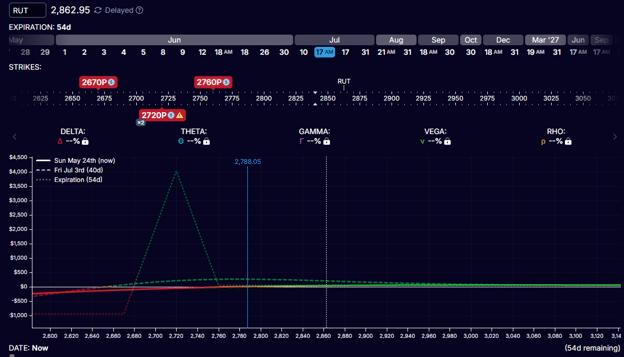
The strikes of the butterfly are:
One upper long put contract at 2760
Two center short put contracts at 2720
One lower long put contract at 2670
This is a standard put butterfly centered at 2720.
The position profits most when the RUT index is at or near 2720 at expiration,and loses money if the underlying moves significantly in either direction.
The width between the upper long and the center short is 40 points, and the width between the center short and the lower long is 50 points, making this a slightly asymmetric structure.
Because the upper long put at 2760 is the highest strike in the existing butterfly, it becomes the point of overlap when the investor tries to add a new butterfly 40 points higher.
The new butterfly requires a short put at 2760, which conflicts directly with the existing long put at that same strike.
The underlying RUT asset is trading at 2863, above the butterfly, and the investor wants to add another butterfly with strikes 40 points higher than the existing butterfly.
The desired strikes of the new butterfly are:
The RUT index is a popular underlying for butterfly spreads because of its consistent liquidity, broad strike availability, and the fact that it is cash-settled at expiration.
Cash settlement eliminates the risk of unexpected stock delivery or early assignment that can complicate equity option positions.
For traders running multiple butterflies simultaneously, using a cash-settled index also simplifies the accounting at expiration since there is no requirement to manage shares.
One upper long put contract at 2800
Two center short put contracts at 2760
One lower long put contract at 2710
As is common, we want the two butterflies to have the same expiration date as the existing butterfly.
This scenario arises frequently when a trader wants to scale into a position by adding width to an existing butterfly.
Rather than closing the original structure and re-entering a wider one, layering a second butterfly with an overlapping center strike is a more capital-efficient approach.
The shared strike reduces the total number of open contracts, which directly lowers the cost of commissions and fees over the life of the trade.
Understanding how your broker handles overlapping long and short positions at the same strike is an important part of position management.
Different platforms enforce different rules, and knowing these rules in advance prevents unexpected errors when you are trying to execute quickly in a live market.
The Problem
When the investor submits the following order into the trading platform:
Buy to open one contract July 17 am RUT 2800 put
Sell to open two contracts July 17 am RUT 2760 put.
Buy to open one contract July 17 am RUT 2710 put
Some platforms may display an error message along the lines of:
“You currently have an open long position. You cannot be long and short the same options.”
It is referring to the existing long put option at the 2760 strike.
And now the investor is trying to open two short put options at the same strike price of 2760.
Shorting at 2760 would effectively cancel the existing long put option at 2760.
Some brokers will not automatically do that.
The investor would have to close the existing long option in order to open the short option at that same strike.
So the investor tries to get creative by placing the close in the same order as the open.
Sell to close one contract July 17, am RUT 2760 put.
Buy to open one contract July 17 am RUT 2800 put.
Sell to open one contract on July 17 am RUT 2760 put.
Buy to open one contract July 17 am RUT 2710 put
The modifications to the order are highlighted in bold.
Depending on the broker, some may now respond with a different error:
“Multi-leg option orders cannot be submitted with legs that contain duplicate symbols.”
It is confusing as to why you have 2760 strikes listed twice in a single order.
This second error is specific to multi-leg order entry.
The platform sees two separate references to the 2760 strike within a single order and rejects it as ambiguous, even though the intent, to close one long and open one short, is perfectly logical from a trading perspective.
The workaround is straightforward once you understand the root cause.
By splitting the butterfly into its two component spreads and submitting them as separate orders, you work within the platform’s constraints without changing the final position.
So what the investor needs to do is to break the new butterfly into two orders:
One order for the upper wing 2800/2760 put debit spread, and another order for the lower wing 2760/2710 put credit spread.
Put Debit Spread Order:
Sell to close one contract July 17 am RUT 2760 put
Buy to open one contract July 17 am RUT 2800 put
Put Credit Spread Order:
Sell to open one contract July 17 am RUT 2760 put
Buy to open one contract July 17 am RUT 2710 put.
The put debit spread needs to be filled first because that closes the overlapping spread.
The sequencing of these two orders is important.
The put debit spread order (sell to close the 2760 long, buy to open the 2800 long) eliminates the existing long position at 2760 that was blocking the new short position.
Once the 2760 long has been closed, the broker no longer sees a conflict, and the second order (the put credit spread) can be submitted without triggering the duplicate symbol error.
In practice, most traders use limit orders for both legs to control the execution price.
For the debit spread, you are buying the 2800 put and closing the 2760 long, so the net debit should reflect the current bid-ask spread on both legs.
For the credit spread, you are selling the 2760 put and buying the 2710 put, collecting a net credit.
Filling both orders at reasonable mid-prices is typically achievable on liquid index products such as RUT.
There is a short window between the filling of the first order and the submission of the second, where the position is temporarily unbalanced.
After the put debit spread fills, the investor holds the original butterfly minus its upper long, plus the newly opened 2800 long.
This creates a net short delta position, since the center shorts are no longer fully hedged on the upside.
The wider the bid-ask spreads and the slower the execution environment, the greater the risk of this transitional exposure.
Once that is filled, the result will be a bit directional as shown…
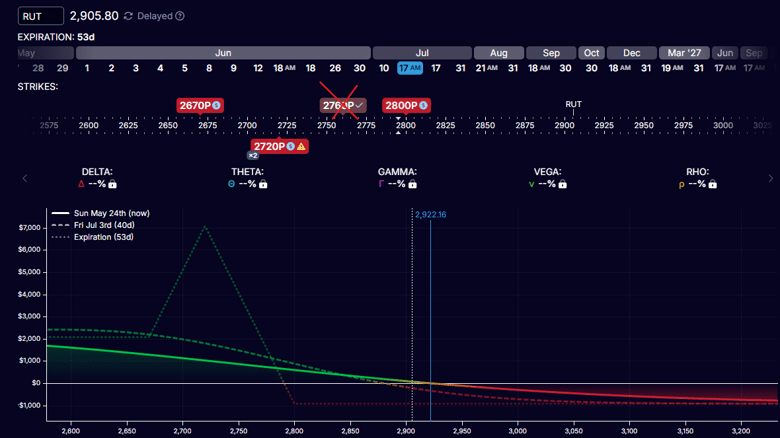
Hence, it is best to get the second order filled as soon as possible afterward to avoid any directional exposure.
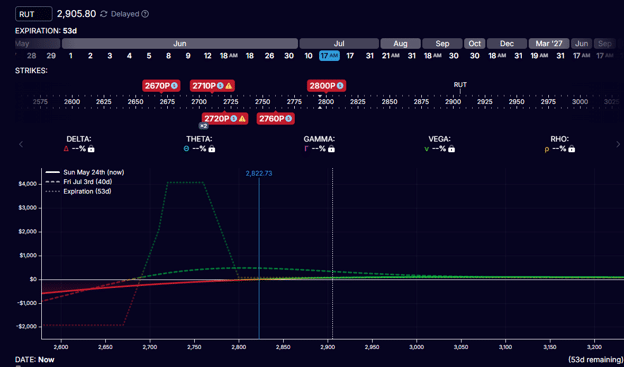
Once the put credit spread is filled, you will have two butterflies with an overlapping leg, as shown.
The combined structure at this point consists of: a long put at 2800, two short puts at 2760 (one from each butterfly), one long put at 2720 (from the original butterfly), and a long put at 2710 (from the new butterfly), with the original lower long put at 2670 remaining as well.
The 2760 strike, which had a single long put before this process began, now carries two short puts, net short one contract at that strike after cancellation.
Traders sometimes refer to this type of structure as a double butterfly or stacked butterfly.
It can also be thought of as a wider butterfly with an internal adjustment, since the two overlapping structures share a wing.
The resulting risk profile has a broader profit zone than a single butterfly, which can be useful when the trader wants more latitude in where the underlying can land at expiration while still maintaining a net positive theta position.
Practical Considerations
Before attempting this approach on a live account, it is worth testing the order-entry process in paper-trading mode if your broker offers it.
The behavior described above is common across major platforms, but the exact error messages and the sequence required to resolve them can differ.
Some brokers handle the overlapping-leg issue transparently, automatically netting the conflicting positions without requiring a split-order workaround.
Others are stricter and will reject any order that references a strike already held in the account, even when the net effect is clearly a risk reduction.
It is also worth noting that the fill quality of the two separate orders may differ from what you would expect if you had entered the full butterfly as a single four-leg order.
When you break the butterfly into a debit spread and a credit spread, the market maker on each leg will price each side independently.
You may end up paying a slightly wider spread in total than if you enter the combined structure as one order on a platform that supports a four-leg butterfly entry.
For index products like RUT, where liquidity is generally strong, and the bid-ask spreads on individual legs are tight, this cost difference is typically small.
For equity options on less-liquid underlyings, the slippage from executing in two separate orders can be more significant, and traders should factor this into the decision about whether to overlap strikes or use non-overlapping butterflies instead.
Finally, keep in mind that the images referenced in this article showing the payoff diagram at each stage of the process are a valuable tool for confirming that each order is having the expected effect on the position.
Always verify the resulting risk graph after each fill before submitting the next order, particularly in fast-moving market conditions.
Conclusion
Beyond the commission savings, the overlapping structure also offers practical benefits for margin and capital allocation.
With six contracts instead of eight, the margin requirement may be lower depending on your broker’s calculation method for butterfly positions.
For traders managing multiple positions simultaneously, these capital-efficiency savings can compound meaningfully across a portfolio.
Count the number of contracts remaining in this dual-butterfly structure: there are six open contracts.
Closing the position, therefore, incurs commissions and fees on six contracts, in addition to the eight contracts paid for when opening the two butterflies.
Altogether, the round-trip cost covers 14 contracts.
If we had wanted to avoid the complexity of overlapping strikes, we could have placed the second butterfly five points higher so the strikes would not collide.
However, opening and closing the two non-overlapping butterflies would incur commissions and fees on 16 contracts.
By overlapping the strikes, the total commissions and fees are reduced by two contracts.
Over a portfolio of trades, these incremental savings add up, making the overlapping butterfly approach not only structurally elegant but also more economical to execute repeatedly.
We hope you enjoyed this article on adding overlapping butterflies.
If you have any questions, please send an email or leave a comment below.
Trade safe!
Disclaimer: The information above is for educational purposes only and should not be treated as investment advice. The strategy presented would not be suitable for investors who are not familiar with exchange traded options. Any readers interested in this strategy should do their own research and seek advice from a licensed financial adviser.