








Of all the decisions that go into an iron condor, strike selection is the one that most directly shapes the trade’s character.
Get it right, and you have a position with a reasonable probability of profit, a sensible premium, and enough room to manage if the market moves.
Get it wrong, and you’re either collecting too little premium to justify the risk or setting strikes so tight that any normal market movement puts the trade in trouble.
The good news is that delta gives you a reliable, objective framework for making this decision, one that removes most of the guesswork.
Contents
- Why Delta Is The Right Tool For Strike Selection
- The Delta Spectrum: Understanding The Trade-Offs
- Symmetric Vs Asymmetric Strike Placement
- How Implied Volatility Changes Strike Placement
- The Width Of The Wings
- Putting It Together
- Frequently Asked Questions
Why Delta Is The Right Tool For Strike Selection
Delta measures how much an option’s price changes for every $1 move in the underlying.
A call option with a delta of 0.30 gains approximately $0.30 in value for every $1 rise in the underlying stock.
But for iron condor traders, delta serves a second, more important purpose: it approximates the probability that an option will expire in-the-money.
A short call with a delta of 0.16 has approximately a 16% chance of expiring in the money, meaning there’s roughly an 84% probability it expires worthless and you keep the full premium on that leg.
A short put with a delta of 0.16 carries the same approximate probability.
This is why delta is the natural language of strike selection for iron condors.
Rather than picking strikes based on technical levels alone or by feel, you’re anchoring your decision to a specific probability framework.
You’re choosing how much of an edge you want the trade to have before it even begins.
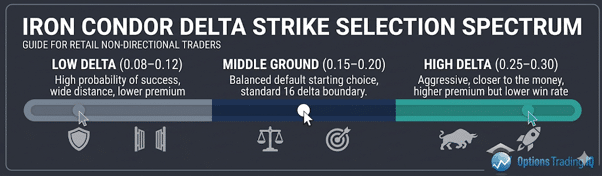
The Delta Spectrum: Understanding The Trade-Offs
There’s no single correct delta for every iron condor.
Different delta levels represent different points on a spectrum between the premium collected and the probability of success.
High delta (0.25–0.30):
Selling closer to the money means you collect more premium. A 0.25 delta short strike might bring in $1.50–$2.00 per side versus $0.50–$0.80 for a 0.10 delta strike.
But you’re also setting strikes that the underlying has a 25–30% chance of reaching, meaning roughly one in four trades will have a short strike tested or breached.
The trade is more aggressive, requires more active management, and has a lower theoretical probability of achieving full profit.
Low delta (0.08–0.12):
Selling further out of the money gives you more distance between the current price and your short strikes.
The underlying has a much smaller chance of reaching your strikes, and the trade tends to feel more comfortable to manage.
The trade-off is that you collect less premium, sometimes significantly less, and need to be more disciplined about capital efficiency.
The middle ground (0.15–0.20):
Most experienced iron condor traders settle into the 0.15 to 0.20 delta range for their short strikes as a default starting framework.
This band captures a reasonable premium while maintaining a theoretical probability of profit above 60–65% on each leg.
It’s not so aggressive that every volatile week puts the position under pressure, and not so conservative that the premium collected fails to justify the capital at risk.
For traders building their iron condor process from scratch, starting with the 16 delta, one standard deviation out of the money, is a sensible, well-grounded choice.
It sits at a natural statistical boundary and has been widely studied as a starting point for short premium strategies.
Symmetric Vs Asymmetric Strike Placement
A common assumption among new iron condor traders is that the call and put sides should be placed symmetrically, with the same delta on each side.
In practice, this makes sense in markets with roughly balanced implied volatility on both sides.
Sell the 16 delta call, sell the 16 delta put, collect similar premium on each side, and you have a position with no directional lean.
But options markets aren’t always symmetrical.
Because of put skew, the tendency for out-of-the-money puts to carry higher implied volatility than equivalent out-of-the-money calls, the 16 delta put is often priced further from the current price than the 16 delta call.
On the S&P 500 in particular, this skew is a persistent feature of the market reflecting investor demand for downside protection.
The practical implication: when you place equal delta strikes on both sides, you typically end up with your put strike further from the current price than your call strike.
Your condor isn’t geometrically centered around the current price; it’s skewed slightly to the upside.
This is actually appropriate for most market conditions.
Given that indices tend to drift upward over time and that sharp moves tend to be asymmetric to the downside, a condor with a little more room to the downside isn’t a flaw; it’s a reasonable reflection of how market risk is distributed.
However, if you have a specific directional view, say, you think the market is more likely to move higher in the near term, you might adjust by placing your call strike at a lower delta (further out of the money) to give the call side more room.
Conversely, in a market that has already sold off sharply and where downside risk feels elevated, a slightly lower delta on the put side would give you more buffer.
These adjustments are contextual and situational.
For a default framework, symmetric delta placement is the cleanest starting point.
How Implied Volatility Changes Strike Placement
Delta remains constant as a concept, but where the 16 delta strike sits relative to the current price changes significantly with implied volatility.
In a low-volatility environment with the VIX in the 12–15 range, a 16 delta strike on SPY might be only 3–4% away from the current price.
That’s not much buffer, and the premium collected at that strike will be relatively thin.
In this environment, going out to the 10- or 12-delta might make more sense to achieve adequate distance.
In a high-volatility environment, with VIX at 25 or above, the 16 delta strike on the same underlying might sit 6–8% away from the current price, and the premium collected will be substantially higher.
In this environment, you’re being paid more to take on risk, and the wider strikes give your position more resilience.
This is why monitoring implied volatility before placing an iron condor matters.
The delta tells you the probability.
The premium tells you whether you’re being adequately compensated for carrying that probability.
Both need to pass a basic sanity check before the trade goes on.
A useful rule of thumb: in low IV environments, be more selective, either widen your strikes further out, reduce position size, or wait for better conditions.
In high-IV environments, standard delta placement yields better risk-adjusted outcomes, and the trade is generally worth taking.
The Width Of The Wings
Strike selection isn’t just about where you place the short strikes; it’s also about how wide to make the wing spreads (the distance between your short strike and the long strike that defines and limits your risk).
Wider wings collect more premium but require more capital at risk.
Narrower wings collect less but are cheaper to put on and easier to manage.
A practical starting framework: wings of $5 wide on lower-priced ETFs like SPY, and $10–$25 wide on index products like SPX.
The goal is to ensure that the credit collected represents at least 25–33% of the spread width.
If a $5-wide condor collects less than $1.25 in net credit, the risk/reward isn’t compelling; you’re risking $3.75 to make $1.25.
This credit-to-width ratio check acts as a final filter on your strike selection.
Even if your delta placement looks right, if the market isn’t paying you adequately for the defined risk, the trade doesn’t meet the threshold.
Putting It Together
A practical iron condor strike selection process in four steps:
– Check implied volatility. Is IV elevated enough to produce adequate premium? Use IV rank or IV percentile to assess conditions relative to recent history.
– Select your short strikes using delta. Start at the 15–16 delta on each side as your default. Adjust based on directional view or current IV environment.
– Select your long strikes based on wing width. Aim for wings that produce a credit of at least 25–33% of the spread width.
– Verify the credit-to-width ratio. If the numbers don’t work, either adjust the wing width or wait for better conditions rather than compromising the trade structure.
Delta is not a perfect predictor.
A 16 delta strike will be breached more often than the number implies because markets don’t follow normal distributions, and tail events happen more frequently than theoretical probabilities suggest.
But as a framework for making consistent, repeatable strike selection decisions, it’s the most reliable tool available to the retail iron condor trader.
The goal isn’t to find the perfect strike on every trade.
It’s to make a sensible decision within a consistent framework and let probability work across a large number of trades.
That’s where the edge lives.
Frequently Asked Questions
What delta should I use for iron condor short strikes?
The 15–16 delta is the most widely used starting point for iron condor short strikes.
It places your strikes approximately one standard deviation out of the money, giving each leg a theoretical probability of expiring worthless of around 84%.
More aggressive traders use the 20–25 delta for a higher premium; more conservative traders use the 10–12 delta for more distance.
The 16 delta is the sensible default, to be adjusted based on IV conditions or directional outlook.
Should my call and put strikes be placed at the same delta?
Yes, as a default framework.
Placing both short strikes at the same delta, say, 16 delta on each side, gives you a balanced, non-directional position.
In practice, put skew means the 16 delta put will usually sit further from the current price than the 16 delta call, so symmetric delta placement typically results in slightly more room to the downside.
That’s generally appropriate given how markets behave.
How wide should my iron condor wings be?
A practical starting point is $5-wide wings on ETFs like SPY and $10–$25 wide on index products like SPX.
The more important test is the credit-to-width ratio: the premium you collect should represent at least 25–33% of the total wing width.
If you’re risking $4.00 to make $1.00, the trade doesn’t have a compelling risk/reward profile regardless of how the delta placement looks.
Does strike selection change in high volatility environments?
Yes, significantly.
In high IV environments (VIX above 25), the 16 delta strike sits further from the current price because the market is pricing in larger expected moves.
This gives you more buffer and higher premium, generally the most favourable conditions for iron condors.
In low IV environments (VIX below 15), the 16 delta strike sits much closer to the current price, offering less buffer and thinner premium.
In these conditions, moving out to the 10–12 delta or reducing position size is often the better approach.
What’s the difference between delta and probability of profit for an iron condor?
Delta on a short option approximates the probability that the single leg expires in-the-money.
The overall probability of profit for the full iron condor, both legs expiring worthless, is higher than either leg in isolation because the position profits as long as the underlying stays between both short strikes.
However, the probability of achieving maximum profit (holding through to expiration) is lower than traders assume, which is why closing early at 50% profit and 21 DTE typically yields better results than holding through to expiration.
Related Articles:
- Iron Condors: The Ultimate Guide
- When to Close an Iron Condor Early: The 21 DTE and 50% Profit Rules
- IV Rank vs IV Percentile: What They Mean and How to Use Them
- Adjusting Iron Condors (Ultimate Guide)
We hope you enjoyed this article on iron condor strike selection.
If you have any questions, please send an email or leave a comment below.
Trade safe!
Disclaimer: The information above is for educational purposes only and should not be treated as investment advice. The strategy presented would not be suitable for investors who are not familiar with exchange traded options. Any readers interested in this strategy should do their own research and seek advice from a licensed financial adviser.