








The bull put credit spread is one of the most popular bullish option strategies.
It is a vertical spread because both options share the same expiration date, and it is often one of the first multi-leg strategies that every options trader should learn.
After becoming comfortable with this strategy, some traders may begin exploring alternatives.
One such alternative is the bullish put credit diagonal.
Like the bull put credit spread, it collects a credit upfront and can be configured with a similar risk-to-reward profile.
The key difference is that the long and short puts have different expiration dates.
But does the diagonal actually offer an advantage?
Or is it simply a different way to structure the same bullish outlook?
To answer that question, we’ll compare the two strategies under three market scenarios: when the underlying moves higher as expected, trades sideways, and falls against our position.
Contents
- Bull Put Credit Spread
- Bull Put Credit Diagonal
- Stock Goes Sideways
- Example of Stock Going Down Against the Position
- FAQ
- Conclusion
Bull Put Credit Spread
Here is a bull put credit spread in Apple (AAPL):
Date: May 1st, 2026
Price: AAPL @ $285.50
Buy one contract June 12th AAPL $260 put @ $2.01
Sell one contract June 12th AAPL $270 put @ $3.52
Net Credit: $151
Max risk: $848
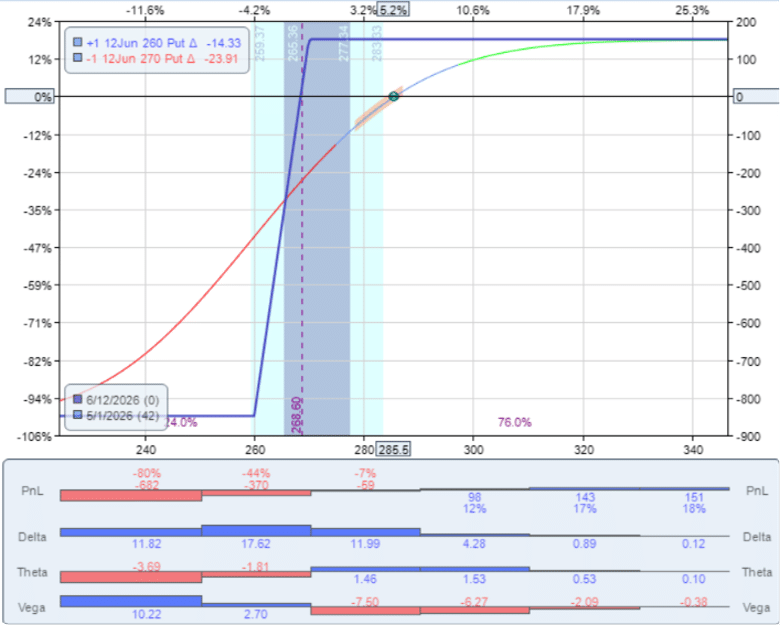
Delta: 9.59
Theta: 1.78
Vega: -8.15
The expiration P&L graph shows upside profit of $151 and downside risk of $848.
Bull Put Credit Diagonal
Now here is our experimental bull put credit diagonal:
Date: May 1st, 2026
Price: AAPL @ $285.50
Buy two contracts June 18th AAPL $270 put @ $4.02
Sell two contracts June 12th AAPL $275 put @ $4.70
Net Credit: $131
Max risk: $865
We used two contracts here to get the initial credit and max risk to be approximately the same as the bull put credit spread that we are comparing to.
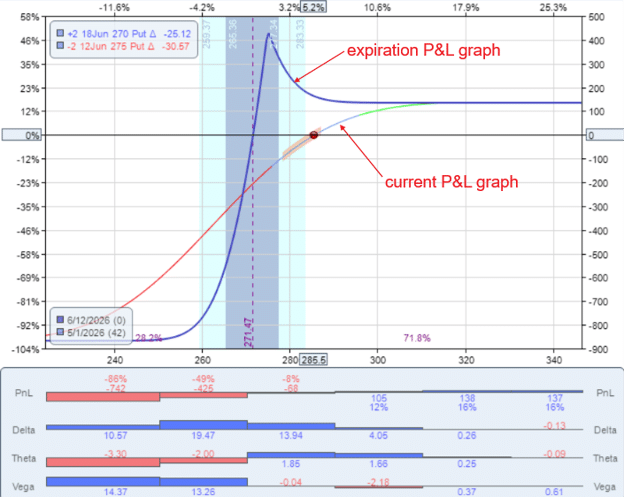
The current P&L graph looks very similar to that of the bull put credit spread.
However, the expiration P&L graph is noticeably curved because the two options have different expiration dates.
In contrast, the expiration graph of a bull put credit spread – or any option structure in which all legs share the same expiration – consists entirely of straight-line segments.
Although the expiration graph displays a noticeable profit “bump,”, the upside profit of $131 and the downside risk of $865 is close enough for us to compare it with the bull put credit spread.
When we look at the Greeks for the bull put credit diagonal, we see a slight increase in theta and a significant decrease in the amount of negative vega.
Delta: 10.89
Theta: 2.22
Vega: -1.94
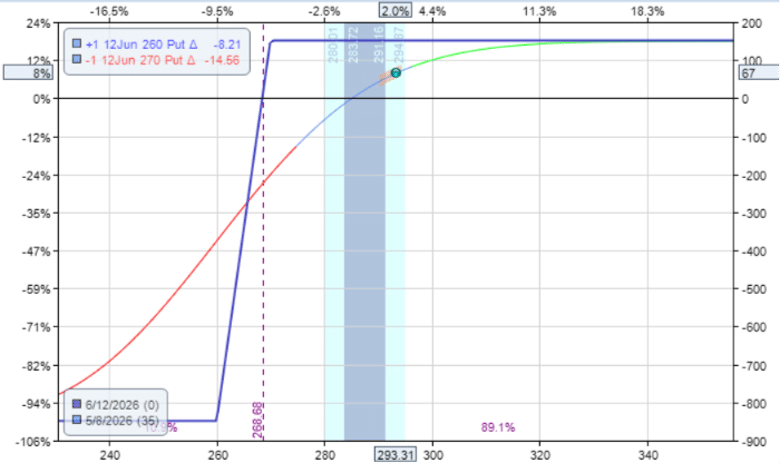
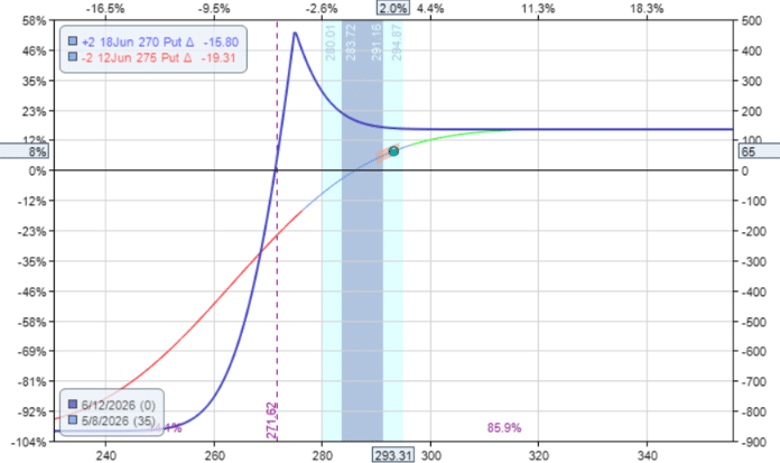
Whether these will play into the profitability of the trade, we shall see when we advance the trade one week in time.
The bull put credit spread made $67…
The bull put credit diagonal made about the same at $65…
Another week later, both trades had profits close to $100.
No difference between the two trades.
Stock Goes Sideways
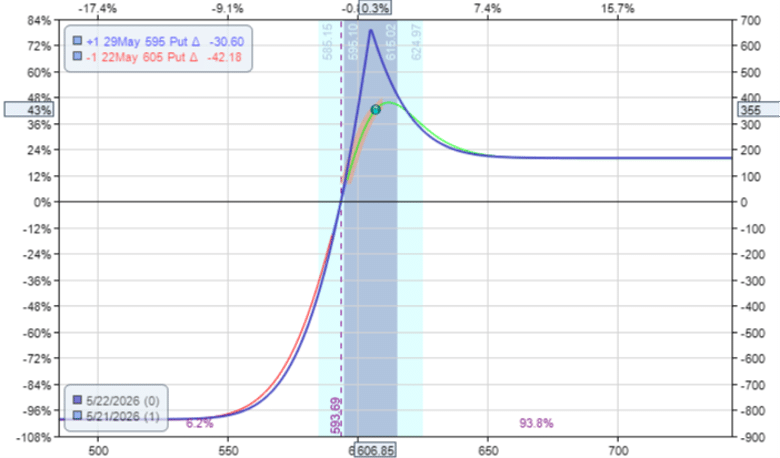
META is at $613.86 on May 1st, 2026.
Bull Put Credit Spread:
Buy two contracts May 22nd META $570 put @ $4.25
Sell two contracts May 22nd META $575 put @ $5.22
Credit: $195
Max risk: $805
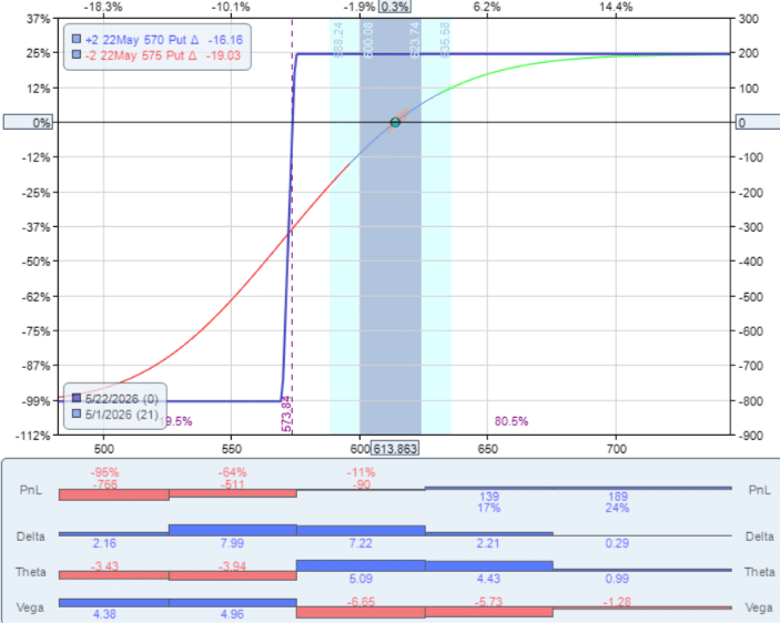
Delta: 5.73
Theta: 6.05
Vega: -7.86
Bull Put Credit Diagonal:
Buy one contract May 29th META $595 put @ $12.32
Sell one contract May 22nd META $605 put @ $14.00
Net Credit: $167
Max risk: $833
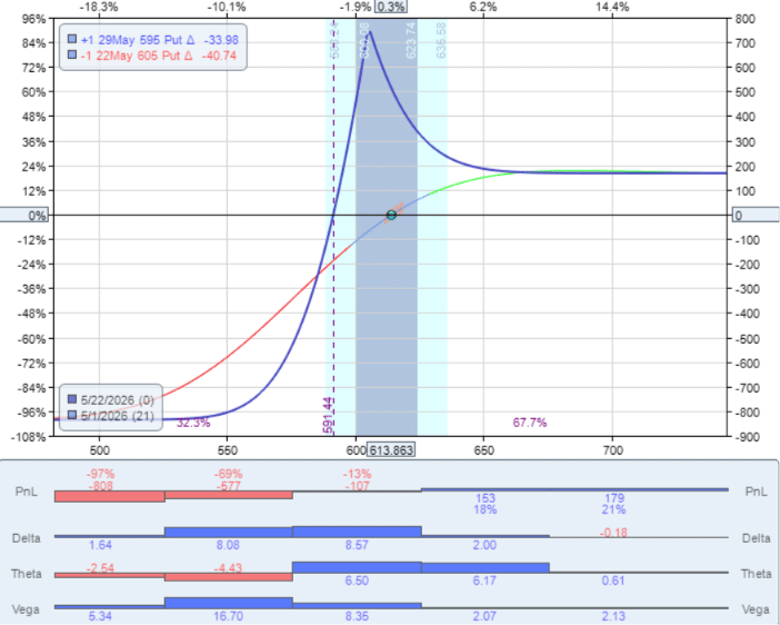
Delta: 6.76
Theta: 8.25
Vega: 5.13
In this example, vega is negative for the bull put credit spread while it is positive for the bull put credit diagonal.
But will that make any difference?
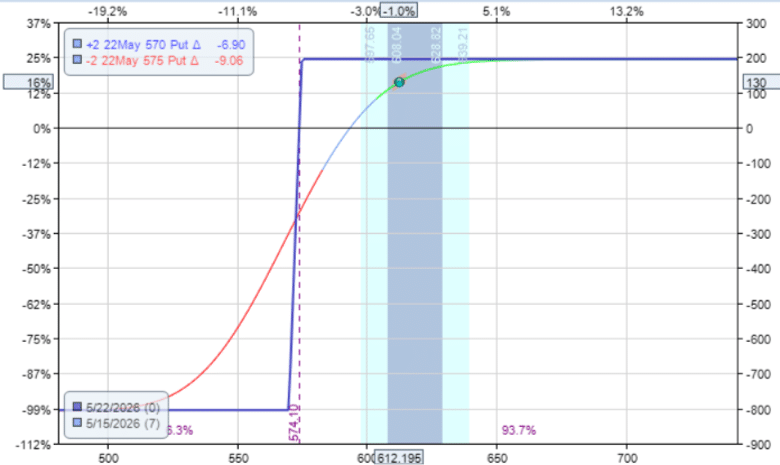
Two weeks later, Meta at $612.19 around the same price as when the trade started.
Bull put credit spread profit $130.
Bull put credit diagonal profit $142 – just slightly higher but not significantly.
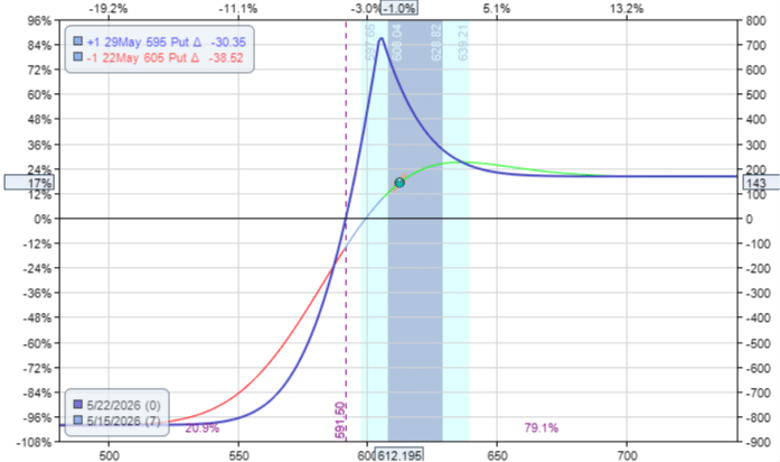
This is the point where we want to exit the bull put credit spread because the following Monday begins the expiration week.
We do not want to risk being assigned 100 shares of META if the stock falls below the $575 short put strike, causing the short option to finish in the money.
Although our long $570 put still provides downside protection during expiration week, allowing us to sell both the shares and the long put if assignment occurs, that protection disappears at expiration.
For example, if META closes between $575 and $570 at the close of trading on expiration Friday, May 22nd, the $575 short put will be assigned 100 shares of META, while the $570 long put expires worthless.
We would then be left holding a $57,500 stock position with no downside protection.
If unfavorable news breaks over the weekend when we are unable to sell our shares and META gaps sharply lower on Monday morning, the resulting loss could be substantial and can easily exceed the original maximum risk of the bull put credit spread.
To avoid this “between-the-strikes” expiration risk, always close a bull put credit spread before expiration.
Even better, close the position before expiration week.
For a real-life example of this assignment risk, watch our YouTube story covering an actual assignment event.
The bull put credit diagonal is somewhat more forgiving in this respect.
Because if the short $605 put expires in-the-money on May 22nd and we are assigned 100 shares, the long $595 put remains active for another week.
This provides continued downside protection in the event of assignment, giving the trader time to exit the position.
On rare occasions, the bull put credit diagonal can benefit from favorable timing, with the stock price hovering near the peak-profit area of the expiration graph just one day before the short option expires.
Example Of Stock Going Down Against The Position
MSFT at $447 on June 2nd, 2026.
Bull Put Credit Spread:
Buy two contracts June 26 MSFT $410 put @ $3.10
Sell two contracts June 26 MSFT $415 put @ $3.92
Credit: $165
Max risk: $835
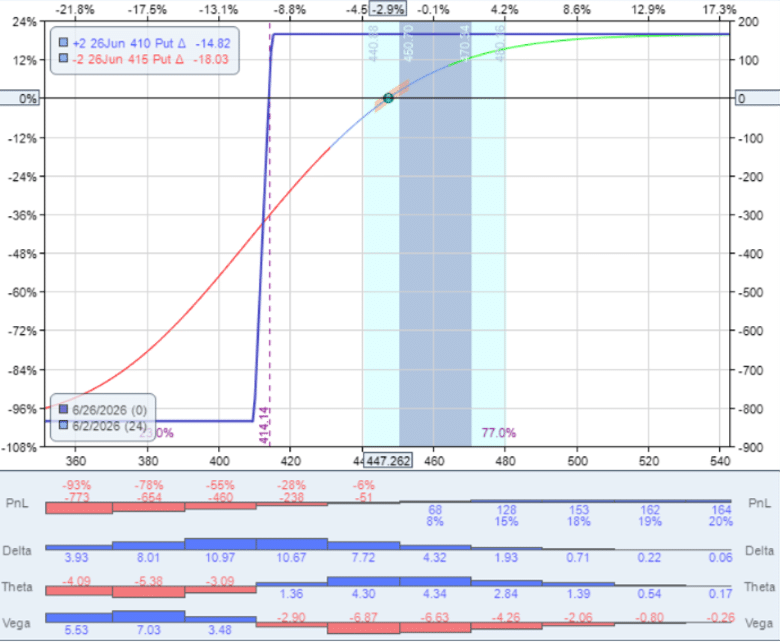
Delta: 6.43
Theta: 4.61
Vega: -7.21
Bull Put Credit Diagonal:
Buy one contract July 2nd MSFT $425 put @ $7.15
Sell one contract June 26th MSFT $435 put @ $9.15
Credit: $200
Max risk: $800
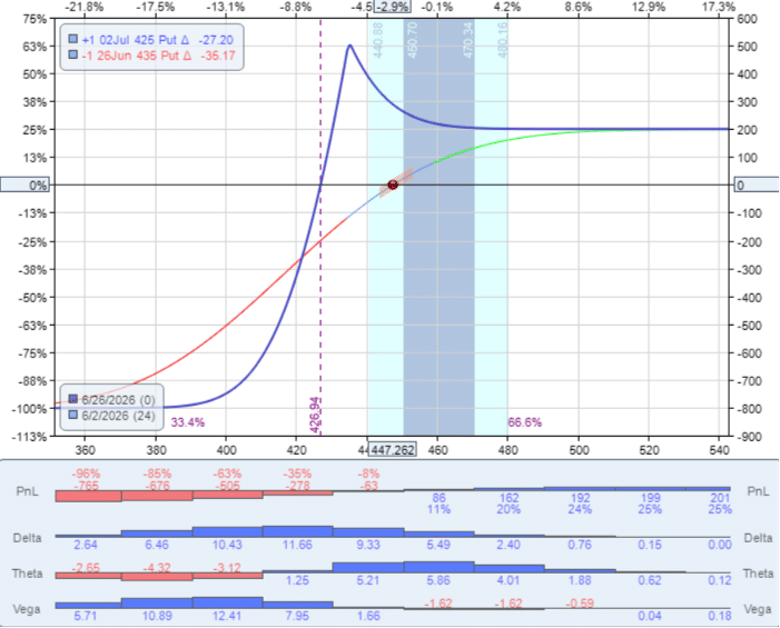
Delta: 7.97
Theta: 5.85
Vega: 0
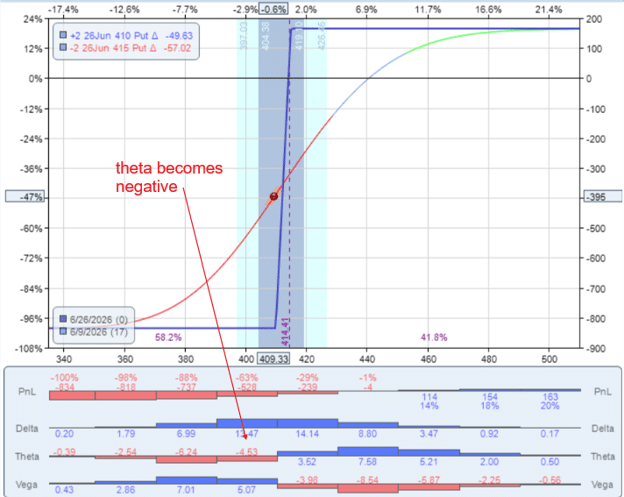
One week later, the price was clearly going against us.
The bull put credit spread lost $395:
And the bull put credit diagonal loss a bit more at -$482…
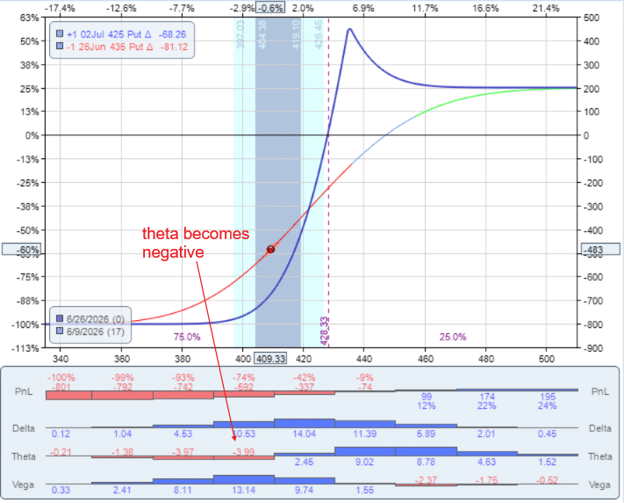
Why did the bull put credit diagonal lose more money than the bull put credit spread, even though it started with slightly higher theta and essentially neutral vega?
FAQ
What Is The Main Difference Between A Bull Put Credit Spread And A Bull Put Credit Diagonal?
Both strategies collect a credit and profit when the underlying stays above the short put strike.
The key difference is expiration structure: a bull put credit spread uses the same expiration date for both legs, while a bull put credit diagonal uses different expiration dates — the long put expires later than the short put.
This difference in expiration dates changes the vega exposure (the diagonal can be positive or near-neutral vega vs the spread’s negative vega) and creates a curved rather than straight-line expiration P&L graph.
Which Strategy Has Better Assignment Protection?
The bull put credit diagonal has a slight advantage in assignment protection.
If the underlying closes between the strikes of a bull put credit spread at expiration, the short put is assigned and the long put expires worthless — leaving the trader holding a large stock position with no downside protection.
With the diagonal, the long put expires later, providing continued downside protection in the event of assignment on the short put.
That said, the practical advice for both strategies is the same: close the position before expiration week to avoid the scenario entirely.
Does The Bull Put Credit Diagonal Perform Better In High Volatility?
Potentially, but it depends on the configuration.
When the diagonal is structured with positive vega (as in the META sideways example), rising implied volatility benefits the position.
A standard bull put credit spread with negative vega is hurt by rising volatility.
However, the difference in practice is modest, and delta remains the dominant driver of P&L in both strategies.
A large adverse move in the underlying will overwhelm any vega advantage the diagonal might have.
When Should I Use A Diagonal Instead Of A Vertical Spread?
The diagonal makes the most sense when you specifically want to reduce negative vega exposure, for example, when entering a bullish trade in a low-IV environment where you expect volatility to rise.
The diagonal’s positive vega means it won’t be hurt as much if IV increases.
It also makes sense when you want the extended long put protection around expiration.
For most other situations, the vertical spread’s simplicity, lower transaction costs, and linear expiration graph make it the more practical choice.
Why Did The Diagonal Lose More Money In The Bearish Scenario?
Delta was the culprit.
Even though the diagonal had higher theta and near-neutral vega at entry, its delta was meaningfully higher than the comparable vertical spread (8.0 vs 6.4 in the MSFT example).
Delta is the dominant Greek.
It measures the position’s direct sensitivity to price movement.
When the underlying moved sharply against the position, the higher delta amplified the loss.
This illustrates an important principle: when comparing options structures, always check the delta, not just the credit collected.
Should I Close A Bull Put Credit Spread Before Expiration?
Yes, always.
As the article demonstrates with the META example, holding a bull put credit spread into expiration week exposes you to “between-the-strikes” risk: the short put is assigned while the long put expires worthless, leaving you holding a full stock position with no downside protection.
Close the spread before expiration week regardless of how profitable the position looks.
The small amount of additional premium you might collect by holding longer is not worth the assignment risk.
Conclusion
The answer is that the diagonal has a larger delta.
As it happens to be configured in the example, the delta for the credit diagonal was 8.0, compared with 6.4 for the credit spread.
While not a big difference, it makes the diagonal a more directional trade in its current configuration.
As a result, when the underlying price moved against the position, the diagonal experienced a larger loss.
Among the option Greeks, delta is the dominant driver of profit and loss.
Theta contributes positively through time decay, but its effect is relatively small.
Vega also influences the position, but it is generally a secondary factor compared with delta.
It’s also important to remember that the Greeks are not static.
They change as the underlying price moves.
Although both trades began with positive theta, a sufficiently adverse price move can cause theta to shrink or even turn negative (see in the above graphs when theta becomes negative).
Theta eventually becomes negative for both positions once the underlying moves far enough against the spreads.
Based on these examples, there does not appear to be any significant performance difference between the bull put credit spread and the bull put credit diagonal when they are configured with similar risk-to-reward ratios and time to expiration.
Their current P&L curves are nearly identical, and they behave very similarly under bullish, neutral, and bearish market conditions.
One might argue that the diagonal might have a few potential advantages: it often starts with slightly higher theta, reduces assignment risk when the underlying finishes between the two strikes because the long put expires later, and occasionally benefits from a fortunate “pin” near the expiration profit peak.
However, these are relatively infrequent scenarios and are unlikely to provide a consistent edge over the simpler bull put credit spread.
For most traders, the bull put credit spread remains the cleaner choice: fewer moving parts, simpler management, and no confusion around multi-expiration settlement.
The diagonal is worth understanding because it reveals how time spreads affect Greek behaviour, particularly the vega flip from negative to positive, and because the assignment risk comparison is instructive.
But unless you’re actively exploiting the diagonal’s specific advantages (the expiration profile peak or the extended long put protection), the additional complexity doesn’t justify the trade.
Want to Master Credit Spreads and Diagonal Strategies?
Both the bull put credit spread and the diagonal are covered in detail in Options Income Mastery, including exact entry rules, strike selection, when to close, and how to manage the assignment risk that catches many spread traders off guard.
We hope you enjoyed this article on the bull put credit spread versus the bull put credit diagonal.
If you have any questions, please send an email or leave a comment below.
Trade safe!
Disclaimer: The information above is for educational purposes only and should not be treated as investment advice. The strategy presented would not be suitable for investors who are not familiar with exchange traded options. Any readers interested in this strategy should do their own research and seek advice from a licensed financial adviser.