








The 50% profit rule for iron condors has become so widely repeated that many traders treat it as an immutable law.
Close at 50% of max profit.
Simple, systematic, move on.
The rule has real merit, it’s well-researched, and it works reliably in certain conditions.
But applied mechanically across all market environments and all trade setups, it leaves significant money on the table in some situations and closes positions prematurely in others.
This article examines the 50% rule honestly, when it works, when it doesn’t, and what you should be using instead.
Contents
- Where The 50% Rule Comes From
- When The 50% Rule Works Well
- When Closing Earlier Than 50% Is The Right Call
- When Holding Past 50% Makes Sense
- The Time Dimension: 50% Profit In 20% Of Duration Vs 80% Of Duration
- A Smarter Framework: Combining Profit Target With Time And Conditions
- FAQ
- Summary
Where The 50% Rule Comes From
The 50% profit target for iron condors was popularised by Tastylive (formerly Tastytrade) through their research into systematic options selling.
Their studies showed that closing short premium positions at 50% of max profit, rather than holding to expiration, improved risk-adjusted returns by reducing time spent in the high-gamma danger zone near expiration while still capturing most of the available profit.
The logic is sound.
By the time an iron condor has made 50% of its maximum credit, it has harvested the most efficiently earned portion of its theta decay curve.
The remaining 50% takes as long or longer to earn and is earned during the period when gamma risk is rising, and the position’s sensitivity to adverse moves is increasing.
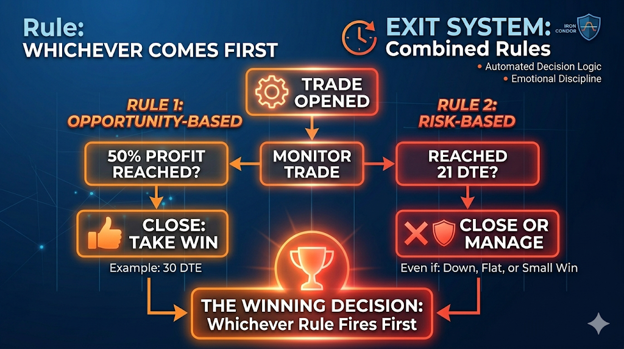
The standard rule is a 50% profit target or a timed exit at 7-21 DTE, whichever comes first.
This is illustrated across iron condor examples and the best iron condor strategy breakdowns.
But “standard rule” and “universal rule” are not the same thing.
When The 50% Rule Works Well
Before examining the exceptions, it’s worth being precise about the conditions where the 50% rule functions as intended.
Range-bound, moderately volatile markets.
When the underlying is oscillating within a predictable range, and IV is neither extremely high nor extremely low, the 50% target is typically reached in the middle portion of the trade’s life, well before gamma risk becomes acute.
Close at 50%, redeploy capital, repeat.
The rule is elegant in these conditions.
Short to medium DTE condors (30-45 DTE).
The 50% rule was largely developed in the context of 30-45 DTE condors on liquid underlyings like SPY, IWM, and SPX.
In this timeframe, reaching 50% profit signals that the trade has worked as intended and the risk/reward of holding the remaining premium is genuinely unfavourable.
Closing at 50% here is disciplined, not timid.
When you’re running high trade frequency.
If you’re managing a systematic portfolio of 6-10 condors simultaneously and cycling through positions quickly, the 50% rule keeps capital moving efficiently.
You’re not trying to squeeze every last cent from individual trades, you’re optimising for the compound effect of many high-probability trades executed consistently.
In these conditions, the 50% rule is genuinely well-designed.
The critique isn’t that it’s wrong; it’s that it isn’t always the right framework.
When Closing Earlier Than 50% Is The Right Call
There are specific situations where waiting for 50% means accepting risks that aren’t justified by the remaining reward.
The trade reaches 25-30% profit quickly, and conditions have changed.
If you entered a condor in a high-IV environment and IV has collapsed sharply, the condor may be sitting at 30-35% profit with the underlying now near the edge of the profit zone.
The vega tailwind that helped build that profit is gone.
Closing at 30-35% rather than waiting for 50% is rational; the conditions that made the trade attractive no longer exist.
The underlying is trending toward a short strike.
If a condor is 35% profitable but the underlying has been trending steadily toward one of your short strikes over multiple sessions, waiting for 50% is wishful thinking dressed up as discipline.
The directional risk has changed.
Closing at whatever profit you have, or converting to a different position, is better risk management than anchoring to a profit target that was set in different conditions.
You’re inside 21 DTE with significant profit but a threatened short strike.
This is the situation where the 50% rule most dangerously misleads traders.
A condor at 40% profit with 15 DTE and a short strike at 28 delta does not have a favourable risk/reward profile for the remaining 10% of profit available.
Close it.
The gamma risk of the final days is not worth 10 percentage points of credit.
Binary events have appeared within the remaining expiration window.
If a Fed meeting, earnings announcement, or major economic release has been scheduled after your trade entry within your expiration window, the risk profile has changed.
Close early if the profit is meaningful, don’t wait for 50% while carrying binary event risk you didn’t price in at entry.
When Holding Past 50% Makes Sense
The 50% rule also fails in the other direction; sometimes, it encourages premature exits that cost you real income.
You’ve reached 50% in the first 20-25% of the trade’s duration.
This happens in benign market conditions when IV contracts quickly after entry.
A condor entered at 45 DTE might reach 50% profit in 8-10 days if the market moves into your profit zone immediately and IV drops.
Closing at this point means you’ve earned the 50% target, but you’ve also given up a potentially clean remainder of the trade that carries very little risk.
In this situation, many experienced traders hold longer, either to a higher profit target (60-70%) or to a time stop, rather than closing the moment 50% is touched.
Longer DTE condors in quiet market conditions.
A 90-day condor that reaches 50% profit with 50 days still remaining is in a different risk position than a 45-day condor reaching 50% profit with 15 days remaining.
With 50+ days left and the underlying sitting comfortably between the short strikes, the gamma risk is modest, and the remaining premium is still meaningful.
Holding to 65-70% profit in this scenario is reasonable.
Low-volatility environments where the premium is thin.
When you’ve entered a condor in a compressed-premium environment, with IV Rank below 30 and collecting a modest credit, the 50% profit target represents a small absolute dollar gain.
In these conditions, many traders adjust the target upward (to 60-70%) to make the trade worthwhile relative to the capital committed, provided the market remains cooperative.
The Time Dimension: 50% Profit In 20% Of Duration Vs 80% Of Duration
Here’s the part the simple 50% rule misses entirely: when you reach 50%, profit matters as much as the fact that you reached it.
Consider two scenarios on the same condor entered at 45 DTE for a $400 credit:
Scenario A: The condor reaches 50% profit ($200) at day 10, and only 22% of the trade’s duration has elapsed.
The underlying is sitting comfortably in the middle of the profit zone.
IV has contracted but is still reasonable.
There are 35 days remaining.
Scenario B: The condor reaches 50% profit ($200) on day 38, with 84% of the trade’s duration elapsed.
The underlying has drifted toward one short strike.
There are 7 days remaining, and gamma is elevated.
These are not the same situation.
Scenario A has a much better case for holding longer; the remaining risk is low, and the potential additional reward is meaningful relative to where the trade sits.
Scenario B has a clear case for immediate closure, the remaining premium is minimal, and gamma risk is high.
A framework that treats both as identical “close at 50%” decisions is leaving money on the table in Scenario A and potentially holding too long in Scenario B.
The better framework: a 50% profit target in less than 50% of the trade’s duration means considering holding longer.
50% profit target in more than 75% of the trade’s duration means closing immediately.
In between, use the current position of the underlying, DTE remaining, and delta of the short strikes to guide the decision.
This is reflected in the standard approach: the 50% target is paired with the condition “in less than 50% of the trade duration,” if the target isn’t reached in half the trade’s life, close at 7 DTE regardless of P&L.
A Smarter Framework: Combining Profit Target With Time And Conditions
Rather than a single profit target, a more robust iron condor exit framework uses three inputs:
1. Profit target adjusted for timing. 50% of max profit is a reasonable baseline, but adjust upward (to 60-65%) if you’ve reached it early in the trade and conditions are benign. Don’t anchor to 50% when the risk/reward of holding longer is clearly in your favour.
2. Time stop. Close the trade at a fixed DTE regardless of profit, 7-21 days before expiration, depending on your entry DTE and the gamma profile of the position. This prevents you from holding into the high-gamma danger zone while chasing the remaining premium.
3. Condition override. If the market is trending toward a short strike, if a binary event has appeared within the window, or if IV has expanded significantly since entry, override both targets and close at whatever profit you have. Conditions matter more than rules.
The no-stress iron condor example illustrates how this plays out in practice, 50% profit reached with 29 days remaining, immediate close, no holding for the final increment of potential profit that would have required absorbing more gamma risk than warranted.
FAQ
Q: Is the 50% profit rule backed by research?
Yes, Tastylive’s research on closing at 50% of max profit showed improved risk-adjusted returns compared to holding to expiration for systematic 45 DTE condors on liquid underlyings.
The research is legitimate.
The limitation is that it was developed for specific conditions and is sometimes applied to contexts where those conditions don’t hold.
Q: What if I never reach 50% profit?
This happens, especially in trending markets or when the condor is entered in a low-premium environment.
In this case, the time stop becomes your primary exit rule.
Closing at 7-21 DTE with whatever profit you have (or a small loss) is nearly always better than holding through the final high-gamma period hoping the trade will improve.
Disciplined use of timed exits significantly improves real-world outcomes.
Q: Should I use a different profit target for different underlyings?
Broadly yes.
Condors on high-beta, volatile underlyings deserve more conservative targets (closer to 40-50%) because the risk of a sudden adverse move is higher.
Condors on broad, low-beta indices can sometimes justify holding to 60-65% in benign conditions.
Stock-specific condors near earnings should almost always be closed earlier than the standard target if a meaningful profit has been accumulated.
Q: What about the Tastylive 21 DTE exit rule? Does that replace the 50% rule?
They work together, not as alternatives.
The 50% profit target is your proactive exit when the trade works as planned.
The 21 DTE exit is your defensive exit when the trade hasn’t reached the profit target in time.
Use whichever is triggered first.
Summary
The 50% profit rule is a useful default, not a law of nature.
It works well in range-bound markets at standard DTE windows with systematic trade cycling.
It breaks down when applied rigidly to situations where timing, market conditions, or the risk profile of the remaining position argue for a different decision.
The most important insight is the time dimension: reaching 50% profit early in a trade is a different situation from reaching it late in the trade.
Early arrival with benign conditions often justifies holding longer; late arrival with a threatened short strike and elevated gamma argues for immediate closure.
Replace the single 50% rule with a three-part framework: a profit target adjusted for timing and conditions, a firm time stop, and a condition override that closes the trade when market behaviour has changed from what you assumed at entry.
That’s a system you can apply consistently across all market environments, not just the benign ones where the simple rule happens to work.
Related articles:
- Iron condors: the complete guide
- Iron Condor: when to adjust vs when to close
- Iron condor examples with adjustments
- The best iron condor strategy
- Iron condor success rate: backtest results
- No stress iron condor trade example
- Trading iron condors in low volatility
We hope you enjoyed this article on when to close an iron condor.
If you have any questions, send an email or leave a comment below.
Trade safe!
Disclaimer: The information above is for educational purposes only and should not be treated as investment advice. The strategy presented would not be suitable for investors who are not familiar with exchange traded options. Any readers interested in this strategy should do their own research and seek advice from a licensed financial adviser.