





When people say they want to generate income from options, they don’t all mean the same thing.
Some want to spend 30 minutes a month on their portfolio and collect consistent premium.
Others want to be more engaged, actively managing positions, rotating between strategies based on market conditions, and squeezing more return from the same capital.
Both are legitimate. But they require different strategies, different tools, and a different relationship with your trading account.
Running the wrong approach for your personality and lifestyle is one of the most common reasons income traders struggle.
This article maps out the full spectrum, from the most passive options-income approaches to the most active, so you can honestly assess which suits you.
Contents
- The Passive-to-Active Spectrum
- The Passive End: Set It and Mostly Forget It
- The Middle Ground: Systematic but Engaged
- The Active End: Dynamic, Multi-Strategy Management
- How to Honestly Assess Your Own Position
- What Happens When You Choose the Wrong Approach
- FAQ
- Summary
The Passive-to-Active Spectrum
Options income isn’t a single activity; it’s a spectrum from near-total passivity to full-time active management.
The key variables that determine where you sit on that spectrum are:
Time available. How many hours per week or month can you realistically commit? Not ideally, realistically, accounting for work, family, travel, and the fact that you probably won’t want to watch a trading platform during the market’s best moments.
Monitoring access. Can you check positions during US market hours, or do you access markets at night (a common situation for international traders and those with day jobs)? Some strategies demand real-time monitoring; others are fine with once-a-week reviews.
Emotional tolerance for complexity. More active approaches offer more control and higher potential returns, but also more decisions under pressure. Each additional decision point is an opportunity to make a mistake.
Capital size. Larger portfolios support more simultaneous positions across multiple strategies. Smaller accounts benefit from simplicity, fewer positions, and less complexity to manage.
Understanding where you honestly sit on these dimensions determines which approach you should take, not which approach sounds most appealing.
The Passive End: Set It And Mostly Forget It
The most passive, legitimate options income strategy is covered calls on existing stock holdings, particularly broad ETFs like SPY, QQQ, or IWM.
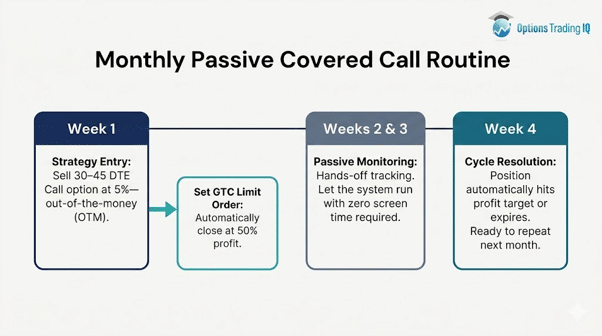
The routine looks like this: once a month, sell one covered call per 100 shares owned at a strike 5-8% above the current price, 30-45 days to expiration.
Set a GTC (good-till-canceled) buy order to close the position at 50% of the credit received. Check back in a week.
That’s essentially it.
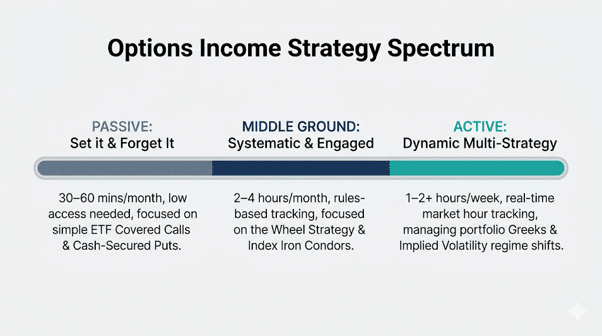
Time commitment: 30-60 minutes per month.
Income potential: approximately 8-15% annual premium on the covered stock, depending on IV environment and strike selection.
What you sacrifice: you cap your upside to the strike price.
In strong bull years, a covered call strategy underperforms simple stock ownership because the calls get exercised and you miss gains above the strike.
This is the fundamental trade-off of all passive options income.
Cash-secured puts on ETFs are equally passive.
Sell one put per month on SPY or QQQ at a strike 5-8% below the current price, collect premium, wait.
If assigned, you now own an index ETF, which most people are happy to hold anyway.
More active traders sometimes dismiss these approaches as “leaving money on the table.” For the retiree who wants a consistent income without screen time, they’re ideal.
Our guide to generating monthly income as a retiree covers these strategies in their most practical form.
Covered call ETFs like QYLD sit even further toward the passive end; you delegate the entire process to a fund manager.
The trade-offs are higher fees, a mechanical ATM strategy with no flexibility, and NAV erosion from selling all upside every month.
We cover this in detail in our QYLD vs selling your own covered calls guide.
For genuinely passive investors who won’t manage positions themselves, there is a role, but most people capable of reading this article can do better.
The Middle Ground: Systematic But Engaged
Most serious income traders operate here.
They have a defined system, they follow rules, but they’re actively monitoring positions and making tactical decisions within a framework.
The Wheel strategy is the archetypal middle-ground approach. You systematically rotate between cash-secured puts and covered calls on quality stocks, cycle after cycle.
There are clear entry rules (which stocks, which delta, which DTE), clear profit targets, and a defined process for handling assignment.
It’s systematic enough to reduce emotional decision-making, but engaged enough to generate better returns than the fully passive approach.
Time commitment: 2-4 hours per month, with occasional 15-minute check-ins during the week.
Our complete Wheel strategy guide covers the full process.
Iron condors on broad indices are another classic middle-ground strategy.
You enter a position at 30-45 DTE, set alert levels at your adjustment triggers, check in a few times per week, and close at 50% of max profit or 21 DTE.
More monitoring than covered calls, but far less than day-trading approaches.
Income potential: higher than purely passive covered calls in good conditions, with more flexibility to respond to changing market conditions.
What distinguishes middle-ground traders from passive ones isn’t the frequency of action; it’s the quality of the framework they’re operating within.
A systematic Wheel trader who checks positions twice a week using defined rules is more likely to succeed than an “active” trader who makes gut decisions daily.
The goal of the middle ground is rules-based consistency, not frequent trading.
The options income portfolio guide covers how to systematically build a portfolio at this level.
The Active End: Dynamic, Multi-Strategy Management
Active options income trading means running multiple strategy types simultaneously, rotating among them based on the current IV environment, monitoring positions more frequently, and making tactical decisions about when to adjust, roll, or close positions.
A fully active income portfolio might combine:
- Iron condors on indices (short vega, high IV environments)
- Calendar spreads as vega hedges (long vega, low IV environments)
- Covered calls and the Wheel on individual stock positions
- Occasional credit spreads on specific high-IV underlyings
The active trader also pays closer attention to the IV regime, shifting allocation toward iron condors in high-IV periods and toward calendar spreads when IV is compressed, as our high-IV vs. low-IV strategy guide covers.
They manage portfolio-level delta and vega rather than just monitoring individual trades.
Time commitment: 1-2 hours per week minimum. During volatile markets, potentially daily attention.
Income potential: highest of the three approaches, but the gap over the middle-ground approach narrows significantly once trading friction, adjustment costs, and the potential for emotional errors under active management are accounted for.
The active approach is not inherently superior to the middle ground.
Research and experience consistently show that the best returns in systematic income trading come from disciplined rule-following, not from frequent tactical decisions.
The risk of the active approach is over-trading, the mistaken belief that more activity equals more income.
How to Honestly Assess Your Own Position
Answer these questions before deciding where on the spectrum you belong.
How many hours per month will you actually spend on this?
Not how many you want to spend, but how many you will.
If you’re a busy professional with an international travel schedule, an “active” multi-strategy portfolio is a recipe for missed adjustment windows and stressed decisions made from airport lounges.
What happens if you can’t check your positions for a week?
The fully passive approach, covered calls on ETFs, can survive a week of inattention comfortably.
A short iron condor in the final week before expiration cannot.
Have you ever abandoned a trading system mid-implementation? If yes, the complexity of an active approach will not fix that. Simpler, more consistent systems that you’ll actually follow beat sophisticated ones you’ll abandon.
What’s your genuine reaction to a position going against you?
If a condor breaching a short strike triggers the urge to over-manage or revenge-trade, more active approaches amplify that tendency.
If you can follow pre-defined rules mechanically, active management becomes more viable.
Are you doing this for income or for intellectual engagement?
Both are legitimate motivations, but they lead to different optimal approaches.
Income-focused traders often do better with simpler, more systematic strategies that generate reliable cash flow.
Traders who enjoy the intellectual challenge of options markets may find more satisfaction in active multi-strategy management, even if the pure income advantage over a systematic Wheel is modest.
What Happens When You Choose The Wrong Approach
The consequences of a mismatched approach to lifestyle are predictable.
A passive trader trying to run an active approach ends up with positions they don’t have time to monitor properly.
They either miss adjustment windows (condors breach short strikes without response, losses compound) or they make reactive, underprepared decisions when they do check in.
The result is usually worse performance than the passive approach they abandoned.
An active trader trying to force themselves to be passive gets restless, starts making unnecessary adjustments to positions that didn’t need them, and introduces costs and complexity that erode the simplicity advantage.
The irony is that over-managing a passive position often produces worse results than leaving it alone.
The right approach isn’t the one that sounds most sophisticated or most effortless.
It’s the one you can implement consistently, monitor appropriately, and follow your own rules within, month after month, across both good and bad market conditions.
FAQ
Q: Can I Start Passive and Move Toward Active Over Time?
Yes, and this is the recommended path.
Start with covered calls on 2-3 positions you already own. Run that for 6-12 months until the mechanics are second nature.
Then add cash-secured puts. Then connect them into the Wheel.
Add iron condors only once you’re consistently profitable with the simpler strategies.
Each step adds complexity that’s only manageable once the previous level is fully understood.
Q: Is a More Active Approach Always More Profitable?
Not necessarily.
Once you account for adjustment costs, the opportunity cost of time, and the higher probability of emotional errors in more active management, the performance gap between a disciplined Wheel trader and an active multi-strategy trader is often smaller than expected.
The advantage of active management is most pronounced for traders with genuine skill, significant capital, and the discipline to follow rules under pressure.
Q: How Much Time Do I Really Need for Iron Condors?
At 30-45 DTE with strikes at 10-15 delta on broad indices, checking positions 2-3 times per week is generally sufficient.
Setting delta alerts at your adjustment trigger (25-30 delta) handles most of the monitoring automatically.
The time pressure increases significantly inside 21 DTE and when short strikes are being tested, which is why a clear time stop and profit target are essential before entering.
Our “When to Close an Iron Condor guide” covers exit management in detail.
Q: What If My Lifestyle Changes? Do I Need to Change My Strategy?
Yes.
A trader who has retired and now has full market-hours access can reasonably move from passive covered calls to more active management.
A trader who takes a demanding new job should simplify, not try to maintain a complex active portfolio while distracted.
Strategy selection should be regularly re-evaluated against your actual circumstances.
Summary
The right options income approach is the one that fits your life, not the one that sounds most impressive or generates the most theoretical return.
The passive end (covered calls on ETFs and cash-secured puts on index ETFs) requires minimal time, produces consistent income, and can withstand periods of inattention.
The middle ground (the Wheel, systematic iron condors) generates better returns with a structured 2-4 hour monthly commitment.
The active end (multi-strategy portfolios rotating by IV regime) offers the highest ceiling. Still, it demands time, discipline, and genuine skill to exceed the middle ground on a risk-adjusted basis.
Most people, assessed honestly, belong at the middle ground.
They have enough time for a systematic approach, but not enough to manage a complex multi-strategy portfolio without errors.
Building a well-run Wheel and Condor portfolio that generates 10-15% annually on deployed capital, without the stress of constant monitoring, is a better outcome for most income traders than an active approach that generates the same return while consuming significantly more attention.
If you’re serious about building an income-generating options portfolio:
Options Income Mastery: Learn the complete wheel strategy including covered calls, cash-secured puts, position sizing, and adjustment techniques for consistent monthly cash flow ($397)
The Accelerator Program: Advanced training covering portfolio-level management, multiple income strategies, systematic approaches, and professional risk management techniques for serious traders ($997)
Related Articles:
- How to Build an Options Income Portfolio From Scratch
- How to Generate Monthly Income with Options: A Retiree’s Guide
- QYLD vs Selling Your Own Covered Calls
- The Wheel Strategy: Selling Puts and Calls for Income
- Iron Condors: The Complete Guide
We hope you enjoyed this article on passive vs active options income.
If you have any questions, send an email or leave a comment below.
Trade safe!
Disclaimer: The information above is for educational purposes only and should not be treated as investment advice. The strategy presented would not be suitable for investors who are not familiar with exchange traded options. Any readers interested in this strategy should do their own research and seek advice from a licensed financial adviser.