







Contents
- Why Do Some Option Expiration Dates Have Two Expirations?
- Why Are There Not Two Expirations For SPY?
- Why Does XSP Not Have Two Expirations On The Same Date?
- Why Are The VIX Index Options Expirations Always Marked As “AM”?
- Is There Additional Overnight Risk For AM-Settled Options?
- Should I Choose Monthly Or Weekly Expirations For SPX?
- Summary
Options expirations are more complicated than they first appear — particularly for index products like SPX, RUT, and VIX where AM-settled and PM-settled contracts coexist on the same expiration date.
This creates genuine confusion for traders moving from equity options to index options for the first time.
This article answers the most common questions: why the same date appears twice on the SPX chain, what the difference between AM and PM settlement means in practice, and how to choose between them for different strategies.
We will answer some frequently asked questions regarding common points of confusion around AM- versus PM-settled expirations and monthly versus weekly option contracts.
We will cover what the distinction actually means, which underlyings offer which combination, and how they differ across the major index-option products.
What may appear to be simple questions may turn out to have somewhat complicated answers.
Why Do Some Option Expiration Dates Have Two Expirations?
If you’ve looked at an option chain for SPX (the index options for S&P 500), you’ve probably noticed something confusing.
Occasionally, the same calendar date appears twice.
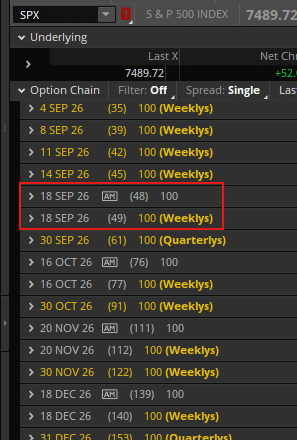
Source: ThinkOrSwim
Here we see two expirations listed for September 18th, 2026.
We also see two expirations for October 16th.
Another duplicate expiration in November.
And the same thing happens in December.
For every month, there is a duplicate expiration date.
They are not duplicates.
They are in fact different expiration option contracts.
One of them is the weekly option expiration, and the other is the monthly expiration.
In the ThinkOrSwim platform (see screenshot above), the second expiration labeled Weekly is the weekly SPX option.
That means that the other expiration (labeled AM) is the monthly SPX expiration.
The AM-settled monthly expiration is listed first because it expires earlier than the weekly contract.
Trading for the AM monthly option ends at the close of regular trading on the Thursday before the stated expiration date of Friday September 18, 2026.
The contract is then settled on Friday morning using the Special Opening Quotation which is calculated from the opening prices of all 500 stocks in the S&P 500 Index.
By contrast, the weekly SPX option continues trading throughout the expiration date on Friday September 18th.
It stops trading at the close of the regular trading session on Friday.
It settles using the official closing value of the S&P 500 Index.
Because these weekly options settle based on the afternoon market close, they are commonly referred to as PM-settled expirations.
Why Are There Not Two Expirations For SPY?
But if we were to look at the option chain for SPY (the ETF of the S&P 500), we would never see two expirations on the same date.
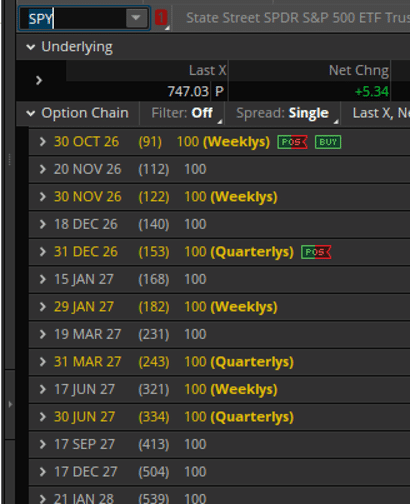
This is because SPY is an ETF which is treated the same as a stock.
In contrast, SPX is an index.
While the monthly expiration for the index option for SPX and RUT are AM-settled, stock and ETF options are always PM-settled.
Stocks and ETFs are less complicated in that whether they are monthly or weekly or quarterly expirations, nearly all equity options are PM-settled and tradable until the market closes on the expiration date (typically Friday).
If you own an option on a stock such as AAPL, MSFT, NVDA, or an option on an ETF (such as SPY, IWM, GLD, QQQ), the option’s value is determined using the stock’s closing price on expiration day.
Why Does XSP Not Have Two Expirations On The Same Date?
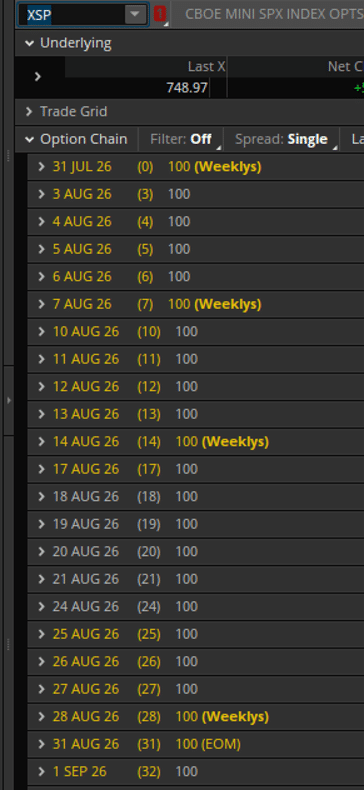
XSP is also an index product, but unlike SPX and RUT, its monthly expiration is PM-settled.
That’s because XSP never split into a separate AM product.
Why Are The VIX Index Options Expirations Always Marked As “AM”?
VIX is an index.
But it also never has two expirations on the same date.
Looking at the option chain, it is unique because every expiration of this index is AM-settled.
Also the expiration dates are typically on Wednesday rather than the typical Friday.
Because VIX is built to represent 30-day expected volatility of the S&P 500, VIX expiration is pinned to whatever date sits exactly 30 calendar days before the SPX monthly expiration.
Is There Additional Overnight Risk For AM-Settled Options?
Yes, AM-settled options can have overnight gap risk.
For an AM-settled contract like the SPX September 18th 2026 monthly expiration contract, trading stops at Thursday’s close.
But the actual settlement price isn’t set until Friday morning.
There is a 17.5-hour gap where news can break (Fed announcements, geopolitical events, overnight earnings, economic data releases at 8:30am) and Futures can move, causing the Friday opening price to be quite different from Thursday’s close.
While the market is closed, you have no way to adjust, close, or hedge your position.
In contrast, for PM-settled expirations, you can trade right up until 4:00pm on expiration day itself.
If something’s moving against you into the close, you can still exit, roll, or adjust with real-time information.
Settlement is just the final closing print.
There is no overnight risk.
Practical Implication for Iron Condor and Spread Traders
For options income traders running iron condors or credit spreads on SPX, the AM settlement risk is the primary reason most experienced traders close positions by 21 DTE rather than holding to expiration.
A position that’s comfortably profitable on Thursday afternoon can be challenged by Friday morning’s SOQ if an overnight gap occurs.
The standard discipline of closing at 21 DTE or 50% profit sidesteps this risk entirely.
You’re never exposed to the overnight window because you’ve already exited.
Traders who specifically want to hold SPX positions to expiration, including 0-DTE traders, typically use the weekly PM-settled contract precisely to maintain the ability to exit on Friday afternoon if needed.
Should I Choose Monthly Or Weekly Expirations For SPX?
For most income traders running iron condors, credit spreads, or butterflies on SPX with 30–45 DTE, the monthly AM-settled expiration is typically the better choice.
Institutional participation is highest in the monthly contracts, which keeps bid-ask spreads tighter on OTM strikes further from the money, where most income traders place their short strikes.
The AM-settlement is a risk factor at expiration, but traders who follow the standard practice of closing positions well before expiration (at 21 DTE or 50% profit) never encounter the overnight gap risk.
For 0-DTE and short-term trades (1–5 DTE), the weekly PM-settled contract is almost universally preferred.
You can trade right up until the 4pm close with full real-time information, and the settlement is clean.
No overnight gap risk, no Friday morning SOQ uncertainty.
The practical rule: if you’re a premium seller running income trades with weeks remaining, use the monthly AM.
If you’re trading 0-DTE or very short-duration, use the weekly PM.
For non-SPX underlyings such as AAPL, MSFT, SPY, QQQ the question doesn’t arise because all equity and ETF options are PM-settled regardless of whether they’re weekly or monthly contracts.
What Is The Special Opening Quotation (SOQ)?
The Special Opening Quotation is the settlement price used for AM-settled index options like the SPX monthly contract.
It is calculated using the opening prices of all 500 individual S&P 500 stocks on the Friday morning of expiration, not the opening print of the SPX index itself.
Because different stocks open at different times and prices, the SOQ can differ significantly from the SPX’s own opening value and from Thursday’s closing value.
This is why AM-settled positions carry overnight risk.
The SOQ won’t be known until all 500 stocks have opened, which can take until mid-morning.
What Does 0-DTE Mean And Which Expiration Should I Use?
0-DTE stands for zero days to expiration, or options that expire at the end of the current trading day.
For SPX 0-DTE trading, the weekly PM-settled contract is the standard choice because it allows trading until the 4pm close and settles on the closing price.
Monday, Wednesday, and Friday all have SPX expirations available for 0-DTE trading.
The AM-settled monthly contract is not suitable for 0-DTE because trading stops at Thursday’s close for a Friday AM settlement, meaning by the time you’d want to trade it as a “0-DTE,” you can no longer enter new positions.
Want to Trade SPX Options With a Systematic Income Approach?
Understanding AM vs PM settlement is the foundation — knowing which expiration to use for your specific strategy comes next.
Options Income Mastery covers the complete framework for income trading on SPX and individual stocks, including expiration selection, strike placement, and exactly when to close positions to avoid settlement risk.
Learn more about Options Income Mastery →
Summary
Stock and ETFs are always PM-settled.
When you see two expiration dates for the same date for SPX and RUT, the earlier expiration is the AM-settled Monthly expiration.
The second one is the PM-settled Weekly expiration.
XSP options only have PM-settled expirations.
VIX options only have AM-settled expirations and they are typically on Wednesdays instead of Fridays.
We hope you enjoyed this article on AM/PM monthly versus weekly options expirations.
If you have any questions, please send an email or leave a comment below.
Trade safe!
Disclaimer: The information above is for educational purposes only and should not be treated as investment advice. The strategy presented would not be suitable for investors who are not familiar with exchange traded options. Any readers interested in this strategy should do their own research and seek advice from a licensed financial adviser.