








Most iron condor traders understand the structure of the trade before they fully understand why it behaves the way it does.
They know the position makes money when the underlying stays range-bound and loses money when it moves sharply.
What’s less clear, until you’ve spent some time studying the Greeks, is the precise mechanism behind those outcomes and what the Greeks are telling you at any given point in the trade’s life.
Understanding theta, delta, and vega in the context of an iron condor isn’t academic.
It directly improves the decisions you make about when to enter, how to manage, and when to exit.
Here’s how each Greek works and how they interact as the trade develops.
Contents
Theta: The Engine of the Trade
Theta is the Greek iron condor traders care about most.
It measures how much value an option loses each day due to the passage of time alone, all else being equal.
When you sell an iron condor, you’re selling two options — a call and a put.
Each of those options has positive theta from the buyer’s perspective and negative theta from the seller’s perspective.
As the seller, theta works in your favour.
Every day that passes without a significant move in the underlying, the options you sold lose value.
Your position, which profits when the options you sold decrease in value, therefore gains from the passage of time.
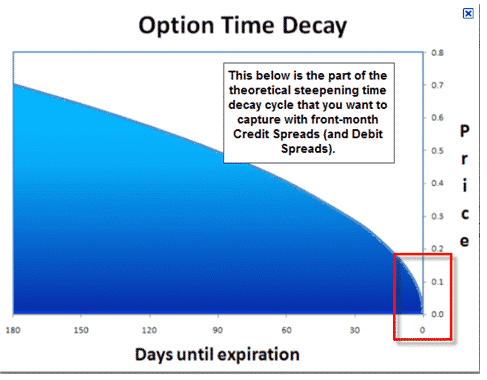
At 45 DTE, theta accrual is measurable but not dramatic.
The real acceleration happens in the final 30 days.
This is the fundamental reason the 45 DTE entry and 21 DTE exit framework exists: you’re entering before the steepest decay begins, capturing the most efficient portion of the curve, and exiting before gamma risk (more on that shortly) starts to dominate.
What theta looks like across a trade’s life:
In a 45-day iron condor, theta in the first two weeks might be modest, perhaps $5–$10 per day on a standard SPY condor.
By the time the position reaches 21 DTE, that daily decay may have increased to $15–$25 per day.
This acceleration is why many traders feel the temptation to hold past 21 DTE.
Theta is working hardest right when the rules say to close.
The discipline is recognising that gamma risk is also accelerating alongside theta, and that the additional premium collected in those final weeks rarely compensates for the additional risk carried.
Delta: Your Directional Exposure
Delta in an iron condor measures the position’s net directional sensitivity.
I.e. how much the overall position’s value changes for every $1 move in the underlying.
When you first put on a balanced iron condor at equal deltas on each side, the net position delta is close to zero.
You have no meaningful directional bias.
The position is designed to profit from time and stability, not from a move in either direction.
That zero-delta state doesn’t last.
As the underlying moves, the deltas of your short options change, and your position delta shifts accordingly.
When the underlying moves toward your short call: The call spread you sold starts to gain in value (moving against you), while the put spread you sold loses value (moving in your favour). The call side’s delta increases as it moves closer to the money. Your overall position takes on negative delta — meaning further upward moves hurt the position more.
When the underlying moves toward your short put: The reverse happens. The put spread gains value and your position takes on positive delta. Further downward moves become increasingly damaging.
This delta drift is the primary signal you’re watching when managing an iron condor.
A position that has drifted to a net delta of 10 or 15 is telling you the underlying has moved meaningfully toward the put side and the position has developed a directional skew.
That’s the point at which most experienced traders start considering adjustment or closure.
A useful rule of thumb: when your net position delta drifts beyond 10–15 deltas in either direction from zero, the trade is no longer behaving as a market-neutral position.
It’s time to actively manage rather than passively wait.
Vega: The Hidden Risk Most Beginners Underestimate
If theta is the engine of an iron condor and delta is the steering, vega is the weather.
It’s the Greek that can dramatically change the value of your position without the underlying stock moving at all.
Vega measures an option’s sensitivity to changes in implied volatility (IV).
When you sell an iron condor, you are a net seller of options and selling options means you are short vega.
A short vega position loses value when implied volatility rises and gains value when implied volatility falls.
This has significant practical implications.
Consider a scenario where the market drops 2% in a single session.
Your short put spread has moved closer to the money.
That’s bad, and you’d expect the position to show a loss.
But the loss is typically worse than the delta movement alone would suggest.
Why?
Because a sharp market move almost always comes with an IV spike.
The options you sold, which were already losing due to delta, are now also losing due to vega.
The rise in implied volatility has made them more expensive to buy back.
This double impact of delta and vega moving against you simultaneously is what makes a fast, sharp market decline so damaging to iron condors.
It’s not just that the underlying moved, it’s that the underlying moved and volatility expanded at the same time.
The positive version: When markets are calm and IV slowly drifts lower over the life of your trade, you benefit from both theta decay and vega compression. The options you sold become cheaper to close out for two independent reasons. These are the ideal conditions for an iron condor, and they’re why the trade performs best in low-to-moderate, stable markets rather than in trending or volatile ones.
Practical implication: Pay attention to IV rank before entering. High IV environments produce more premium and mean that if IV subsequently falls (which it tends to do after spikes), vega works in your favour. Entering iron condors in low IV environments means you’re short vega at a point when IV has limited room to fall further and meaningful room to rise against you. It’s a structurally weaker setup.
Gamma: The Force That Counteracts Theta
Gamma deserves a mention here because it’s the Greek most directly in tension with theta, and understanding that tension clarifies why the 21 DTE exit rule exists.
Gamma measures how quickly delta changes as the underlying moves.
High gamma means your position’s delta can shift rapidly with relatively small moves in the underlying.
Low gamma means delta changes slowly.
For an iron condor, gamma is always working against you.
The position is short gamma.
As expiration approaches and theta accelerates (a good thing), gamma also accelerates (a bad thing).
This is the fundamental trade-off of short premium strategies: the same proximity to expiration that makes theta work fastest also makes your position most sensitive to rapid directional moves.
In the final two to three weeks of a condor’s life, a position that has been stable and comfortable can shift dramatically within a single session if the underlying moves sharply.
This isn’t bad luck.
It’s gamma doing exactly what it’s supposed to do.
Understanding it means you won’t be surprised, and you’ll respect the 21 DTE exit rule not as an arbitrary guideline but as a logical response to changing position dynamics.
How the Greeks Interact Over a Typical Trade
Put the four Greeks together and you can map the lifecycle of a well-behaved iron condor:
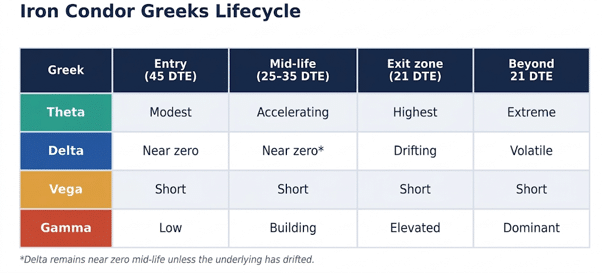
Entry (45 DTE): Net delta near zero, modest positive theta, short vega, low gamma. The position is patient. It profits slowly from time decay and benefits if IV drifts lower.
Mid-life (25–35 DTE): Theta is accelerating. If the underlying has stayed range-bound, the position is likely profitable. Delta remains near zero unless the underlying has drifted. Gamma is starting to build.
Exit zone (21 DTE): Theta is at its highest. Gamma is also elevated. The position is increasingly sensitive to sharp moves. If the 50% profit target has been reached, this is the natural exit point. If not, 21 DTE is the time-based stop.
Beyond 21 DTE: Gamma dominates. A position held here is carrying disproportionate risk relative to the remaining premium available. This is where comfortable trades can turn painful quickly.
Watching the Greeks across the life of a trade gives you real-time feedback on whether the position is behaving as expected and what the risk profile looks like at any given moment.
Most trading platforms display position Greeks live and checking them regularly is one of the simplest habits that separates disciplined iron condor traders from those who fly blind.
Want to Trade Iron Condors With a Complete Greeks-Based Framework?
Understanding how theta, delta, vega, and gamma interact is the foundation of disciplined iron condor management.
Options Income Mastery covers the complete iron condor system — from Greeks-based entry and exit rules to adjustment triggers and portfolio-level risk management.
Learn more about Options Income Mastery →
Frequently Asked Questions
Which Greek Matters Most For Iron Condors?
Theta is the primary Greek iron condor traders focus on.
It’s the source of the trade’s income as time passes.
But vega is arguably the most dangerous Greek for condor traders to underestimate.
A sharp IV expansion can cause larger losses than a comparable move in the underlying, particularly when the move and the IV spike happen together as they often do in selloffs.
Why Does An Iron Condor Lose Money When Volatility Rises, Even If The Stock Doesn’t Move Much?
Because iron condors are short vega, selling options means you benefit from falling implied volatility and are hurt by rising implied volatility.
When IV rises, the options you sold become more expensive to buy back, increasing your unrealised loss even if the underlying price hasn’t moved significantly.
This is one of the key reasons to enter condors during elevated IV environments, so that vega can work in your favour as IV normalises.
What Does It Mean When My Iron Condor’s Position Delta Drifts Negative?
A negative position delta on an iron condor means the underlying has moved toward your short call strikes.
The call side of your condor has become more valuable (more expensive to buy back), while the put side has become less valuable.
The further negative the delta, the more the position is behaving like a directional short rather than a neutral strategy.
At -10 to -15 net delta, most experienced traders consider adjustment or closure.
Why Does Gamma Increase As Expiration Approaches?
Gamma accelerates near expiration because the relationship between an option’s price and the underlying becomes increasingly binary.
The option is either in the money or it isn’t, with very little time for the market to change that outcome.
Near expiration, even a small move can flip an option from worthless to valuable very quickly, which is why position delta changes so rapidly in the final weeks.
This is the risk that the 21 DTE rule is specifically designed to sidestep.
Is It Better To Enter Iron Condors When Iv Is High Or Low?
High IV environments are significantly more favourable for iron condors.
High IV means more premium collected, strikes placed further from the current price for the same delta, and a statistical tendency for IV to mean-revert lower after spikes, which adds a vega tailwind to your theta income.
Low IV environments produce thinner premium, tighter strike placement, and a vega headwind if volatility normalises upward.
When IV rank is below 30%, many experienced condor traders reduce position size or wait for better conditions entirely.
We hope you enjoyed this article on iron condor Greeks.
If you have any questions, please send an email or leave a comment below.
Trade safe!
Related Articles:
- Iron Condors: The Ultimate Guide
- Iron Condor Strike Selection: How to Choose the Right Delta
- 30 vs 45 vs 60 DTE: Which Expiration Is Best for Iron Condors?
- When to Close an Iron Condor Early: The 21 DTE and 50% Profit Rules
- IV Rank vs IV Percentile: What They Mean and How to Use Them
Disclaimer: The information above is for educational purposes only and should not be treated as investment advice. The strategy presented would not be suitable for investors who are not familiar with exchange traded options. Any readers interested in this strategy should do their own research and seek advice from a licensed financial adviser.