







One of the first questions new iron condor traders ask, usually after the basics click into place, is which expiration to use.
You understand the structure.
You know you’re selling an out-of-the-money call spread and an out-of-the-money put spread simultaneously, collecting premium, and hoping the underlying stays inside your short strikes until expiration.
What you’re less sure about is when that expiration should be.
30 days out? 45? 60?
Does it actually matter?
It matters more than most beginners realise.
DTE (days to expiration) affects the premium you collect, the rate at which your position profits, how much time the market has to move against you, and how frequently you’re cycling through trades.
Getting this right is one of the more important structural decisions in your iron condor framework.
Let’s work through each window honestly.
Contents
- Why DTE Matters: The Theta Decay Curve
- 30 DTE: The Fast Cycle
- 45 DTE: The Industry Standard
- 60 DTE: The Longer Runway
- What I Actually Recommend
- FAQ
Why DTE Matters: The Theta Decay Curve
Before comparing the three time periods, it helps to understand what you’re actually trying to capture.
When you sell an iron condor, your primary income comes from theta decay, or the rate at which the time value of an option erodes as expiration approaches.
The relationship between time and theta isn’t linear.
Options don’t decay at a steady rate throughout their life.
They decay slowly when there’s plenty of time remaining, then accelerate as expiration approaches.
The sharpest decay happens in roughly the final 30 days of an option’s life.
This is the zone where theta works hardest for the seller.
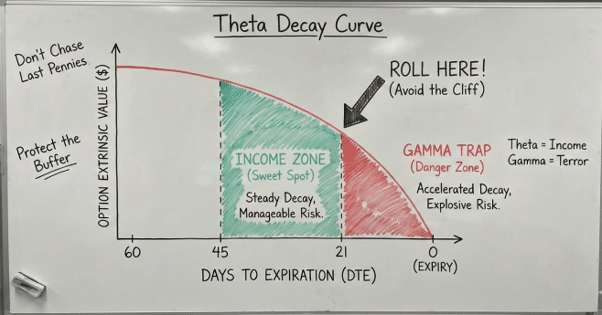
This has a direct implication for iron condor traders: the closer you are to expiration when you enter the trade, the faster the premium decays in your favour.
But closer to expiration also means less time for the trade to recover if the market moves against you early.
Further out, premium decays more slowly, but you have more cushion and more time to manage the position if needed.
Both are legitimate trade-offs.
The right DTE for you depends on how you want to balance them.
It is also worth noting that at 60 DTE, the vega exposure of the position is at its highest of the three windows.
Vega measures sensitivity to implied volatility changes, and with more time remaining, a spike or drop in IV will have a larger dollar impact on the position.
For traders entering 60-day iron condors specifically because IV is elevated, this vega sensitivity is the mechanism by which the trade profits if IV contracts: the short options lose value faster than time decay alone would produce.
Understanding this vega component is important for correctly managing 60-day positions.
One underrated aspect of the 45-day window is its compatibility with most standard brokerage platforms’ margin calculations.
Many brokers use a 30- to 45-day volatility window when calculating the buying power reduction for short options positions.
Entering at 45 DTE often aligns with these windows in a way that can keep your margin requirements relatively stable throughout the trade, compared to positions entered further out, where the margin calculation may shift more noticeably as expiration approaches.
One practical note on 30-day entries: because you’re cycling through trades more frequently, transaction costs and the bid-ask spread on entry and exit matter more.
Over twelve cycles per year, a slightly unfavourable fill on each entry or exit compounds into a meaningful drag on overall performance.
Using limit orders and being patient on fills becomes more important at higher trading frequencies.
Additionally, a 30-day trader needs a clear, predefined set of management rules from day one, since there is little margin for deliberation.
Having an adjustment trigger and an exit rule established before the trade goes on removes the emotional component from decisions that may otherwise need to be made quickly under stress.
This is one reason many traders first cut their teeth at 45 DTE and then migrate to 30 DTE once their process is established.
It also helps to think about DTE in terms of what research on options pricing has consistently shown: options tend to lose roughly one-third of their remaining time value in the last month of their life, compared to roughly two-thirds in the first two months.
This compression effect is what makes the final 30 days of an option’s life so valuable for sellers and so dangerous for buyers.
The non-linear shape of the decay curve is also why the concept of entering at 45 DTE and exiting at 21 DTE, rather than holding to expiration, has become so widely adopted: it isolates the most efficient portion of the curve while avoiding the highest-gamma period near expiry.
For iron condor traders, the practical implication is that entering at different DTE points isn’t just about collecting more or less premium.
It’s about where on that decay curve you want to spend most of your time.
A 45-day entry lets you ride through the slow early decay and then harvest the faster decay in the final three weeks, while a 30-day entry drops you directly into the fast zone from the start.
30 DTE: The Fast Cycle
Entering an iron condor with 30 days to expiration puts you right on the front edge of the steepest theta-decay zone.
You’re entering precisely when time erosion starts to accelerate most meaningfully.
The Case for 30 DTE:
The main appeal is efficiency.
You’re collecting premium that will decay relatively quickly, cycling through trades every month, and getting more at-bats per year.
Twelve full cycles of iron condors gives you more data, more experience, and theoretically more opportunities to let probability work in your favour.
Premium collected is also more responsive to current implied volatility conditions.
A 30-day option reflects the market’s near-term volatility expectation very directly, which can be an advantage when IV spikes and you want to put on a trade while conditions are favourable.
The Case against 30 DTE:
The shorter time frame is less forgiving.
If the underlying makes a significant move in the first week of a 30-day trade, you’ve used up a meaningful portion of your runway before theta has had much chance to work.
Management decisions need to be made quickly.
For newer traders who haven’t yet developed confidence in adjusting or rolling positions, 30 DTE can feel like there’s never enough time to react.
Strike selection also becomes more sensitive.
A 30-day iron condor on a high-beta stock that gaps 4% overnight can go from comfortable to threatening very quickly.
30 DTE Works Best For: Experienced traders who are comfortable with active management, traders who prefer higher trading frequency, and situations where implied volatility is elevated, and you want to capture the premium efficiently before IV mean-reverts.
45 DTE: The Industry Standard
If you’ve studied options income strategies seriously, you’ve almost certainly encountered the 45 DTE guideline.
It’s the most widely taught entry point for iron condors and credit spreads, and the data behind the recommendation is solid.
The Case for 45 DTE:
Forty-five days sits in a zone that balances premium richness with time cushion.
You’re collecting meaningful premium, while still being close enough to expiration that theta decay is working at a reasonable pace.
More importantly, 45 DTE gives you room to manage.
If the underlying moves against you in week one, you still have five to six weeks to let the trade breathe, wait for mean reversion, or make a thoughtful adjustment.
That’s a significant psychological and practical advantage, particularly for traders who are still building their management framework.
The standard practice of closing at 50% of maximum profit or at 21 DTE, whichever comes first, also pairs naturally with 45-day entries.
By targeting a 50% profit close at roughly the halfway point of the trade, you’re capturing the most efficient portion of the theta decay curve and getting out before the trade enters the final period where gamma risk (the risk of rapid delta changes) becomes more significant.
The Case against 45 DTE:
There isn’t a strong one for most traders.
The 45 DTE framework has become something of a convention for good reason.
It’s robust across different market conditions and suits a wide range of account sizes and experience levels.
The slight disadvantage is that you’re running roughly eight to nine trade cycles per year rather than twelve, and the slower theta decay in the early weeks of the trade can feel like the position isn’t doing much.
But that slower initial decay is part of what makes the trade manageable.
The position simply has more time to work and less gamma risk.
45 DTE Works Best For: Most iron condor traders at most experience levels. It’s the starting point I recommend for anyone building their condor framework, and the benchmark against which the other windows should be evaluated.
60 DTE: The Longer Runway
Moving out to 60 days to expiration is less common for iron condors, but it offers specific advantages worth understanding.
The Case for 60 DTE:
At 60 DTE, you’re collecting the most premium of the three windows, because there’s significantly more time value in the options you’re selling.
This translates to wider buffers if you’re using the premium collected to define your stop-loss thresholds, or simply more income per trade if you’re targeting a fixed strike placement.
The extended runway also provides the most generous management window.
A sharp move in week one of a 60-day trade is uncomfortable, but you still have nearly nine weeks remaining.
That’s plenty of time for the market to settle and for theta to resume eroding your position’s value.
Some traders also find that 60-day entries allow them to be more selective about their timing, waiting for elevated IV environments and then entering with confidence that they have enough time horizon to weather short-term volatility without being forced into a reactive management decision.
The ability to be patient and selective is itself an edge, and the longer runway of a 60-day position supports a more deliberate, process-driven approach to trade selection.
The Case against 60 DTE:
The premium you collect at 60 DTE decays slowly for the first few weeks.
You’re waiting longer for theta to really bite in, and if you’re using a 50% profit target as your closing trigger, it may take considerably longer to reach that level compared to a 45-day entry.
The result is that capital is tied up in the position for longer, potentially limiting your ability to put on new trades.
You’re also exposed to two full months of potential market events, such as earnings seasons, Fed meetings, and geopolitical news, versus roughly one to one-and-a-half months with a 45-day entry.
More time in the market means more opportunity for something unexpected to test your strikes.
60 DTE Works Best For: Traders who prefer a slower, more deliberate pace. Situations where you’re entering an elevated IV environment and want maximum premium cushion. Larger accounts where capital efficiency is less of a constraint.
What I Actually Recommend
For traders who are new to iron condors, 45 DTE is the right starting point.
It’s where the balance between premium richness, theta efficiency, and management room consistently works out most favourably across different market conditions.
As you build experience, experimenting with 30 DTE in high-IV environments and 60 DTE when you want a more patient, measured approach will help you develop a feel for how DTE interacts with your strike selection and management rules.
There’s no single universal answer, but there is a logical framework: match your DTE to your management style and the current volatility environment.
One final point: whichever DTE you use, closing the position before expiration is almost always preferable to letting it ride to zero.
The final weeks of an iron condor’s life introduce gamma risk that isn’t compensated by the small remaining premium.
Getting out at 50% profit and 21 DTE, regardless of whether you entered at 30, 45, or 60 days, is a discipline worth building into your process from day one.
FAQ
What Is The Best DTE For Iron Condors?
For most traders, 45 days to expiration is the best starting point.
It balances meaningful premium collection with enough time to manage the trade if the underlying moves against you early.
Traders with more experience and a preference for active management often move to 30 DTE, while those wanting a more patient, less frequent approach may prefer 60 DTE.
Should I Close My Iron Condor At 50% Profit Or Hold To Expiration?
Closing at 50% of maximum profit, or at 21 days to expiration — whichever comes first — is the standard discipline most experienced iron condor traders follow.
This captures the most efficient portion of the theta decay curve while avoiding the disproportionate gamma risk that builds in the final three weeks before expiration.
Does DTE Affect Margin Requirements On Iron Condors?
Yes, indirectly.
Many brokers use a rolling volatility window of 30–45 days when calculating buying power reductions for short options.
A 45 DTE entry often aligns well with this window, keeping margin relatively stable through the life of the trade.
Positions entered at 60 DTE may see more noticeable shifts in margin calculation as the trade approaches its final weeks.
Is A 30 DTE Iron Condor Riskier Than A 45 DTE Iron Condor?
It carries different risk characteristics rather than simply being “riskier.”
A 30 DTE condor has less time cushion if the underlying moves against you early, meaning management decisions need to happen faster.
However, it also spends less total time exposed to market risk per trade and decays more quickly if the position behaves as expected.
The overall risk depends heavily on your management discipline and how quickly you react to adverse moves.
Can I Use Different DTEs For Different Market Conditions?
Yes — and many experienced traders do exactly this.
A common approach is using 30 DTE when implied volatility is elevated and you want to capture rich premium efficiently before IV reverts to its mean, and 60 DTE when you want to be more patient and selective, particularly in lower-IV environments where you’re willing to wait for a better entry.
45 DTE remains a solid default for most other conditions.
Want a Complete Iron Condor Framework?
Choosing the right DTE is one piece of a systematic iron condor process.
Options Income Mastery covers the complete framework — strike selection, DTE, position sizing, and exact management rules — so every decision follows a process rather than a guess.
We hope you enjoyed this article on iron condor DTE selection.
If you have any questions, please send an email or leave a comment below.
Related Articles:
- Iron Condors: The Complete Guide with Examples and Strategies
- Adjusting Iron Condors: 2026 Ultimate Guide
- Best Stocks for Iron Condors
- Iron Condor Success Rate: How to Achieve an 86% Win Rate
- Trading Weekly Iron Condors for Income
Trade safe!
Disclaimer: The information above is for educational purposes only and should not be treated as investment advice. The strategy presented would not be suitable for investors who are not familiar with exchange traded options. Any readers interested in this strategy should do their own research and seek advice from a licensed financial adviser.