







If you’ve spent any time in the options education world, you’ve heard the 45 DTE rule preached as gospel.
Tastylive built much of their brand around it: enter iron condors at 45 days to expiration, exit at 21 DTE or 50% profit, repeat.
The research is real, the logic is sound, and the framework has helped countless traders.
But it isn’t the only framework, and for many traders, it isn’t the best one.
I’ve traded 90-day iron condors as my primary approach for years.
This article makes the honest case for both timeframes, so you can choose based on your trading style, risk tolerance, and how much time you can realistically commit to monitoring positions.
Contents
- The Case For 45 DTE: Why It Became The Standard
- The Case For 90 DTE: What The Longer Timeframe Offers
- Theta Efficiency: Where Each Approach Wins
- Gamma Risk: The Critical Difference
- Adjustment Room: Where 90 DTE Has A Clear Edge
- Capital Turnover: Where 45 DTE Has A Clear Edge
- Which Trader Suits Which Approach
- FAQ
- Summary
The Case For 45 DTE: Why It Became The Standard
The tastylive research into 45 DTE is legitimate.
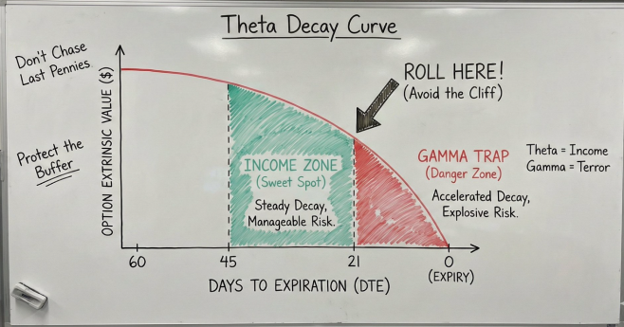
At 45 days to expiration, iron condors are in what researchers describe as the theta decay “sweet spot”, the point where daily time decay is meaningful relative to the premium collected, without the explosive gamma risk that comes with shorter-dated options.
Beyond 45 DTE, each additional day adds a diminishing marginal premium for the same strike placement.
You’re committing capital longer for proportionally less additional income.
Inside 30 DTE, theta accelerates significantly, but so does gamma, making positions more sensitive to adverse moves.
The 45 DTE entry, paired with a 21 DTE exit (when gamma risk is rising rapidly) and a 50% profit target, is a clean, systematic framework that can be executed with relatively limited monitoring.
It works well for traders who want defined, repeatable cycles with relatively fast capital turnover.
The 45 DTE condor also captures the period of most efficient premium collection per day of capital commitment, at least in terms of raw theta per dollar of risk.
The Case For 90 DTE: What The Longer Timeframe Offers
The standard critique of longer-dated condors is that the daily theta income is lower and the capital is tied up longer.
Both are true.
But they miss several things that matter significantly in practice.
More time means more buffer.
A condor entered at 90 DTE has roughly twice the time before expiration compared to one entered at 45 DTE.
If the market makes a sharp move against your short strikes in the first two weeks, a 90-day condor has 75+ days remaining for the underlying to revert.
A 45-day condor entered on the same day has only 30 days before you’re closing or adjusting under time pressure.
Lower gamma at any given price level.
Gamma, the rate of change of delta, is lower at longer expirations for the same strike placement.
This means that a $10 adverse move in the underlying produces a smaller delta shift in a 90 DTE condor than in a 45 DTE condor.
The position is less reactive to short-term market noise.
Fewer required adjustments over the same market period.
A trader running 45 DTE condors through a volatile month might find themselves adjusting or closing multiple times prematurely.
A 90 DTE condor through the same volatility may simply flex and recover without requiring intervention, exactly as illustrated in a March 2018 RUT example where a 90-day condor weathered a sharp two-day selloff that required active management in the 30-day version of the same trade.
Better for part-time traders.
Checking a 90 DTE condor once or twice a week is generally sufficient.
A 45 DTE condor in a volatile market may require daily monitoring in the later weeks when gamma is rising.
For traders who can’t monitor their positions frequently, especially those in time zones different from US markets, the 90-day timeframe is significantly more practical.
Options trading while working full-time is a real constraint for many people, and the DTE you choose should reflect that reality.
Theta Efficiency: Where Each Approach Wins
The comparison of theta efficiency is more nuanced than it first appears.
On a pure daily-theta-per-dollar-of-risk basis, 45 DTE condors win.
The premium collected per day is higher relative to capital committed at shorter expirations.
However, this comparison is somewhat misleading for two reasons.
First, a 90 DTE condor can be placed with the short strikes further from the money for the same premium target, giving you a wider buffer.
You’re not comparing the same effective risk profile.
A 45 DTE condor placed at 16 delta is not equivalent to a 90 DTE condor at 16 delta; the 90-day short strikes are further from the current price in dollar terms, providing more room for the underlying to move.
Second, when measured against annualised return, the advantage of 45 DTE narrows considerably once you account for the fact that 90 DTE condors can still be exited well before expiration (typically at 50% of max profit).
At the same time, their longer duration provides more recovery opportunity if the trade goes against you early.
Our iron condor success rate guide shows how actively managed condors, regardless of starting DTE, tend to perform better than those held mechanically to a fixed exit rule.
Gamma Risk: The Critical Difference
This is where the 90 DTE approach has its most compelling advantage, and it’s the reason many experienced income traders prefer it.
At 45 DTE, by the time you’re in the final 21 days before your planned exit, gamma is rising meaningfully.
A short strike that was at 16 delta on entry might be at 25–30 delta three weeks in if the market moves moderately against you.
At that point, each additional dollar of adverse movement produces an accelerating delta shift, and losses compound faster than they accumulate.
At 90 DTE, you have a much longer runway before gamma becomes a serious concern.
A condor entered at 90 days has the same 21 DTE gamma profile only when you’re deep into the trade, and by that point, either the trade has reached its profit target (and you’ve exited), or it’s been giving you clear signals for weeks that an adjustment is warranted.
In concrete terms: the same 5% market drawdown that might force an immediate adjustment or close on a 45 DTE condor might be entirely manageable, or even self-resolving, on a 90 DTE condor with 70+ days remaining.
The iron condor adjust or close guide explores this dynamic, but the foundational point is that more DTE means more time for mean reversion to work in your favour before gamma risk becomes acute.
Adjustment Room: Where 90 DTE Has A Clear Edge
Related to gamma, but distinct enough to deserve its own section: the practical ability to adjust a condor that’s being tested is dramatically better at 90 DTE.
When a 45 DTE condor is tested, with a short strike approaching or breaching the adjustment trigger, you typically have at most a few weeks to act.
Rolling the tested side out in time is an option, but the available expirations are limited, and the credit available for the roll diminishes quickly.
At 90 DTE, a tested condor still has ample time value in the short strikes, more available expiration dates to roll to, and the critical psychological advantage that you’re not acting under time pressure.
The decision to roll, adjust, or hold is made from a position of relative calm rather than emergency management.
This translates to better decisions.
An adjustment made with 60 days remaining is treated on different terms than the same adjustment made with 15 days remaining, with gamma climbing.
For income traders who have experienced the particular stress of managing a condor in its final two weeks, this point resonates strongly.
Capital Turnover: Where 45 DTE Has A Clear Edge
This is the main legitimate advantage of 45 DTE condors that shouldn’t be minimised.
A trader running 45 DTE condors and exiting at 21 DTE, or at 50% profit, completes approximately 8–10 trade cycles per year on each position.
A trader running 90 DTE condors and exiting at 50% profit might complete 4–6 cycles.
If annualised returns are similar on a per-trade basis, the 45 DTE approach can compound capital faster simply through more frequent turnover.
Understanding options position sizing is especially important when cycling through positions at this frequency, since each new entry represents a fresh capital commitment.
In low-volatility, benign market environments, where condors rarely get tested and the 45 DTE timeframe works smoothly, this turnover advantage is real and meaningful.
The question is whether the annualised return advantage holds up once you account for the higher adjustment frequency and the occasional forced close that comes with shorter-dated condors in choppy or trending markets.
Tracking the volatility risk premium across different market regimes helps clarify when 45 DTE is genuinely delivering on its turnover promise and when it’s simply generating more transaction costs.
For traders who are disciplined, systematic, and actively monitoring positions, 45 DTE can generate slightly better annualised returns in favourable conditions.
For traders who are less active or who trade through periods of genuine volatility, the 90 DTE approach typically produces better risk-adjusted outcomes.
Which Trader Suits Which Approach
45 DTE works best for:
- Traders who can monitor positions daily, particularly in the final three weeks
- Traders in US time zones who have convenient access during market hours
- Traders who want faster capital turnover and are comfortable with higher adjustment frequency
- Relatively calm, low-volatility market environments
90 DTE works best for:
- Part-time traders or those who can only check positions a few times per week
- Traders in non-US time zones who can’t easily monitor the final weeks of a 45 DTE trade
- Traders who prefer fewer adjustments and more recovery time when positions are tested
- Traders managing multiple positions simultaneously who need lower per-position attention
Neither approach is objectively superior.
The best DTE for you is the one that matches your monitoring capacity, your psychological comfort with position management, and your market environment, not the one some research framework labelled “optimal.”
For a broader view of how DTE choice fits into a complete options income portfolio, consider how each timeframe interacts with your other open positions and your overall risk exposure.
FAQ
Q: Does the Tastylive 45 DTE research prove that the approach is better?
The research shows 45 DTE is optimal within their specific framework (16 delta strikes, 50% profit target, 21 DTE exit, undefined-risk strangles on liquid underlyings).
It’s well-constructed data for that setup.
It doesn’t address the risk-adjusted comparison with longer DTE approaches under volatile conditions, or the practical monitoring requirements for traders who aren’t watching positions daily.
Q: Can I use 60 DTE as a middle ground?
Yes, and many traders do.
60 DTE captures most of the advantages of 90 DTE while maintaining somewhat faster capital turnover than 90 DTE.
It’s a reasonable middle ground if neither extreme feels right for your style.
Q: Does longer DTE mean I should place my strikes further out?
Not necessarily, but you can, and often should.
The wider expected move at 90 DTE means you can maintain a similar percentage distance from the strikes while still collecting a reasonable premium.
Many 90 DTE traders place strikes slightly further out of the money than they would at 45 DTE, accepting a somewhat lower credit in exchange for an even wider buffer.
Q: Does the 21 DTE exit rule apply to 90 DTE condors too?
The spirit of the rule is that you want to close, or be very close to closing, before gamma risk becomes significant.
But for a 90 DTE condor, the comparable checkpoint is more like 45–30 DTE remaining, not 21.
At 21 DTE, a 90-day condor that started at 90 DTE is still within a reasonable management window.
A 45-day condor at 21 DTE is deep into its risk period.
Understanding the risk management principles of options helps clarify why this exit timing matters so much, regardless of the timeframe you trade.
Summary
The 45 DTE framework is well-researched, systematic, and effective for traders who can actively monitor positions.
It optimises for theta efficiency and capital turnover, and it’s the right default for traders running systematic, well-monitored income portfolios.
The 90 DTE approach trades some theta efficiency for meaningfully more adjustment room, lower gamma sensitivity, and reduced monitoring requirements.
For part-time traders, those in inconvenient time zones, or those managing larger portfolios with multiple open positions simultaneously, it’s often the better practical choice, even if the raw per-day theta numbers look less impressive.
The tastylive framework built its 45 DTE narrative around systematic, full-time trading of liquid underlyings.
That’s not everyone’s situation.
The best DTE is the one you can manage consistently and confidently, and sometimes that’s 90 days.
If you’re serious about building an income-generating options portfolio:
Options Income Mastery: Learn the complete wheel strategy including covered calls, cash-secured puts, position sizing, and adjustment techniques for consistent monthly cash flow ($397)
The Accelerator Program: Advanced training covering portfolio-level management, multiple income strategies, systematic approaches, and professional risk management techniques for serious traders ($997)
Related Articles
Iron condors: The complete guide
Iron condor: When to adjust vs when to close
Iron condor success rate: Backtest results
No stress iron condor trade example
Trading iron condors in a low volatility environment
Options Greeks for income traders
How to build an options income portfolio from scratch
We hope you enjoyed this article on 45-DTE vs 90-DTE iron condors.
If you have any questions, send an email or leave a comment below.
Trade safe!
Disclaimer: The information above is for educational purposes only and should not be treated as investment advice. The strategy presented would not be suitable for investors who are not familiar with exchange traded options. Any readers interested in this strategy should do their own research and seek advice from a licensed financial adviser.





You’ve made some good points about the premium available at 90 days versus 45 days. I’ve tried trading 45DTE Iron Condors in a small account with very narrow wings ($300 or less max loss) and they don’t pan out; the strikes are too close to money (typically 30 delta), and the net premium is so small that the losers (and the loss frequency is high) out run the winners. I’ll take a look at the 16 delta/90 day combination to see if I can get better premiums on narrow wings. One thing I’ve learned is don’t trade PUT credit spreads; if I’m going to sell PUTs, just sell cash-secured PUTs as the long position has been killing the profit. In two years of trying to trade these, I broke even. I expect the same applies to Iron Condors and Tom Sosnoff’s favorite trade is the straddle; given the profit improvement from dropping the long positions in the Iron Condor I can see why he can get strikes further from the money and improve success, but he has to be able to take the larger risk. It’s looking like options are not for small accounts.
Hi Jeff, thanks for your comment, very interesting to hear your experience. Yes, it’s true, options are a bit easier if you have a large account.
Definitely try the 15-16 Delta though, that might make a difference. Put Credit Spreads on quality companies around that delta have a very good success rate in my experience.