





A long option straddle consists of buying an ATM (at-the-money) call and an ATM put with the same strike and expiration.
A long straddle profits when a stock makes a large move in either direction.
The challenge is that options are priced to reflect expected volatility, so the move needs to be bigger than the market already anticipates.
Here’s how that plays out.
- Rapid time decay (theta) eroding the position’s value over time
- Requirement for a significant price movement beyond the market’s expected move to achieve profitability
- Sensitivity to implied volatility (vega), where a volatility crush can harm the trade even if the price moves
The straddle will profit if the underlying makes a big enough move that would overcome these challenges.
Contents
Long Straddle Example
Suppose a trader buys the following straddle on United Health Care (UNH) that expires in about two weeks.
Date: Sept 16, 2026
Price: UNH at $379
Buy one contract Oct 2nd UNH $380 call @ $9.60
Buy one contract Oct 2nd UNH $380 put @ $9.70
Net Debit: $1930
The upper break-even is $380 + $19.30 = $399.30.
The lower break-even is $380 – $19.30 = $360.70.
UNH needs to move more than 5.1% in either direction to profit at expiration.
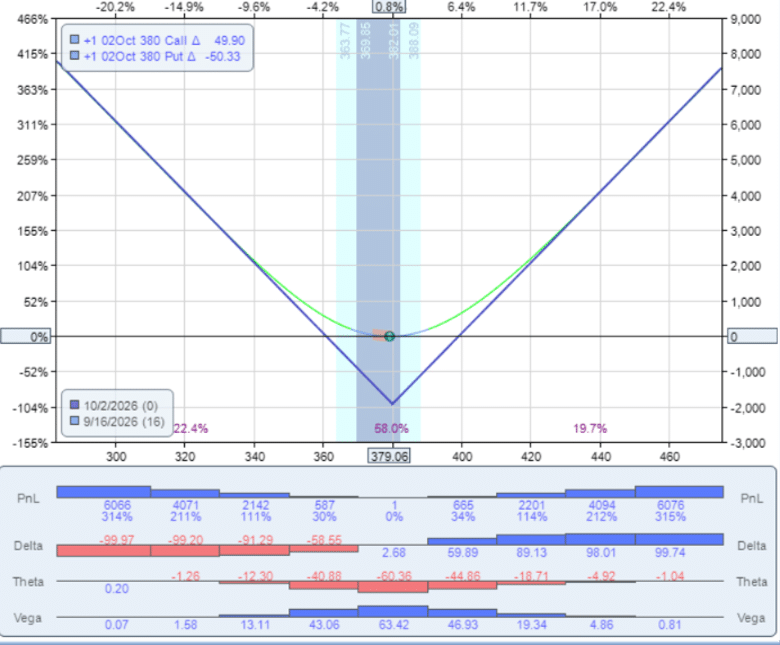
We see that the long straddle is delta-neutral.
It doesn’t have a preference as to whether the stock goes up or down, as long as it makes a big move.
We see that it also has negative theta.
According to the histogram, it is losing $60 per day in time decay.
This is the combined effect of holding a long call and a long put option.
Option contracts lose value as they approach expiration.
Paying a total debit of $1930 for the straddle, this will be the trader’s max potential loss at expiration.
Before entering the trade, the trader establishes a predefined mental stop-loss: if the position declines by 50% of its initial capital, the trader will exit the trade, in this case, that would be when P&L drops to -$965.
Tracking the P&L over each trading day into the trade…
Day 1: -$100
Day 2: -$110
Day 3: -$275
Day 4: -$415
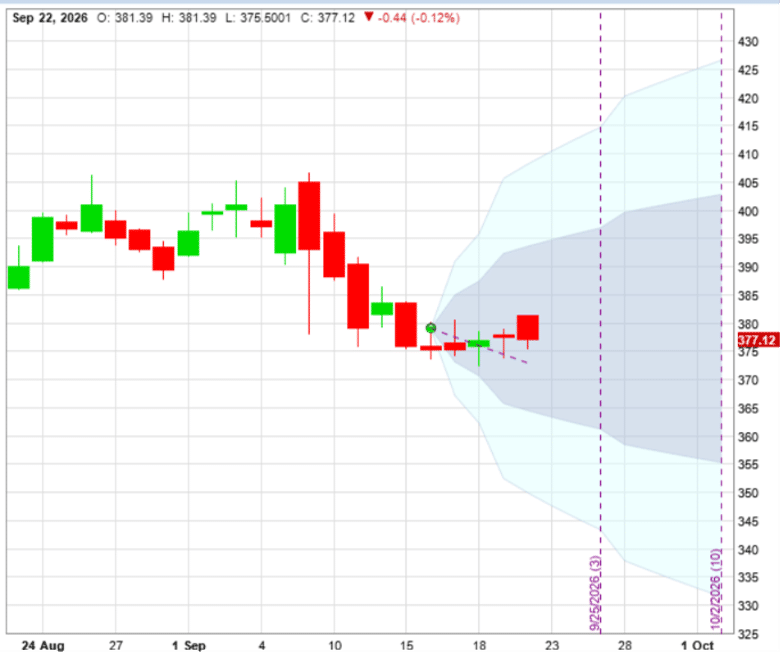
After four trading days into the trade, the P&L is down 20% due to time decay and the stock has not moved…
Source: OptionNet Explorer
Day 5: -$310
The next day, the stock made a down move and the straddle recovered some of its losses.
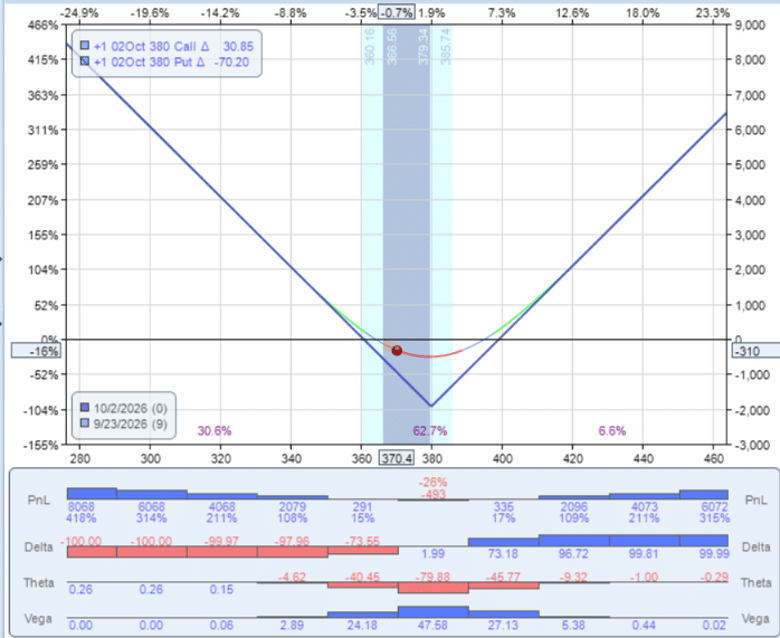
Yet the move was not large enough to overcome the losses that time had already eroded away.
Day 6: -$497
The trade is half-way through its duration with 8 days till expiration.
Some traders may call it quits here and exit the trade.
But let’s continue till the mental stop-loss is hit.
There is still a chance UNH might recover.
Day 7: -$532
Day 8: -$650
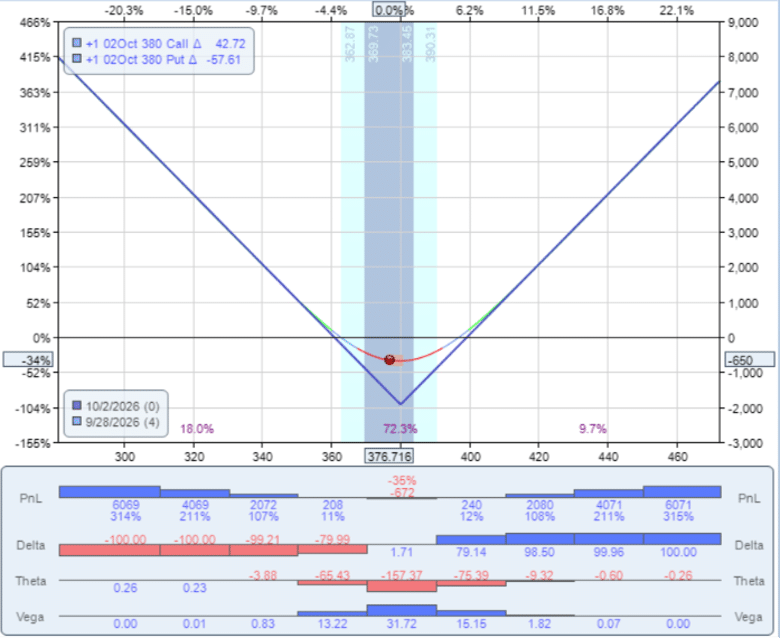
Note that negative theta is ramping up as it nears expiration.
Theta is eroding the P&L at $157 per day now.
Day 9: -$657
The trade is getting stressful for the trader, as the trader has not seen a positive P&L in the trade yet.
And there is only 4 days till expiration.
Day 10: -$509
Day 11: -$263
One day before expiration, P&L has recovered a bit (down only $263 now) because stock is making a down move and volatility has increased (see the black line)…
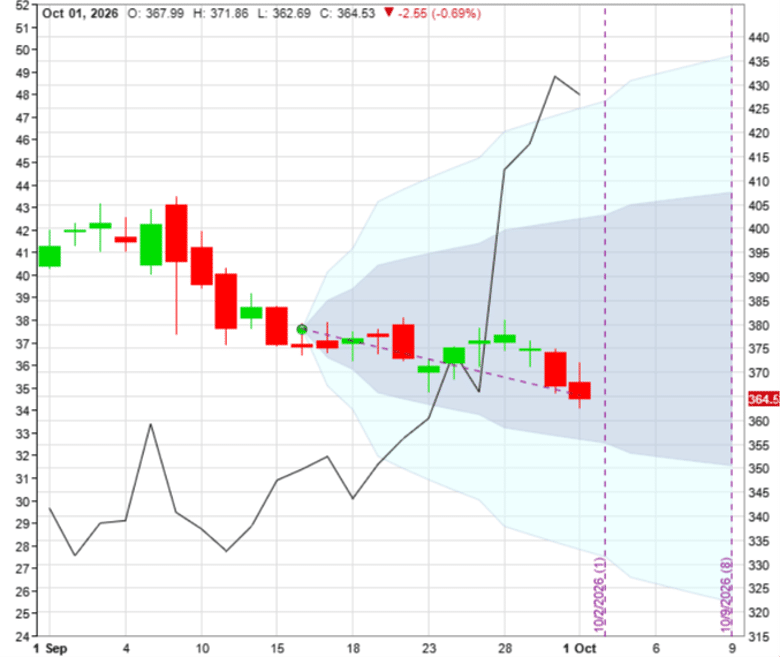
Some traders may exit here instead of gambling to see what happens on expiration day.
Day 12 is expiration day.
In the morning the P&L is showing -$583.
Holding till expiration at the end of the day, UNH closed at $371.90 and the P&L is -$1120.
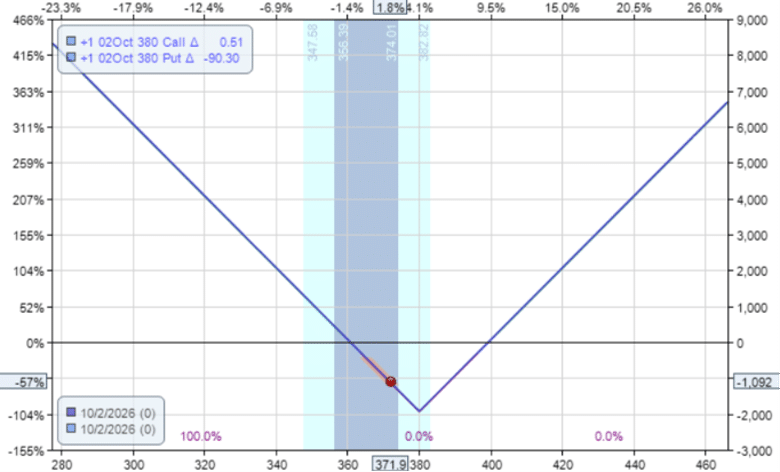
Although the mental stop-loss was not reached during the morning session, by the afternoon, the P&L had deteriorated well beyond the predefined stop-loss level.
This illustrates how dramatically P&L can fluctuate as a trade approaches expiration.
For this reason, some traders use a time-based stop, exiting the position at a predetermined time before expiration to avoid the increasingly rapid P&L swings associated with near-expiration options.
What Happens At Expiration
At expiration, the call option expired worthless because stock price is below its strike price – out-of-the-money call option.
The put option made money because the stock price is below its strike price of $380 – in the money put option.
If held to expiration, the broker auto-exercises the in-the-money put.
The trader ends up short 100 shares of UNH at $380.
Most traders avoid this by closing the position before expiration day.
To unwind his short position, the trader needs to buy back 100 shares of UNH on Monday morning.
Assuming the price of UNH remains unchanged at $371.90 on Monday morning, the P&L for the trader would be:
Initial cost of straddle: -$1930
Sell 100 shares of UNH at $380: $38,000.
Buy 100 share of UNH at $371.90: -$37190
Net P&L: -$1930 + $38,000 – $37,190 = -$1120
When Does A Long Straddle Work Best?
Straddles work best when you expect a large move that the market has underpriced.
Common setups include buying before earnings when IV is low relative to historical post-earnings moves.
The key is entering when implied volatility is low, not after it has already risen
Conclusion
The market’s option-implied expected move is generally designed to represent roughly a 1-standard-deviation range, so statistically you’d expect the stock to finish inside that range about 68% of the time.
The price of the straddle is priced such that it would break-even if the stock reaches its expected move.
By purchasing a straddle, the trader is essentially betting that the stock’s realized movement will exceed the level of volatility already priced into the options.
In this example, we see the candlestick movement of UNH stayed with the shaded gray cone of its one-standard deviation expected move throughout the whole trade…
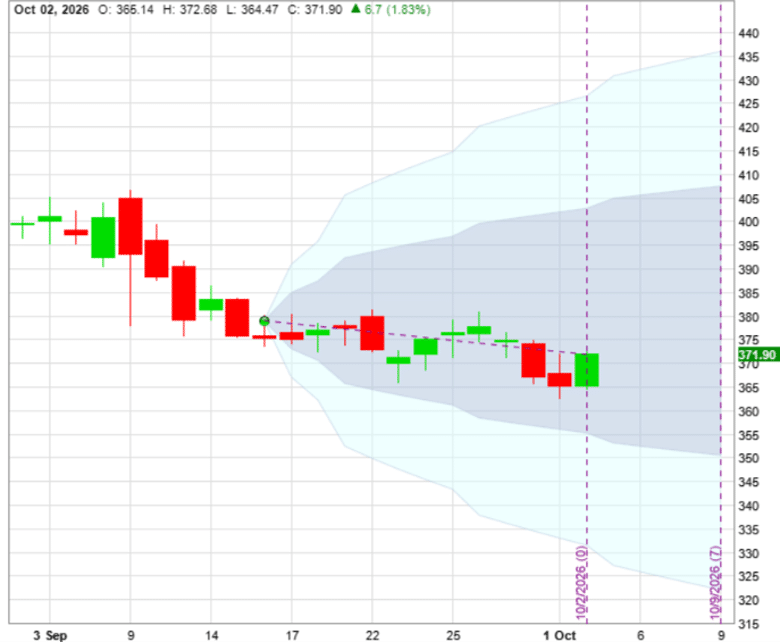
And hence we did not see a single positive P&L day throughout this trade.
If the underlying makes a move significantly larger than the market’s expected move, the straddle can certainly be profitable.
However, for large-cap stocks, ETFs, and broad-market indices, price movements tend to remain within their expected-move range much of the time.
As a result, a long straddle will often fail to generate enough movement to overcome the premium paid for both options.
We hope you enjoyed this article on the long straddle.
If you have any questions, please send an email or leave a comment below.
Trade safe!
Disclaimer: The information above is for educational purposes only and should not be treated as investment advice. The strategy presented would not be suitable for investors who are not familiar with exchange traded options. Any readers interested in this strategy should do their own research and seek advice from a licensed financial adviser.