






A put option credit spread gives you money at the start of the trade.
Similarly, a call option credit spread gives you money upfront.
By structuring the two spreads with the same strikes, we have a box spread.
The market never gives you something for nothing.
So what do you have to pay?
At expiration of the options, you will end up paying the “interest” on that money that the market gave you upfront.
Therefore, it is as if the market is lending you money with a slight cost.
The reverse is true.
You can lend the market money and get some “interest” in return.
We will look at how box spreads can act like a synthetic loan in more detail.
Contents
- Box Spread Where You Are The Borrower
- What Happens At Expiration
- Box Spread Where You Are The Lender
- Comparing With BIL
- Comparing With BOXX
- What Can Go Wrong?
- FAQ
- Conclusion
Box Spread Where You Are The Borrower
In this scenario, we get credit upfront.
Hence we will be constructing a box spread with two credit spreads: a bull put credit spread and a bear call credit spread.
It is important to do this only on indices like SPX, XSP, or RUT where the asset is cash-settled at expiration and is not subject to early assignment.
Do not do this on assets such as SPY, and other stocks or ETFs, which are subject to early assignment.
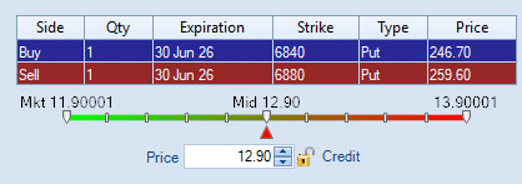
Suppose we have an at-the-money put credit spread on SPX started on January 2nd, 2026:
Date: Jan 2, 2026
SPX @ $6864
Source: OptionNet Explorer
The net credit received for this credit spread is $1290.
This credit spread expires 6 months out on June 30th, 2026.
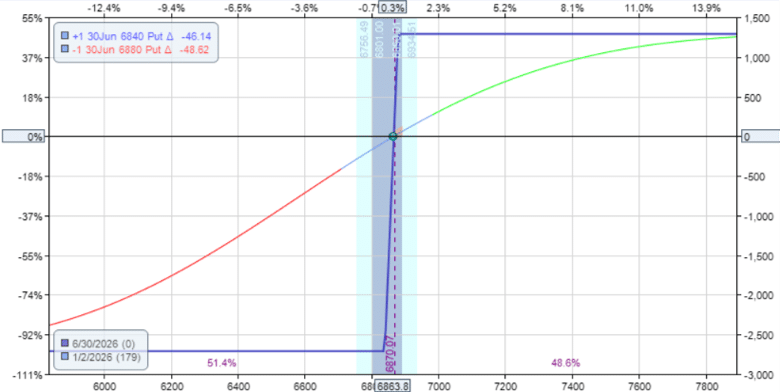
And here is its risk graph:
Next we have a call credit spread with the same strikes and expirations initiated at the same time.
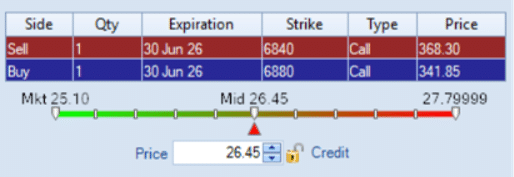
The credit received for this spread is $2645.
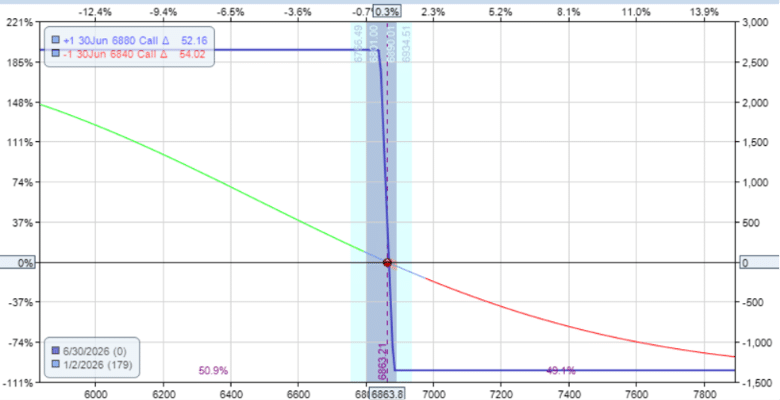
It doesn’t matter that this spread got more credit than the other spread.
The net credit when we combine the two spreads is a box spread for total credit of $3935.
When we combine the risk graph of both credit spreads, we get a flat blue horizontal expiration graph.
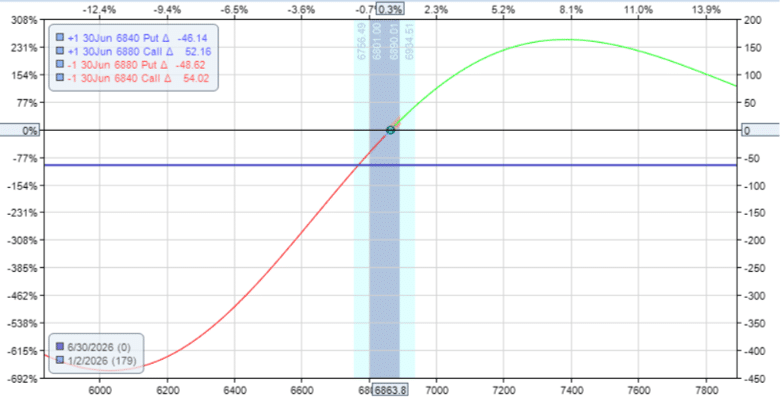
The curvy T+0 line can go up and down which means the box spread can show profits and losses throughout the duration of the trade.
However, at expiration, the P&L will be determined by the blue expiration line.
Regardless of where SPX price ends at expiration, the P&L of the box spread will be -$65 at expiration, because the blue line is $65 below the zero profit horizontal throughout all SPX prices.
What Happens At Expiration
At the end of the session on June 30, 2026, all the options in the box spread expired.
In our example, SPX ended up at $7499.
So the bull put credit spread had max profit.
The bear call credit spread had its max loss.
The bull put credit spread expired out-of-the-money worthless.
The bear call credit spread is in-the-money with the short call option strike at $6840 and the long call strike at $6800.
The investor must pay the difference of the width of the call spread, in this case $40 per share:
$6800 – $6840 = $40
Which means $4000 per contract.
On June 30th, $4000 was debited from the account.
The investor got credit of $3935 on Jan 2nd.
And then paid back $4000 on June $30th.
That is a loss of $65, exactly as the expiration graph of the box spread had predicted.
It is not a prediction.
It is a mathematical certainty that the investor can know beforehand at the start of the trade.
In effect, the market lent the investor $3935 cash for a duration of 6 months.
The investor paid back that loan plus $65 extra for “interest”.
It is not really interest.
But you can think of it as that.
Because it tends to be close to the risk-free rate of return.
The investor paid 3.3% annual rate for getting this credit upfront.
$65 / $3935 = 1.65% for half year = 3.3% annualized.
If we use the U.S. 10-year Treasury yield as a proxy for the risk-free rate of return…
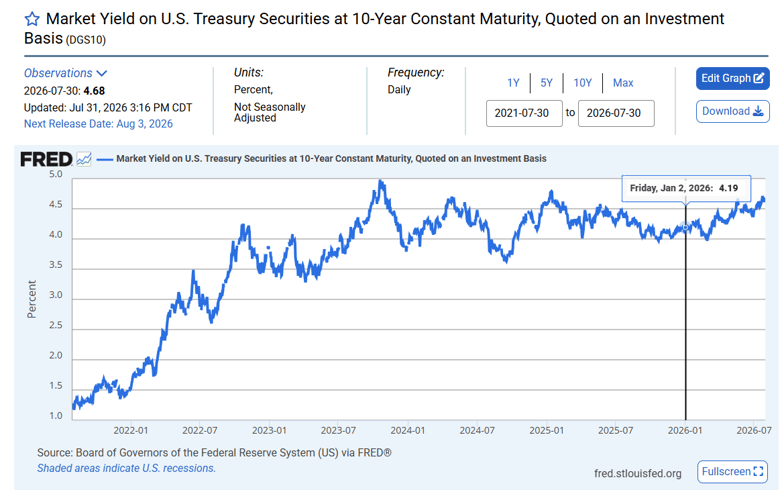
Source: FRED
The investor’s 3.3% rate of borrowing is a good rate, because it is just slightly less than the 4.19% risk-free rate at the time the box spread was initiated.
Box Spread Where You Are The Lender
Now another investor may have too much cash on hand and would like to make some money with that cash.
This investor buys two debit spreads on Jan 2nd, 2026 for the same expiration and the same strikes as in the first example.
A bear put debit spread combined with an equally opposing bull call debit spread also creates a box spread.
This time the investor pays cash upfront to establish the position.
The bear put debit spread cost the investor $1290:
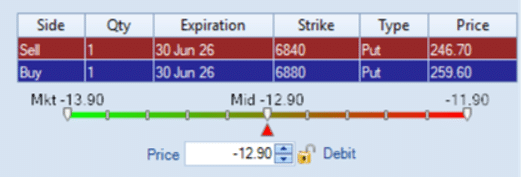
The bull call debit spread cost the investor $2645:
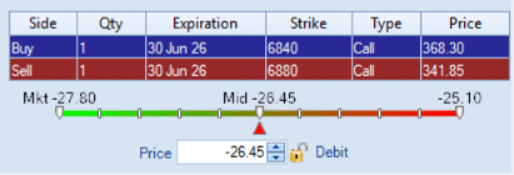
The combined is the long box spread which costs a total of $3935.
Here is its risk graph.
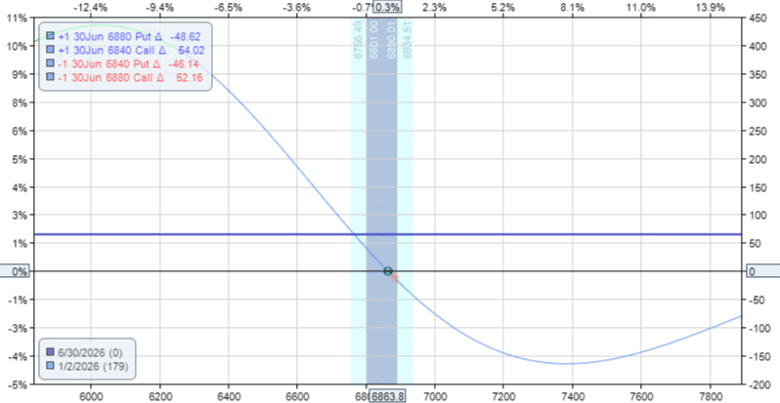
This is known as a long box spread, because when you buy things you are going long.
The previous example was a short box spread, because the investor got a credit (usually from selling something).
At expiration, the box settles for its fixed value, which is slightly greater than what the investor paid.
This relationship only exists when interest rates are positive.
If interest rates were zero, there would be essentially no difference between the present value of the box and its expiration value.
The investor got back his initial $3935 debit plus an additional $65.
That profit represents the implied interest earned on the loan.
In this case, the investor is lending money to the market.
The investor knows this beforehand at the start of the trade, because he knows that one of the debit spreads will be at max profit and the other debit spread will become worthless.
The max profit is the width of the spread.
$40 width = $4000 max profit
So he knows from the start that he will be receiving $4000 at expiration regardless of where SPX ends up.
Any amount less than $4000 that he had paid to get into the trade is his profit.
In this case, it is $65 representing a 3.3% annualized return on investment.
Comparing With BIL
Could the investor have made a better return buying the US Treasury Bill ETF (symbol BIL) instead?
The investor buys 43 shares of BIL on Jan 2nd, 2026 at price of $91.42 per share – a total investment of $3931.
On June 30th, he sells the 43 shares for $91.64 – a profit of $9.46 ($0.22 x 43) from the price appreciation.
But during that duration, he received dividends of…
Feb: $0.274 x 43 = $11.782
March: $0.243 x 43 = $10.449
April: $0.264 x 43 = $11.352
May: $0.27 x 43 = $11.61
June: $0.269 x 43 = $11.567
Net dividends: $56.76
Net profits: $66.22
The profits from BIL are very close to the returns of the $65 profit from the box spread.
This attests to the fact that box spreads generate returns similar to that of the U.S. Treasuries.
Comparing With BOXX
The Alpha Architect 1-3 Month Box ETF (ticker symbol BOXX) employs box spreads to generate income.
Suppose the investor invested the same amount by buying 34.2 shares of BOXX during that same period.
Starting with $115.11 per share, it ended at $117.09, giving a profit of $67.71.
Again, very similar to the $65 profit.
What Can Go Wrong?
Always construct box spreads with cash-settled European-style options such as SPX, XSP, or RUT.
These cannot be exercised early, which guarantees the box holds together until expiration.
Never use American-style options such as SPY or individual stocks for a box spread.
If one leg is assigned early, the box breaks and you are left with an unintended long or short stock position with its full market risk and margin requirements.
This scenario has caused significant losses for traders who constructed box spreads on American-style underlyings.
A well-documented case on social media describes a trader who entered a large SPY box spread and was early-assigned on one side.
The resulting stock position caused losses that exceeded his entire account value.
This is not a theoretical risk.
It happens, and it has happened to experienced traders who understood the mechanics but used the wrong underlying.
Other execution risks to be aware of:
- Closing one leg accidentally — this breaks the box and leaves you with an unintended net position
- Entering mismatched strikes or expirations — the box only works when all four legs share the same strikes and expiration
- Partial fills — if one spread fills but the other doesn’t, you have a naked credit spread rather than a box
Given these risks, box spreads are best suited to traders who are comfortable with multi-leg order entry and have verified all four legs before submitting the order.
How Box Spreads Fit Into a Broader Options Portfolio
For most options income traders, the box spread is not a core strategy — it’s a tool worth understanding for two specific situations.
First, as a cash management vehicle: if you have significant idle cash in your trading account, a long box spread on SPX can generate Treasury-equivalent returns without moving the money out of your brokerage.
This keeps capital accessible for margin requirements and new position entries while still earning a return.
Second, as a buying power tool: a short box spread can temporarily free up buying power in a margin account at implied rates close to the risk-free rate — often cheaper than paying the broker’s standard margin interest rate.
This is an advanced technique and requires verifying your broker’s margining treatment of box spreads before using it.
For traders interested in other strategies that use idle cash productively, see our guide on 100% buffered ETFs as a place to hold idle cash and selling long-term puts for income.
Want to Build a Complete Options Income Portfolio?
The box spread is one of many advanced tools available to systematic options traders.
Options Income Mastery covers the core income strategies — iron condors, credit spreads, the wheel, and covered calls — with the exact entry rules, position sizing, and management discipline that makes income trading consistent over time.
Learn more about Options Income Mastery →
FAQ
What Is A Box Spread In Options Trading?
A box spread is a four-legged options strategy that combines a bull put credit spread and a bear call credit spread (or a bear put debit spread and a bull call debit spread) at the same strikes and expiration.
The resulting position has a fixed, predetermined P&L at expiration regardless of where the underlying closes.
It is essentially a risk-free arbitrage structure that mimics the economics of a loan — either borrowing from the market (short box) or lending to the market (long box).
Why Does A Box Spread Have A Guaranteed Outcome At Expiration?
Because the four legs are constructed so that one spread will always be at maximum profit and the other will always be at maximum loss — and those two outcomes exactly offset each other except for a small difference equal to the implied interest rate.
At any price above the upper strike, the call spread is at max loss and the put spread is at max profit.
At any price below the lower strike, the reverse is true.
In between, one spread partially offsets the other.
The mathematics always resolves to the same fixed P&L.
What Is The Difference Between A Short Box And A Long Box Spread?
A short box spread is constructed with two credit spreads — you receive cash upfront and repay slightly more at expiration.
You are the borrower.
A long box spread is constructed with two debit spreads — you pay cash upfront and receive slightly more back at expiration.
You are the lender.
Both generate the same implied interest rate; the only difference is which direction the cash flows.
Can I Use A Box Spread To Access Cash In My Brokerage Account?
Yes — this is one of the practical applications of the short box spread.
By entering a short box, you receive a credit that can be used as available buying power within your account.
This is sometimes used by traders to effectively “borrow” from their brokerage at implied rates close to the risk-free rate, rather than paying margin interest rates which are typically higher.
However, this only works if your broker recognises the box spread as a defined-risk position and doesn’t margin it as two separate credit spreads.
Verify with your broker before attempting this.
Is A Box Spread Better Than Buying BIL Or BOXX?
For most investors, BIL and BOXX are simpler and carry less execution risk.
As the article demonstrates, the returns are nearly identical — a BIL position returned $66.22 versus $65 for the equivalent box spread over the same period.
The box spread requires precise multi-leg execution on four options simultaneously, carries early assignment risk on American-style underlyings, and can break if any leg is accidentally closed.
Unless you have a specific reason to use the box structure (such as borrowing rather than lending), ETF alternatives like BIL or BOXX are more practical for most traders.
Why Must Box Spreads Use European-Style Options?
European-style options can only be exercised at expiration — not before.
This means the box spread structure is guaranteed to hold together until the expiration date, ensuring the predetermined P&L outcome.
American-style options (stocks, ETFs like SPY) can be exercised at any time before expiration, which means one leg of the box can be assigned early — breaking the structure and leaving an unintended position with undefined risk.
Conclusion
Given that the results of BIL and BOXX are similar – if not slightly better – than implementing the box spread itself, there is little advantage for an investor to construct the box spread solely to generate income.
There is the risk of an execution error.
The box can break if the investor accidentally closes a part of the box, enters wrong strikes or expirations, or gets early-assigned on a short option when used on the wrong underlying.
However, using a box spread as a synthetic loan can be more interesting.
Instead of seeking income, the trader is borrowing money from the options market at an implied interest rate that is often close to the prevailing risk-free rate.
For most investors, the true value of a box spread lies not as an income-producing investment, but potentially as a low-cost financing tool for traders who understand its mechanics and risks.
We hope you enjoyed this article on using the option box spread as a synthetic loan.
If you have any questions, please send an email or leave a comment below.
Trade safe!
Disclaimer: The information above is for educational purposes only and should not be treated as investment advice. The strategy presented would not be suitable for investors who are not familiar with exchange traded options. Any readers interested in this strategy should do their own research and seek advice from a licensed financial adviser.