





Many investors keep a portion of their portfolio in cash that is intentionally not exposed to stock market risk.
The purpose of this cash allocation is to preserve capital so that it remains available regardless of what the market does.
Traditionally, investors place this money in short-term United States Treasury securities or Treasury exchange-traded funds such as BIL, SGOV, or SHV.
These investments are considered among the lowest-risk investments available because they are backed by the United States government.
At the time of writing, they yield approximately 3.7% annually.
Another potential place to hold idle cash is a 100% Buffered ETF.
When held for an entire outcome period, these funds are designed to protect against market losses while providing the opportunity returns greater than what U.S. Treasuries can provide.
The trade-off is that its returns are capped and it risks returning nothing at all.
Contents
- What Are 100% Buffered Etfs?
- Temporary Losses During The Outcome Period
- Different Levels Of Buffer Protection
- Buying In The Middle Of An Outcome Period
- Do You Have To Sell At The End Of The Outcome Period?
- How A Fund Will Perform
- Are Risk-Free Investments Possible?
- FAQ
- Conclusion
What are 100% Buffered ETFs?
As an example, consider the Innovator Equity Defined Protection ETF with the ticker symbol JAJL.
The most important concept to understand is the fund’s outcome period.
Every buffered ETF has a defined period during which its stated protection and return cap apply.
For JAJL, one outcome period began on January 1, 2026, and ended on June 30, 2026.
The ticker name reflects this schedule: JA represents the January start date, while JL indicates that the next outcome period begins in July.
If an investor purchases shares at the beginning of the outcome period and holds them until the end of the outcome period, the fund is designed to not have any losses excluding fees and expenses.
As stated in its prospectus, this protection is not a guarantee.
Outside of extraordinary events, it is a fair assumption that in most cases the fund will do properly what it was designed to do.
In exchange for this downside protection, the investor gives up any gains above a predetermined return cap.
For the outcome period mentioned, the cap is 3.3% for the six month period.
That is equivalent to a 6.6% annualized return in the best case scenario.
Temporary Losses During The Outcome Period
The zero loss only applies when held through to the end of the outcome period.
The funds NAV can fluctuate throughout that period and can dip below its starting price.
For example, JAJL opened the outcome period at approximately $29.14 per share.
During the period, it traded as low as approximately $28.95.
An investor who sold at that point would have realized a loss.
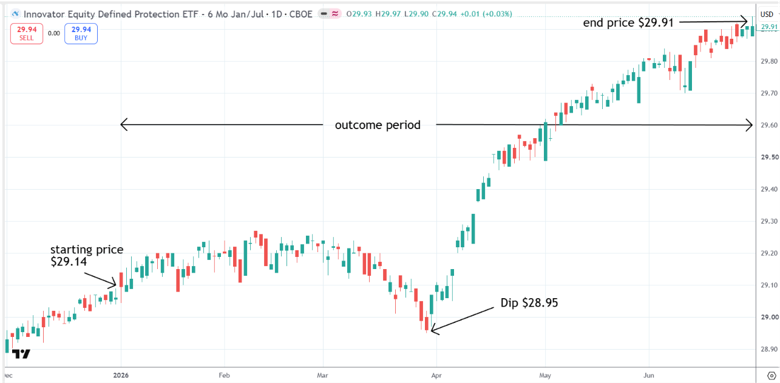
However, an investor who continued holding through the end of the outcome period would have zero losses.
In this case, the fund ended at $29.91, giving the investor an 2.6% return over a six-month period.
($29.91 – $29.14) / $29.14 = 2.6% return over a six-month period
This would be 5.2% annualized, which is better than what U.S. Treasuries could provide.
Different Levels Of Buffer Protection
The Buffer Level is the amount of loss the ETF is designed to mitigate.
There are funds of varying buffer levels such as 10%, 20%, 30%, 100%, etc.
While the JAJL provides 100% downside protection, a 20% Buffered ETF would provide protection against the first 20% of losses.
After that the fund can still lose up to 80% of its value.
Likewise, outcome periods vary.
Depending on the fund, they may last six months, one year, two years, or other defined periods.
Buying In The Middle Of An Outcome Period
Like any exchange-traded fund, buffered ETFs can be bought or sold on any trading day.
So when an investor sees that JAJL on March 30 had dropped below its outcome period start price, the savvy investor may buy shares or add more shares at the lower price, expecting that the shares will recover toward the defined outcome price.
Conversely, buying or selling at the wrong time in the middle of the outcome period could have a less favorable effect.
In general, investors buying or exiting in the middle of the outcome period should understand that their actual buffer and return cap will differ from those published at the start of the period.
Do You Have To Sell At The End Of The Outcome Period?
No.
An investor may continue holding the shares after the outcome period ends.
A new outcome period begins immediately, with a newly established downside buffer and a newly determined return cap.
For example, the next JAJL outcome period began on July 1, 2026 and will end on December 31, 2026.
Its return cap is 4.10%, which can be different from the previous six-month period.
The investor can also exit the fund at any time.
If the fund shows a return close to its cap, an investor may exit early instead of tying up capital in the fund waiting for the outcome period to end.
How A Fund Will Perform
How well the fund performs will depend on its reference asset.
The reference asset for JAJL is SPY (S&P 500).
Other funds can have reference assets of Russell, Nasdaq, or other.
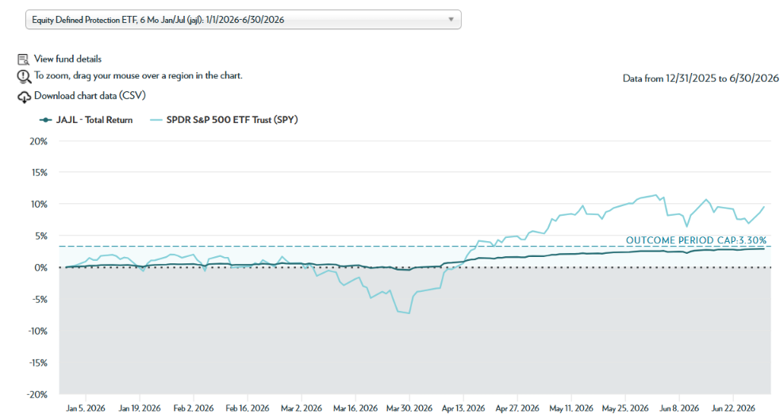
Innovator’s performance charts also show that JAJL generally follows the direction of the S&P 500 but with much smaller drawdowns and a capped upside.
Source: innovatoretfs.com
The cyan line is the S&P 500 returns.
The dark blue line is the JAJL return.
The S&P 500 may experience significantly larger gains or losses, while the buffered ETF produces a much smoother return profile.
Are Risk-Free Investments Possible?
Yes, as long as interest rates are positive.
With a 3.7% rate, risk-free investments are possible.
One can invest in the U.S. Treasury or BIL as a risk-free investment to earn that interest rate.
Risk-free collar trades are also possible.
Which is how the 100% buffered ETFs are implemented behind the scenes – or a slight variation of that.
The 100% buffered ETFs protects 100% of its capital when held over the whole outcome period.
However, one does have the risk of earning lower than the risk-free rate of return.
FAQ
What Happens If I Need to Sell a Buffered ETF Before the Outcome Period Ends?
You can sell a buffered ETF on any trading day like any standard ETF.
However, if you sell before the outcome period ends, your actual buffer and return cap will differ from those stated at the start of the period.
The fund’s NAV can trade below the outcome period’s starting price during the period — so selling at the wrong time could result in a loss, even in a 100% buffered fund.
The zero-loss protection only applies when you hold from the start to the end of the outcome period.
How Is a 100% Buffered ETF Different From a Money Market Fund?
A money market fund typically offers a stable NAV of $1.00 per share and pays daily accrued interest — it functions essentially like cash.
A 100% buffered ETF does not guarantee a stable NAV during the outcome period, pays no daily interest, and has its returns capped at a predetermined level.
The trade-off is potential upside participation: in a rising market, the buffered ETF can outperform money market rates.
In a flat or declining market, it may return nothing — whereas the money market continues paying its daily rate regardless.
What Is the Return Cap on a 100% Buffered ETF?
The return cap is set at the beginning of each outcome period and represents the maximum gain the fund can deliver, even if the reference asset (typically the S&P 500) rises more than that amount.
The cap varies by fund and by period depending on prevailing interest rates and options pricing.
For JAJL, the cap was 3.3% for a six-month period (approximately 6.6% annualised).
When interest rates are higher, caps tend to be higher because the fund can afford to buy more upside exposure.
Are 100% Buffered ETFs Suitable for Options Traders’ Cash Reserves?
Potentially — with one important caveat.
Options traders often need immediate access to cash for margin, assignment, or new position entries.
A 100% buffered ETF’s protection only applies at the end of the outcome period, meaning forced liquidation at an inopportune time during the period could result in a small loss.
If your cash reserve may be needed at any point before the outcome period ends, short-term Treasuries are the safer vehicle.
If you have a specific pool of capital you can commit for a full six or twelve months, a buffered ETF is worth considering.
Is There an Options-Based Alternative to Buffered ETFs?
Yes — the risk-free collar trade achieves a structurally similar result to a 100% buffered ETF by using options directly.
Buying a protective put against a stock or ETF holding and financing it by selling a covered call creates the same protection-and-cap profile that a buffered ETF provides.
The DIY approach eliminates the ETF’s management fee and gives you more control over the specific strikes and expiration dates.
See our guide on the risk-free collar trade for how this works in practice.
Conclusion
For investors with idle cash, both short-term United States Treasuries and 100% Buffered ETFs can serve as conservative choices — but they offer meaningfully different trade-offs.
Short-term Treasuries provide certainty: a known yield that closely tracks the prevailing risk-free rate with no outcome period timing risk.
BIL, SGOV, and SHV are the most straightforward implementations.
A 100% Buffered ETF offers the possibility of earning more — potentially 6–7% annualised in a rising market versus the current ~3.7% Treasury yield — but it also carries the possibility of earning little or nothing if the market is flat or weak over the outcome period.
It also introduces timing risk: investors who buy or sell in the middle of an outcome period may receive materially different protection and cap levels than those who hold the full period.
The practical framework: if your idle cash may be needed at any point in the next six months, Treasuries are the safer vehicle — predictable, liquid, no timing dependency.
If you have capital that can genuinely be committed for a full outcome period and you want some participation in a rising market, a 100% buffered ETF is worth considering as an alternative.
In either case, understanding what you own is more important than chasing the higher potential return.
For options traders, a third alternative worth knowing about is the risk-free collar trade — which achieves a similar result to the 100% buffered ETF by constructing the protection and cap yourself using options rather than paying an ETF’s fee structure to do it for you.
Want to Put Your Capital to Work More Actively?
Buffered ETFs and Treasuries are useful places to park idle cash — but for capital you’re actively deploying, a systematic options income approach can generate significantly higher returns on the same capital.
Options Income Mastery covers how to generate consistent monthly income from credit spreads, the wheel strategy, and iron condors — with defined risk on every trade.
Learn more about Options Income Mastery →
We hope you enjoyed this article on 100% buffered ETFs as a place to hold idle cash.
If you have any questions, please send an email or leave a comment below.
Trade safe!
Disclaimer: The information above is for educational purposes only and should not be treated as investment advice. The strategy presented would not be suitable for investors who are not familiar with exchange traded options. Any readers interested in this strategy should do their own research and seek advice from a licensed financial adviser.