







Contents
- Global X Uranium ETF (URA)
- Constellation Energy (CEG)
- Cameco (CCJ)
- Brookfield Renewable Partners (BEP)
- GE Vernova (GEV)
- Oklo (OKLO)
- How Options Traders Can Play Nuclear Stocks
- Final Thoughts
After decades on the sidelines, nuclear energy is having a moment.
And it shows no sign of slowing.
The convergence of soaring AI-driven electricity demand has put nuclear back at the center of the global energy conversation.
About 20% of U.S. electricity comes from nuclear energy, and its capacity is projected to double by 2050.
There are currently 96 operable reactors in the United States generating about 100 gigawatts of electricity (GWe) capacity.
Last year, in 2025, President Trump signed a series of executive orders to increase US nuclear energy capacity to 400 GWe by 2050.
For investors, the nuclear opportunity spans four distinct categories:
- power operators who generate and sell electricity
- uranium miners who supply the raw fuel
- reactor technology and services companies
- speculative small modular reactor (SMR) developers building the next generation of plants.
The stocks below represent the most compelling opportunities in each category.
Nuclear energy carries a distinct advantage over wind and solar: it generates electricity around the clock regardless of weather conditions.
A single uranium fuel pellet, roughly the size of a fingertip, contains the equivalent energy of approximately 17,000 cubic feet of natural gas, 1,780 pounds of coal, or 149 gallons of oil.
That energy density makes nuclear one of the most capital-efficient forms of clean baseload power ever developed.
It is this combination of reliability, energy density, and zero-carbon output that has brought governments, technology companies, and investors back to the nuclear story after two decades of declining interest following the 2011 Fukushima accident.
Global X Uranium ETF (URA)
The Global X Uranium ETF, ticker URA, is a fund that lets you invest in a basket of uranium and nuclear industry companies through a single stock-like purchase.
It tracks the Solactive Global Uranium & Nuclear Components Total Return Index, giving investors access to companies involved in uranium mining, extraction, refining, exploration, and the manufacture of nuclear components.
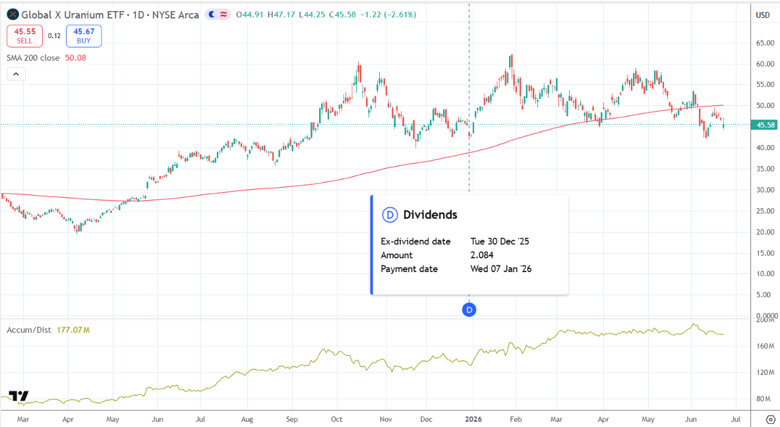
The Accumulation/Distribution Line in the bottom panel shows that the fund has been under accumulation for the last 15 months.
Plus, an annual dividend yield of 4.4% is a big plus.
URA is not a pure-play on any single company but rather a diversified wrapper across the entire nuclear fuel cycle.
Its top holdings typically include Cameco, Kazatomprom’s publicly listed shares, and a range of exploration-stage miners, giving investors a blend of stable cash-flow producers and higher-risk growth names in a single ticker.
The ETF rebalances periodically, so its exposure shifts as the industry evolves.
For investors who want nuclear exposure without the single-stock risk of a speculative developer or a concentrated miner, URA offers a straightforward entry point into the uranium theme.
Constellation Energy (CEG)
Constellation Energy is the largest nuclear power generator in the United States, operating 21 reactors across roughly a dozen nuclear plant sites.
Nuclear generation makes up the majority of its electricity output.
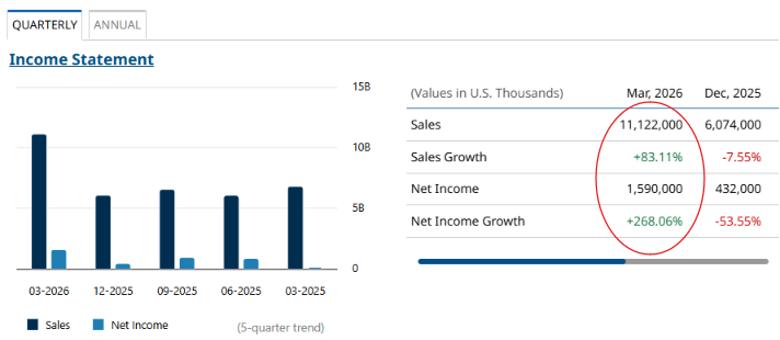
The first quarter of 2026, we saw Sales Growth jumped 83% from the quarter before.
Source: barchart.com
Constellation Energy has also benefited from corporate power purchase agreements (PPAs), in which large technology companies commit to buying nuclear electricity directly under multi-year contracts.
Microsoft and Amazon have both signed agreements to purchase power from Constellation’s fleet, providing long-dated revenue visibility that traditional utilities rarely enjoy.
Constellation’s decision to restart the Three Mile Island Unit 1 reactor, rebranded as the Crane Clean Energy Center, under a 20-year PPA with Microsoft, was widely seen as a landmark moment for the industry, demonstrating that nuclear energy can attract blue-chip corporate off-takers willing to pay a premium for carbon-free, always-on power.
For investors focused on generating income and stability in the energy sector, Constellation represents the most established operator in this theme.
Beyond the Microsoft deal, Constellation has been actively pursuing power purchase agreements with other hyperscale data center operators.
The company operates 21 reactors at facilities including Exelon’s former fleet and has been investing in licence extensions to keep existing plants running through the 2040s and 2050s.
Extending the life of an already-built reactor is significantly cheaper than constructing a new one, which means Constellation’s existing asset base represents a form of durable competitive advantage that new entrants will struggle to replicate for decades.
Cameco (CCJ)
Cameco is the world’s second-largest uranium miner, producing 15% of the uranium globally in 2025.
It is second only to the state-owned company Kazatomprom of Kazakhstan, which produces about 40% of global uranium.
Cameco controls two of the highest-grade uranium mines on earth and has a substantial long-term uranium contract portfolio.
Its McArthur River/Key Lake operation is the world’s largest high-grade mine.
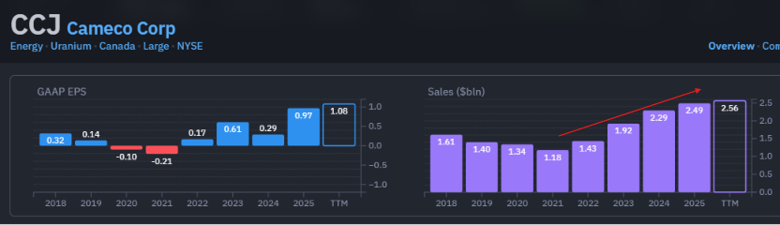
Cameco has been increasing its sales year over year for the past five years.
Cameco had partnered with Brookfield Asset Management to acquire Westinghouse Electric, dramatically diversifying its business beyond mining into reactor technology and fuel services.
The Westinghouse acquisition was transformative because it shifted Cameco from a pure mining company into a vertically integrated nuclear services provider.
Westinghouse designs and services reactors, supplies fuel assemblies, and provides outage and maintenance work across a large fleet of plants worldwide.
That recurring services revenue stream is far less volatile than uranium spot prices, giving Cameco a more predictable earnings base while still retaining the upside leverage to rising uranium prices through its mining operations.
The combination has attracted institutional investor interest that was previously reluctant to own a pure-play commodity miner.
Brookfield Renewable Partners (BEP)
Brookfield’s majority ownership of Westinghouse Electric provides meaningful exposure to nuclear services.
Westinghouse is one of the world’s preeminent nuclear technology companies, supporting reactor operations and fuel supply across dozens of plants globally.
Brookfield’s chart is a textbox example of an uptrend.
Look at the wave pattern with the 20, 50, and 200-day moving averages.
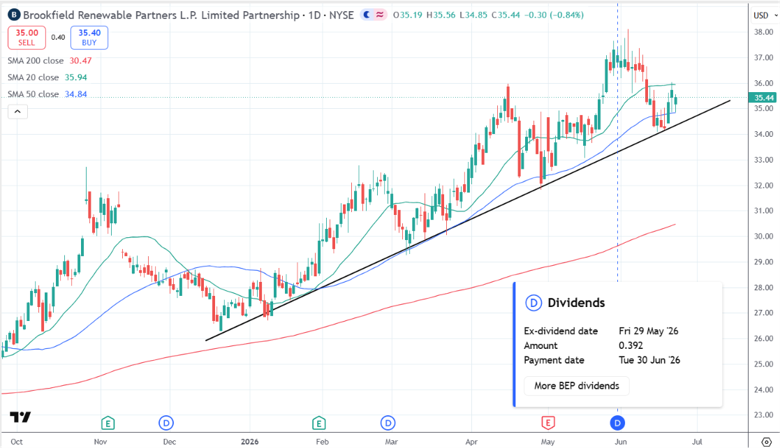
Price making higher highs and higher lows while sitting firmly on a diagonal uptrend line.
Brookfield Renewable Partners trades as a limited partnership, which means it distributes the majority of its cash flows to unitholders as distributions rather than traditional dividends.
Its nuclear exposure through Westinghouse is complemented by a large portfolio of hydroelectric, wind, solar, and battery storage assets globally, making it a diversified clean energy holding rather than a pure nuclear play.
For investors seeking income alongside capital appreciation in the energy transition, BEP offers a compelling combination of infrastructure-grade assets and growth optionality through its nuclear services business.
One factor that distinguishes Brookfield Renewable from a pure nuclear play is its strong balance sheet and access to institutional capital.
Brookfield’s parent company manages hundreds of billions in real assets globally, giving BEP preferential access to financing for large-scale energy projects.
That capital advantage is particularly relevant in nuclear, where the upfront costs are high, and project timelines are long.
Investors who want nuclear exposure packaged within a broader clean energy platform with visible distribution growth may find BEP attractive as a core position rather than a speculative bet.
GE Vernova (GEV)
Spun out of General Electric in April 2024, GE Vernova and its GE Hitachi subsidiary are one of the industry’s most important suppliers of small modular reactors (SMR).
These compact units can be factory-assembled and deployed far faster than conventional plants.
GE Vernova received construction approval for an SMR in Ontario, the first of its kind in the Western hemisphere, capable of powering roughly 300,000 homes.
GEV’s price just reclaimed its 50-day moving average.
Long term moving average sloping up with positive MACD and RSI.
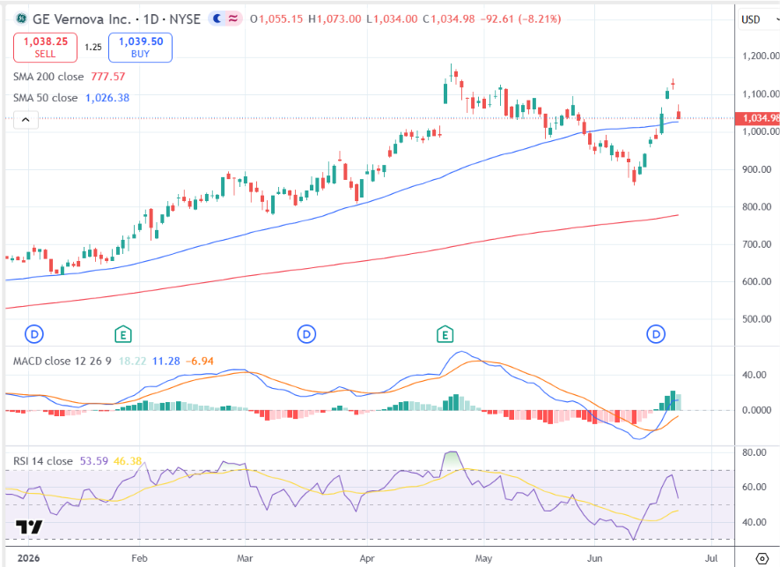
Its reported first-quarter 2026 EPS of $17.44 caught the market off guard, driving the stock up to $1,150 per share, roughly triple its $360 level just 12 months earlier.
GE Vernova’s SMR program, carried out through its BWRX-300 design developed in partnership with GE Hitachi, is one of the most commercially advanced SMR projects in the world.
The BWRX-300 uses proven boiling water reactor technology adapted for a compact, modular footprint, which significantly de-risks the deployment timeline compared with entirely new reactor designs.
Beyond Ontario, GE Vernova has announced agreements and memoranda of understanding with utilities in Poland, Estonia, and several U.S. states, suggesting a pipeline of projects that could sustain revenue growth well into the 2030s.
The stock’s sharp re-rating reflects the market pricing in that future backlog.
Oklo (OKLO)
Oklo is part of a new wave of companies developing Small Modular Reactors (SMRs).
These are compact, factory-built nuclear systems designed to deliver reliable, carbon-free power with lower upfront costs and faster deployment than traditional large reactors.
These SMRs can sit right next to data centers, aligning with growing demand for 24/7 clean energy driven by AI infrastructure and electrification.
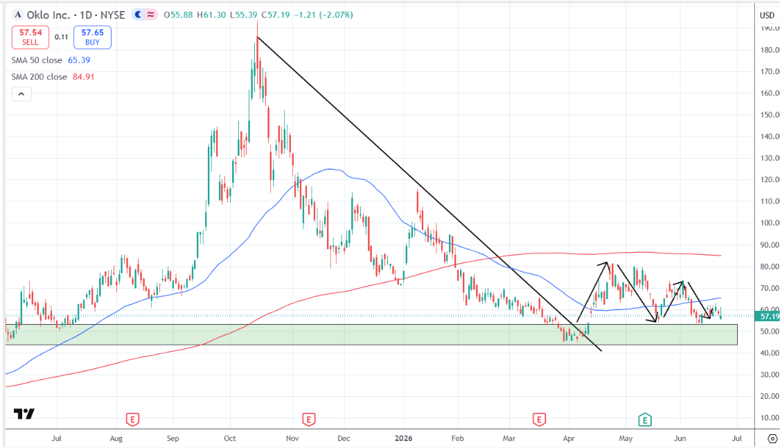
Oklo broke out of its prior downtrend and is now consolidating above its longer-term support zone.
Oklo was taken public through a SPAC merger, and like many SPAC-listed companies, its stock has experienced significant volatility as investors balance the long runway of its technology against the uncertainty of its commercialisation timeline.
The company does not yet generate revenue in the traditional sense, instead operating on a development-stage model funded by government grants and private capital.
Oklo has signed letters of intent with data center operators and defence contractors interested in its compact reactors as on-site power sources, which provides visibility into potential future revenue but not yet contracted bookings.
This makes it a high-risk, high-reward position best sized as a small, speculative allocation within a broader nuclear basket.
How Options Traders Can Play Nuclear Stocks
For options traders, the nuclear theme offers several compelling setups beyond simply buying shares.
Covered calls on established operators. Constellation Energy (CEG) and Brookfield Renewable (BEP) both pay income and have active options markets. Selling covered calls against existing share positions generates additional income on top of dividends — a natural fit for the wheel strategy on quality energy names.
Cash-secured puts for entry. If you want to own Cameco or GE Vernova but find the current price steep, selling cash-secured puts at a strike below the market is a way to either get paid while waiting for a pullback, or to acquire shares at a lower effective cost basis. Given the chart momentum in GEV specifically, selling puts on pullbacks to key support levels is a high-probability entry approach.
Avoid selling uncovered options on Oklo. Speculative SMR names like Oklo carry gap risk — sharp overnight moves on regulatory news, government contract announcements, or broader market sentiment. Undefined-risk option positions on these names should be avoided. If you want options exposure to the speculative end of the nuclear theme, defined-risk structures like bull call spreads limit your downside to the debit paid.
For a complete guide to these strategies, see The Wheel Strategy, Selling Put Options, and Covered Calls.
Final Thoughts
As with any thematic investment, nuclear stocks carry risks that investors should weigh carefully.
Regulatory timelines can extend construction schedules by years, adding cost and diluting returns.
Uranium spot prices are volatile, and a prolonged period of low prices could squeeze miner margins even as power demand grows.
Political risk is also material: a change in government policy, a high-profile reactor incident anywhere in the world, or public opposition to nuclear plant siting can derail project timelines or suppress valuations across the entire sector.
Diversifying across the four categories outlined above, rather than concentrating in any single segment, is one practical way to manage these risks while maintaining meaningful exposure to the long-term nuclear growth story.
The nuclear investment theme spans multiple parts of the energy stack, from uranium fuel supply to power generation and next-generation reactor technology.
Uranium-focused ETFs like Global X Uranium ETF (URA) provide broad exposure to the commodity cycle.
At the same time, miners such as Cameco represent more fundamental-driven plays tied to long-term fuel demand.
On the utility side, companies like Constellation Energy and Brookfield Renewable Partners benefit from rising electricity demand driven by AI data centers and electrification.
Industrial and infrastructure exposure comes from players like GE Vernova, which supports grid and generation buildout.
Meanwhile, innovation-focused names such as Oklo represent bets on small modular reactors (SMRs).
Together, these stocks represent a spectrum of nuclear investing for an investor to choose from.
Not financial advice, but just general information to get an investor started on their analysis.
Want to Generate Income From Nuclear and Energy Stocks?
If you’re building a position in nuclear stocks and want to generate additional income through options, Options Income Mastery covers the exact strategies — covered calls, cash-secured puts, and the wheel — that work best on established, dividend-paying stocks like those in the nuclear sector.
We hope you enjoyed this article on the best nuclear stocks.
If you have any questions, please send an email or leave a comment below.
Trade safe!
Disclaimer: The information above is for educational purposes only and should not be treated as investment advice. The strategy presented would not be suitable for investors who are not familiar with exchange traded options. Any readers interested in this strategy should do their own research and seek advice from a licensed financial adviser.




Very concise and superbly written on the sector. Appreciate it.
Excellent and to the point overview of the industry. Thank you Gavin
Excellent article. More than just a Marketing piece! Thank you for the work quality added value and insight. I intend to utilize your materials in the future.
Thanks David.