






When the US government cancelled the Superconducting Super Collider project in 1993, theoretical particle physicist Samir Varma found himself without a career.
He pivoted to finance, founded VS Asset Management in 2001 alongside fellow physicist Rob Harrington, and built a quantitative hedge fund that has been running systematic strategies for over two decades.
The move from particle physics to quantitative trading is less surprising than it sounds.
Both fields involve modelling complex systems with incomplete information, and both reward the same combination of mathematical rigour and intellectual humility about the limits of prediction.
Quantitative trading is using mathematics, statistics, data analysis, and models to make investment or trading decisions, rather than relying primarily on subjective judgment or intuition.
Another term for this style is systematic trading.
Contents
- Timing Risk
- Frequently Asked Questions
- How Options Income Traders Can Apply The Risk Regime Framework
- Conclusion
Timing Risk
The system that they developed and used is the Risk Timing® system.
It is a proprietary system that is a registered trademark of VS Asset Management, LLC.
That’s why I had to put the superscript trademark R after the name, but forgive me if I forget to do that in all places.
Its basic premise is that market direction is difficult to predict in the short term and that it is much easier to determine market regime instead.
Because the Risk Timing® system is proprietary, we do not know its exact “secret sauce.”
However, from publicly available information, we can gather that Samir views volatility and options primarily as regime diagnostics rather than directional predictors.
This perspective is evident in one of his many YouTube interviews, titled Classify Risk, Don’t Chase Alpha.
When the market is in a low-risk regime, the strategy is to be long U.S. equities.
When the market is in a high-risk regime, the strategy reduces its equity exposure and moves toward cash.
But it does not try to profit from market declines.
In his own words, Samir writes…
“It is a systematic US equity strategy with drawdown management. Long when risk is low. Cash when risk is high. No discretion in the signal. … markets are not random — they are computationally irreducible deterministic systems with regime structure.”
Source: SamirVarma.com
Periods of low volatility tend to persist, while periods of high volatility can also cluster together.
Frequently Asked Questions
What Does He Mean When He Says “Computationally Irreducible Deterministic Systems”?
That is probably his physicist side speaking.
Computationally irreducible deterministic systems is a theme that mirrors Samir’s thinking when he wrote his book The Science of Free Will.
He believes that both the universe and financial markets are deterministic systems.
But calculating the future state is so computationally difficult that the only practical way to discover what happens next is to let the market run its course.
This is what makes it computationally irreducible.
Deterministic in theory, but unpredictable in practice.
This is why markets feel random to us even if they technically are not
If The Universe Is Completely Deterministic, Do We Have Free Will Or Not?
Samir answers…
“Free will in theory is impossible: physics leaves no room for it. Free will in practice is perfect; the universe is computationally irreducible, your decisions can’t be predicted in advance, and you really are part of the causal chain that steers your action.”
[reference]
If The Financial Market Is Completely Deterministic, Is It Random Or Not?
In theory, it is not random (according to Samir).
In practice, there is randomness from our perspective, because it is unknowable in advance.
What Potential Tools Can An Options Trader Use To Classify Risk?
Option implied volatility, Volatility term structure, volatility-of-volatility, and option-implied volatility, correlation, breadth, liquidity, sentiment, and momentum.
How Can The VIX Gauge Market Risk?
The VIX index measures the level of volatility that options traders expect in the S&P 500 over the next 30 days.
It is derived from the prices of SPX options, so it reflects how much investors are willing to pay for protection against large market movements.
Low VIX means calm markets and high VIX values may mean more riskier markets.
That is why VIX is loosely referred to as the fear index in the media.
What Is Volatility Of Volatility?
The value of VIX changes.
How fast and how much it changes is measured by VVIX, the VIX Volatility index.
Think of this as the volatility of volatility.
If VIX makes a rapid jump from 15 to 25, it can be a more meaningful signal than if VIX goes from 25 to 26.
A rapid change in the VIX (as indicated by high VVIX) shows that the market’s perception of risk is changing quickly.
How Can Term Structure Categorize Low-Risk Versus High-Risk Regime?
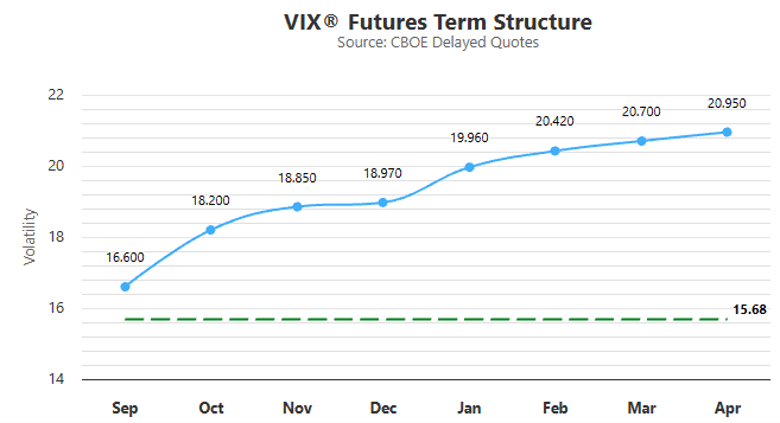
Source: volchart.io
The VIX Futures term structure under normal calm markets will be upward sloping (called contango).
This is where near-term implied volatility is lower than volatility expected several months out.
In a high-risk regime, the term structure can become inverted (in backwardation), with short-term volatility rising above longer-term volatility – for example on October 16th, 2025…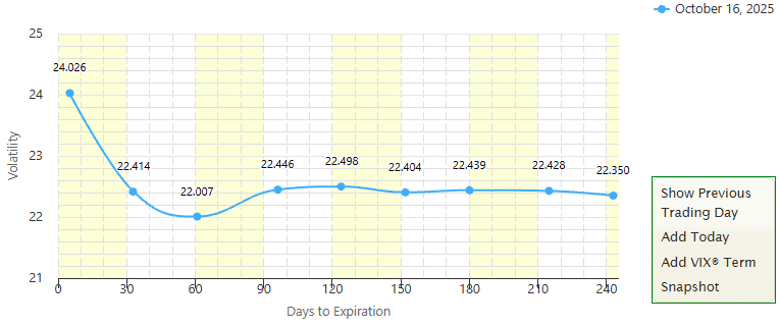
The shape and direction of the volatility term structure and the amount of contango can provide additional information about whether the market is transitioning toward a higher- or lower-risk regime.
How Might Volatility Tenor Inform The Same?
Tenor means the length of time until something expires or matures.
VXST: very short tenor (~9 days)
VIX: short tenor (~30 days)
VXV: medium tenor (~3 months)
VXMT: longer tenor (~6 months)
In a low-risk regime, you would generally expect something like VXST < VIX < VXV < VXMT, producing an upward-sloping term structure.
In a high-risk regime, near-term volatility can rise rapidly, producing VXST > VIX > VXV > VXMT or at least having one of the pairs in backwardation.
Can Term Structure Be Seen On Individual Stocks?
Yes.
Source: marketchameleon.com
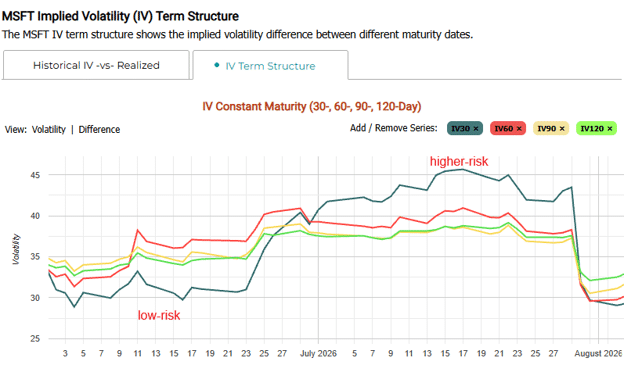
Here is the term structure of Microsoft (MSFT) showing it transitioning from a low-risk to a higher risk regime as it approaches its earning announcement.
Under normal conditions, the shorter-term IV30 should be lower than the longer-term IV60.
But in July, IV30 has risen above IV60 indicating increased risk in this stock as it approaches earnings.
Note that it dropped back down to normal right after the earnings event on July 29th.
How Does Correlation Fit In?
Correlation measures how closely stocks are moving together.
When correlations are high, many stocks move in the same direction, so diversification provides less protection.
Dispersion is the converse (see DSPX).
If volatility is rising and dispersion is dropping, that can be a particularly important warning sign: stocks are becoming more volatile and moving more closely together, increasing systemic market risk.
High correlation by itself is not a market risk.
But high correlation during a volatility spike is a warning sign.
What Does Breadth Have To Do With Risk?
Breadth indicates how many stocks are above their 20-, 50-, or 200-day moving averages.
A high number of stocks above their moving average means a healthy market.
What Advice Does Samir Have For Retail Traders?
“…that durable competitive advantage needs to be 100% congruent with your own personality. … Your edge must be yours. Not borrowed. Not copied. Not theoretically optimal for some abstract investor. Yours. The only way to get congruence with your personality is sheer hard work. Nothing more. And nothing less. You have to test, test, test and test. Then test some more. Test until you’re sick of it. Then test some more. Then test until you want to throw up (and indeed do throw up). Then test some more. You have to have unshakable confidence that what you are doing is correct.”
[Source: The Emperor has no Alpha]
How Options Income Traders Can Apply The Risk Regime Framework
You don’t need Samir’s proprietary Risk Timing® system to apply the core principle to your own trading.
The idea — identify whether the market is in a low-risk or high-risk regime before sizing positions — is directly applicable to iron condors, credit spreads, and the wheel strategy.
A practical simplified version for income traders:
Low-risk regime signals (favour full position sizing, normal strike placement):
- VIX below 20 and falling or stable
- VIX futures term structure in contango
- VXST < VIX < VXV (upward-sloping tenor structure)
- Broad market breadth healthy (most stocks above 50-day moving average)
High-risk regime signals (reduce size, widen strikes, or stay in cash):
- VIX above 25 and rising, especially with high VVIX
- VIX futures term structure inverting toward backwardation
- VXST rising above VIX (near-term fear spiking)
- Broad market breadth deteriorating rapidly
- High volatility accompanied by high correlation (stocks moving together)
This isn’t a mechanical system — it’s a checklist of conditions to consider before deploying premium-selling strategies.
In a confirmed low-risk regime, iron condors and bull put spreads perform at their best.
In a high-risk regime, reducing position size or waiting for conditions to stabilise is often the better choice — even if premium looks attractive.
The premium looks attractive in high-risk regimes precisely because the market is paying you to take a risk it believes is real.
Conclusion
Keep in mind that the formula for Risk Timing® system is not publicly disclosed.
Therefore, we are not saying that the explanation above is how it may tactically allocate assets.
We are speaking in general about how various option information can potentially inform us of different risk regimes.
We hope you enjoyed this article on how a quantum physicist became a quant trader.
If you have any questions, please send an email or leave a comment below.
Trade safe!
Disclaimer: The information above is for educational purposes only and should not be treated as investment advice. The strategy presented would not be suitable for investors who are not familiar with exchange traded options. Any readers interested in this strategy should do their own research and seek advice from a licensed financial adviser.