







The creator of this strategy certainly has a knack for creating memorable strategy names.
Burrito Fly is one of his more creative ones, and even his nickname, Boomer Dan, is catchy and memorable
Boomer Dan, or known as Dan Westbrook in real life, has been trading options for 20 years and shared his latest strategy in an interview with Theta Profits.
This is the second time Dan has been interviewed by host John Einar Sandvand.
In the first interview, Dan presented his “Levitation Trades” which attempts to remove risk from zero-DTE trades as fast as possible.
By achieving riskless trades, the trader can walk away from the computer screen if he wants to.
The Burrito Fly is in the same theme and is applied to the same SPX underlying.
While technically, it does not produce risk-free trade, the strategy manages the risk such that the risk exposure is low.
However, the Burrito Fly is designed to be done with a DTE (days to expiration) of two to three days.
It can be done with higher DTEs up to 14 days.
Contents
- Why Burrito?
- Starting The Burrito Fly
- Pick A Direction
- Making The Trade Nearly Risk Free
- Are The Wings Really Above Zero?
- The Money Rainbow
- My Reaction: Could A Broken Wing Butterfly Be Even Better?
- What If The Price Goes The Wrong Way?
- Increasing The Wing Widths With DTE
- FAQ
- The Verdict
Why Burrito?
It is called the Burrito Fly because Dan refers to profits as burritos.
More profits do buy more burritos after all.
While many options strategies have been named after animals (such as Iron Condor, Jade Lizard, Rhino, etc), Boomer Dan is not the only option trader that has named a strategy after a food item.
Dan Sheridan, another Dan, has named his “Combo Trade” strategy after an Italian Beef and Sausage Combo sandwich that he likes to eat at Portillo’s Hot Dogs in Chicago.
Starting the Burrito Fly
Let’s explain the strategy by backtesting it with OptionNet Explorer.
The trade starts with an at-the-money butterfly with 15-point wide wings.
Date: May 5, 2026
Price: SPX @ 7258
Buy one contract May 8th SPX 7245 call @ $45.95
Sell two contracts May 8th SPX 7260 call @ $36.65
Buy one contract May 8th SPX 7275 call @ $28.40
Net Debit: -$105
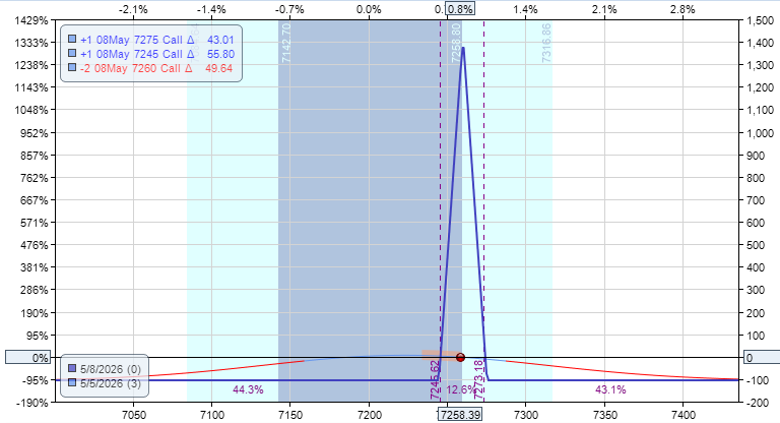
While Dan uses call options butterflies, it can be used with put-butterflies or iron butterflies.
Pick A Direction
Next, pick a direction that you think SPX will go.
Dan and John both joked that neither of them can pick directions.
In that case, the trader can choose the bullish direction since the market tends to drift up over time.
Or sit on this butterfly and see which direction SPX moves before picking.
In this example, we are going to be bullish and add the bull call debit spread 5-point wide at the start of the trade:
Buy one contract May 8th SPX 7275 call @ $28.40
Sell one contract May 8th SPX 7280 call @ $25.90
Net Debit: -$250
The expiration should be the same expiration as the fly (in this case 3 DTE).
The long option of the spread uses the same strike as the upper long leg of the fly.
The resulting combined trade has a total debit of $355, which is the max loss of the trade at this point:
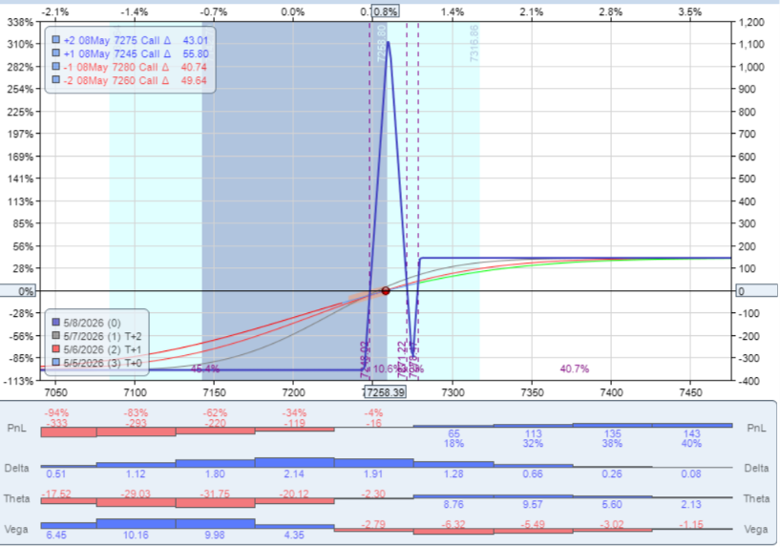
This is a directional bullish trade with a positive delta of 1.8.
It has zero or slightly positive theta of 0.28.
This is because the negative theta of the debit spread cancelled out the positive theta of the butterfly.
But as the price of SPX goes up in our favor, the positive theta increases and the trade behaves more like a credit spread.
Vega is slightly negative at -3.72.
Making The Trade Nearly Risk Free
This example trade started in the morning.
Near the end of the session, the profits showed $25.
$25 / $355 = 7% return on risk
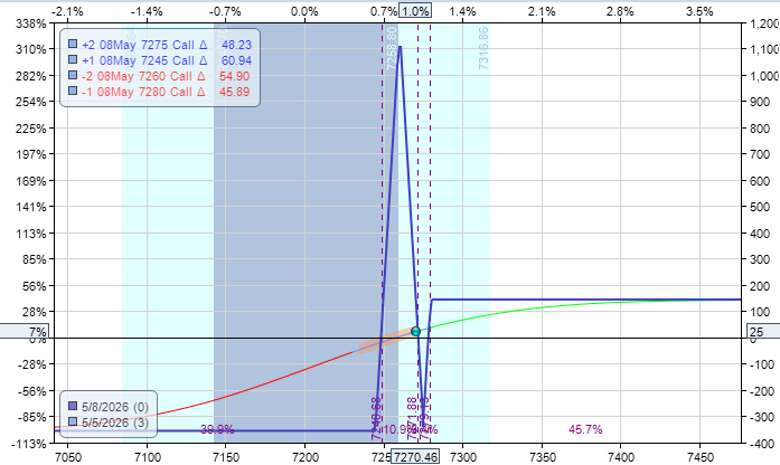
Dan says that the profit target can be 5% or 10% or more depending on the trader.
The trader can take the profit and call it win.
But often, the trade can be kept open for greater potential profits.
If the trader does not want overnight risk, he can complete the burrito fly by adding a put debit spread as the other wing:
Sell one contract May 8th SPX 7240 put @ $22.30
Buy one contract May 8th SPX 7245 put @ $23.70
Net debit: -$140
Even though the width of this spread is the same as the first spread, it cost a lot less simply because the price had moved further away from the spread.
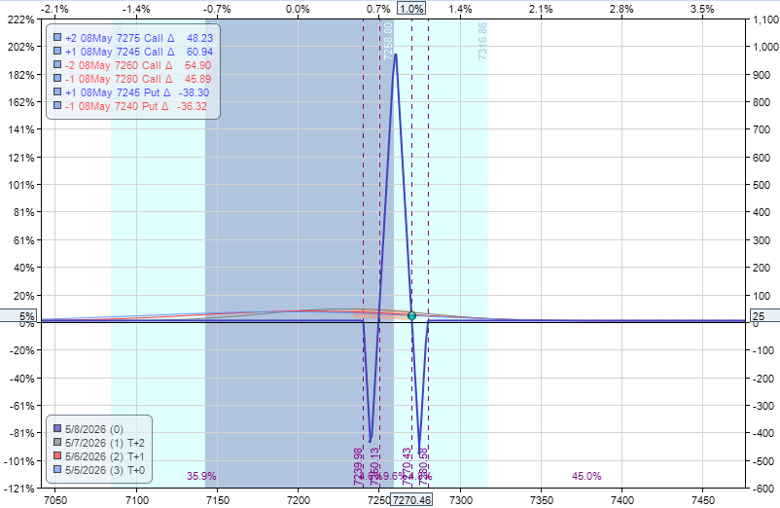
Delta: -0.26
Theta: 2.36
Vega: -0.88
The result is a nearly risk-free trade with most of the expiration graph sitting above the zero-profit horizontal, except for the two “valley of deaths”.
Based on Dan’s experience these two loss zones do not come into play until the last hours of expiration day.
The trader can close the trade before then.
Or if they are really bothersome, then the trader can add a small butterfly to fill in those holes.
Even if the trade was left till expiration, there is no assignment risk because SPX is cash-settled.
For non-US traders who can’t easily access SPX options, XSP (one-tenth the size) or SPY are practical alternatives.
Dan himself mentions XSP as an adjustment tool in the interview.
Are The Wings Really Above Zero?
Yes.
In this example, the wings are $5 above breakeven, meaning the trade still makes a small profit even if SPX expires at either wing.
Here’s how that works.
Before adding the second debit spread, the total debit paid was $355.
When SPX expires exactly at one of the wings, the corresponding debit spread reaches its maximum value of $500, which is credited to the account at expiration.
Therefore, the most you can pay for the second debit spread while still breaking even at the wings is:
$500 − $355 = $145
In other words, if the second debit spread costs $145 or less, the trade will still be profitable if SPX expires at either wing.
In this example, the second debit spread was purchased for only $140.
So the minimum profit at either wing is:
$500 − ($355 + $140) = $5
This is what is meant by the wings being $5 above zero.
The trader has secured the trade so that if he wakes up next morning with SPX crashed, the trade still becomes profitable.
The Money Rainbow
The trade now has become a delta-neutral trade with positive theta.
See in the above screenshot that the T+0 and T+1 and T+2 profit curves form a rainbow shape.
The trader can hold for potentially more profits hoping that the SPX price lands near the center of the butterfly tent.
The pricing can jump around a lot, but let’s say the trader was able to exit the trade the day before expiration with a $40 profit:
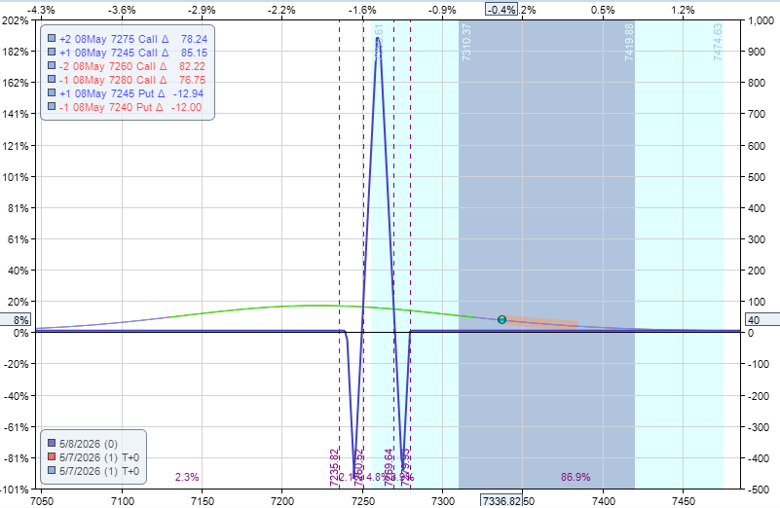
The trade has a maximum risk of approximately $500, as indicated by the lowest point on the risk graph.
So $40 / $500 is 8% return on risk
My Reaction: Could A Broken Wing Butterfly Be Even Better?
My reaction is that why can’t we just start with a broken wing butterfly instead:
Date: May 5, 2026
Price: SPX @ 7258
Buy one contract May 8th SPX 7245 call @ $45.95
Sell two contracts May 8th SPX 7260 call @ $36.65
Buy one contract May 8th SPX 7270 call @ $31.05
Net Debit: -$370
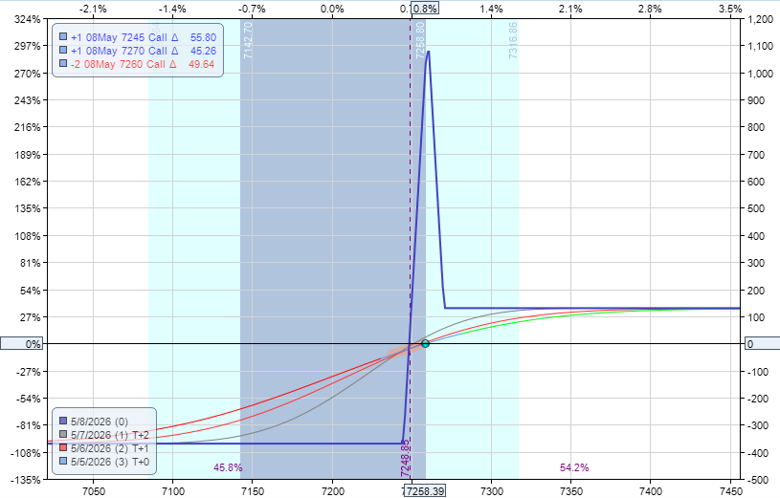
The expiration graph is very similar, so the trade behaves essentially the same.
At the same time, we eliminate one transaction, reducing both commission costs and slippage.
Continuing with the broken-wing example, let’s add the second wing at the same point in the trade as we did in the first example.
Sell one contract May 8th SPX 7240 put @ $22.30
Buy one contract May 8th SPX 7245 put @ $23.70
Net debit: -$140
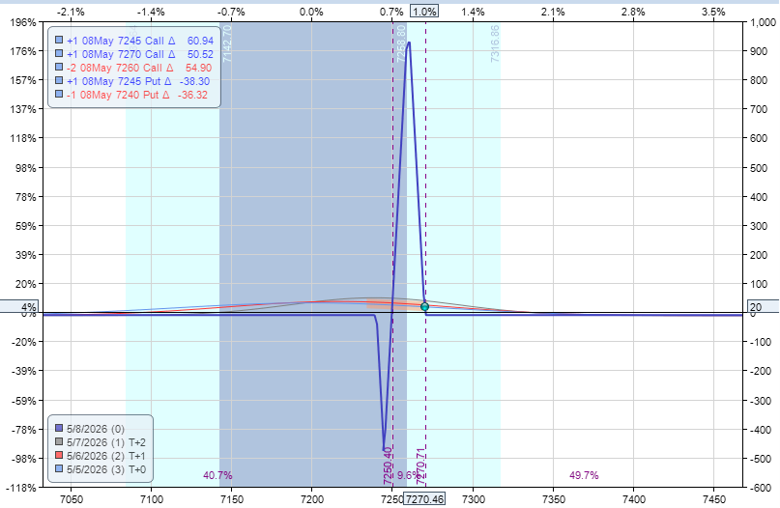
Okay, in this case, we ended up with -$10 loss if SPX expired at the wings.
Because:
$500 – ($370 + $140) = -$10
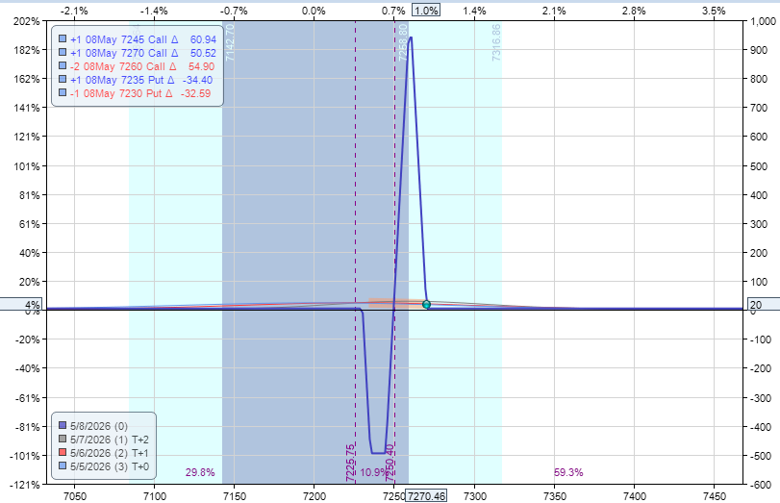
However, if we had moved the put debit spread a little further away from the fly,
Sell one contract May 8th SPX 7230 put @ $19.65
Buy one contract May 8th SPX 7235 put @ $20.90
Net debit: -$125
We can pay less for the spread and are able to can get the expiration graph to be above zero at the wings:
The trade has one slightly wider valley of death, rather than two smaller valleys.
What If The Price Goes The Wrong Way?
Dan did have various adjustment techniques as described in the interview.
Basically, the trader can add the second wing to stop the profit loss.
The expiration graph will likely not be above zero at that point.
Dan mentions the “clawback” method whereby one can incrementally add tiny wings with XSP (one-tenth the size of SPX) to bring those wings up.
As Dan calls it, the “Choo-Choo Train” adjustment can also be used to add additional butterflies to extend the profit tent.
Increasing The Wing Widths With DTE
Traders should experiment with different DTEs and wing widths.
My initial reaction was that the butterfly wings were quite narrow.
But that is probably because I am more accustomed to trading longer-dated strategies.
As the time to expiration is increased, the underlying has more time to make larger price moves, so it generally makes sense to widen the butterfly wings accordingly.
FAQ
What Is The Burrito Butterfly Options Strategy?
The Burrito Butterfly is a short-term options strategy developed by options trader Dan Westbrook (“Boomer Dan”).
It starts with an at-the-money butterfly spread, adds a directional debit spread in the expected direction of the move, and then completes the structure by adding a second debit spread on the opposite side once profits develop — creating a nearly risk-free position where most expiration scenarios result in a profit.
It is designed for 2–14 day trades on SPX.
Why Is It Called The Burrito Butterfly?
The name comes from Boomer Dan’s habit of referring to profits as “burritos” — more profit means more burritos.
The butterfly component is the foundation of the strategy, and the two debit spreads added on either side are the “wrap” that completes the burrito shape of the expiration graph.
What Is The Difference Between The Burrito Fly And A Standard Iron Butterfly?
A standard iron butterfly is a neutral, symmetric structure entered all at once for a credit.
The Burrito Fly is built in stages: an initial butterfly, followed by a directional debit spread, then a second debit spread added only after profits develop.
This staged construction is what allows the trade to become nearly risk-free — the profits from the first debit spread finance the cost of the second, completing the “wrap.”
It is also typically much shorter-dated (2–14 DTE) than the 30–45 DTE iron butterflies most income traders use.
What Are The “Valley Of Deaths” In The Burrito Fly?
The valley of deaths are two narrow loss zones on the expiration graph that appear at the outer edges of the completed Burrito Fly structure.
Based on Dan’s experience, these zones typically only become relevant in the final hours before expiration — giving the trader time to close the position before they matter.
If they are a concern, Dan suggests adding a small butterfly position to fill in those loss zones, or simply closing the trade before expiration.
Can The Burrito Fly Be Done With Put Options Instead Of Calls?
Yes — Dan notes that the strategy can be constructed using put butterflies or iron butterflies instead of call butterflies.
The mechanics are the same; the choice between calls and puts is largely a matter of trader preference and the current options market conditions (specifically which side has more available liquidity and tighter bid-ask spreads at the desired strikes).
What Is The Broken Wing Butterfly Alternative Described In This Article?
Rather than starting with a standard symmetric butterfly and adding a separate directional debit spread, the broken wing butterfly alternative starts with an asymmetric structure that already incorporates the directional bias.
This eliminates one transaction (and therefore reduces commissions and slippage) while producing a similar expiration graph.
The trade-off is that the wing math works out slightly differently — as shown in the article, the BWB alternative requires moving the second debit spread a little further away to keep the wings above zero.
The Verdict
As an options educator, I come across many trading strategies – some of which are not compelling enough to write about.
The fact that you’re reading this article probably tells you my conclusion already.
I like it.
The Burrito Fly focuses on reducing risk while generating near risk-free theta decay.
And its flexible adjustment strategies provide multiple ways to recover from adverse directional moves.
The key is to experiment with the various parameters to find the sweet spot that you feel most comfortable trading.
Want to Learn More Advanced Options Income Strategies?
The Burrito Fly is one of many creative approaches to short-term income trading.
If you want to build a complete, systematic options income framework — from foundational credit spreads through to butterfly spreads, broken wing butterflies, and short-duration structures — Options Income Mastery covers the full toolkit with exact entry rules and trade management.
Learn more about Options Income Mastery →
We hope you enjoyed this article on the Burrito Butterfly strategy.
If you have any questions, please send an email or leave a comment below.
Trade safe!
Disclaimer: The information above is for educational purposes only and should not be treated as investment advice. The strategy presented would not be suitable for investors who are not familiar with exchange traded options. Any readers interested in this strategy should do their own research and seek advice from a licensed financial adviser.