







A calendar option strategy is where the trader sells an option and buys another option with a further-dated expiration with the same strike.
It is not obvious why some brokerages allow calendar spreads to be traded on SPY but not on SPX.
By the end of the article, you will understand why.
Calendars are commonly known as defined-risk trades where the maximum risk is the initial debit paid.
But there are some caveats and differences between a stock-settled calendar (as in SPY) and a cash-settled calendar (as in SPX).
Contents
- Calendar On SPY
- Calendar On SPX
- Why Is SPX Treated Differently
- SPY Calendar At Expiration
- Holding Past Expiration Of Short Option
- Difference Between Stock-Settled And Cash-Settled Calendars
- SPX At Expiration
- FAQ
- Conclusion
Calendar On SPY
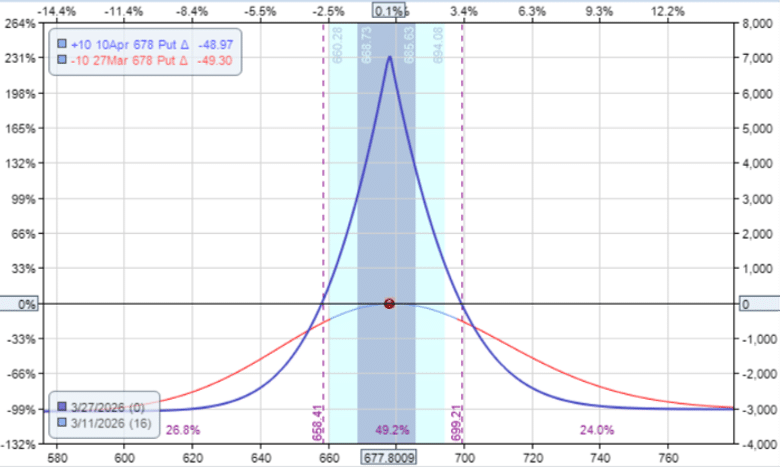
Here is a ten-contract calendar on SPY, the S&P 500 ETF.
Date: March 11th, 2026
Price: SPY @ $677.80
Sell to open ten contracts March 27th SPY $678 put @ $11.86
Buy to open ten contracts April 10th SPY $678 put @ $14.89
Net Debit: 10 x ($1,186 – $1,489) = -$3030
Source: OptionNet Explorer
This risk graph shows the P&L payoff at the expiration of the near-term short option.
Since the max risk on a calendar is the debit paid, the risk graph shows a max risk of $3030.
So the margin requirement for this trade is $3030.
Calendar On SPX
Here is a very similar one-contract calendar on SPX, the S&P 500 index.
Date: March 11th, 2026
Price: SPX @ 6789
Sell to open one contract March 27th SPX $6780 put @ $108.35
Buy to open one contract April 10th SPX $6780 put @ $139.15
Net Debit: $10,835 – $13,915 = -$3080
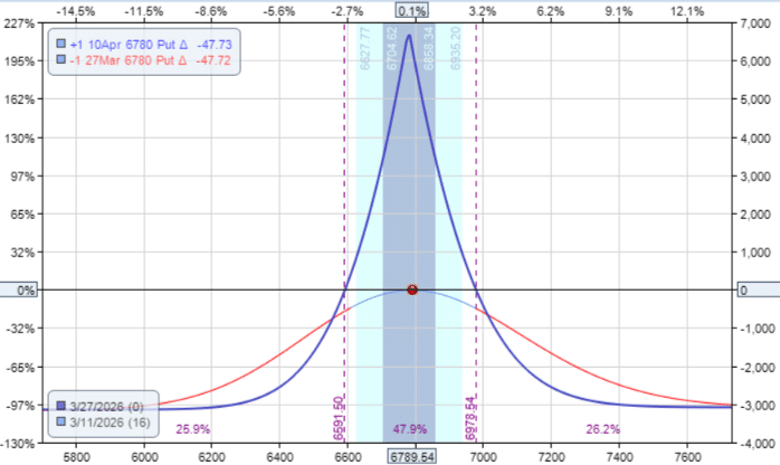
The max risk is similar at $3080.
Because the SPX asset price is 10 times that of SPY, we only need 1 contract.
Another important difference is that the SPX is cash-settled.
One cannot buy or sell shares in an index.
When a short put option is in the money at expiration and is assigned, the trader must pay the loss in cash.
This is why some brokers will impose very high margin requirements: they treat the short leg of an SPX option as a naked short option.
SPX naked puts often require around 15% of the notional index exposure as margin, which could be around $100,000 for a large index like SPX.
If the trader’s account is not large enough, the SPX calendar can not be traded (even though the equivalent SPY calendar can).
Why Is SPX Treated Differently
The difference between SPX and SPY is that SPX is cash-settled and can not be assigned shares.
SPY can be assigned shares.
The shares and the remaining long put options properly hedge each other.
The long leg is supposed to protect you from the short leg going against you.
This works cleanly with SPY because with physical delivery options like SPY, whenever you are assigned on your short puts, you can exercise your long put to offset the assignment.
With SPX, if the short option settles in the money, the trader owes a large cash debit.
Regulators don’t allow the long leg to count as margin cover for the short leg when they settle independently.
This will make more sense when we let our above example play out.
SPY Calendar At Expiration
On expiration at the near-term expiration on March 27th, SPY closes at $634.
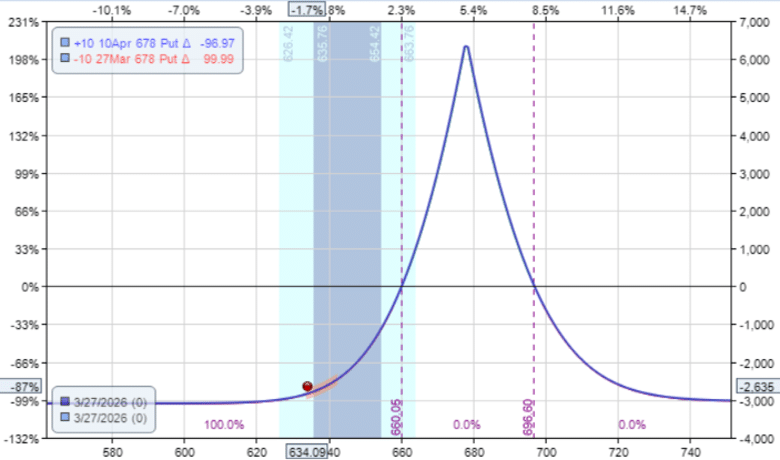
Since this is below the $678 strike price of the short put option, the trader must buy 100 shares per contract.
With 10 contracts on hand, he has to buy 1000 shares of SPY at $678 per share.
That would be a $678,000 debit to buy the shares.
Assuming the account is large enough, the trader will see that his account has been debited by $678,000, and he now owns 1,000 shares of SPY.
The short put options have disappeared.
But ten long put options still remain.
The resulting risk graph of 1000 shares and 10 long put options looks like this…
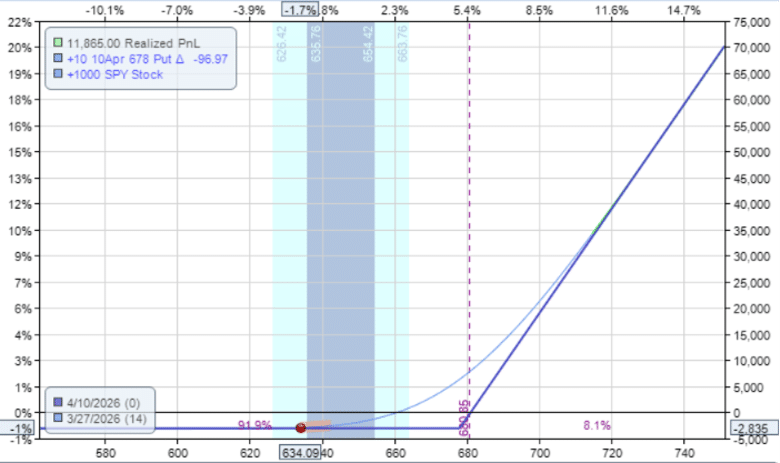
The long put option continues to protect the trade from exceeding the $3,000 maximum risk, even if SPY declines further.
And if the market goes up, the SPY shares hedge the potential loss in value of the long puts.
This symbiotic protection only exists while the long put options are still alive (before their expiration).
This relationship breaks if the trader legs out of the trade, for example, by closing one leg without closing the other.
At this time, the trader can choose to close out the entire position completely by…
Selling 1000 shares of SPY at the market price of $634/share: $634,000
Sell ten contracts of the long put (market price of $44.10/share): $44,100
The net P&L in this case would be:
Calendar initial debit: -$3030
Assigned 1000 shares: -$678,000
Sell 1000 shares at market: $634,000
Sell 10 contracts long put options: $44,100
Net P&L: -$2,930
Alternatively, the trader may tell the broker to exercise the long put options so that the 1000 shares can be sold at $678 per share.
In that case, the trader loses the time value left in the long options, so the loss would be slightly greater, essentially the maximum loss of the calendar.
Calendar initial debit: -$3030
Assigned 1000 shares: -$678,000
Exercise long puts to sell 1000 shares: $678,000
Net P&L: -$3030
Holding Past Expiration Of Short Option
Let’s assume the trader has a large enough account and decides to continue holding the 1000 shares plus the 10 long puts.
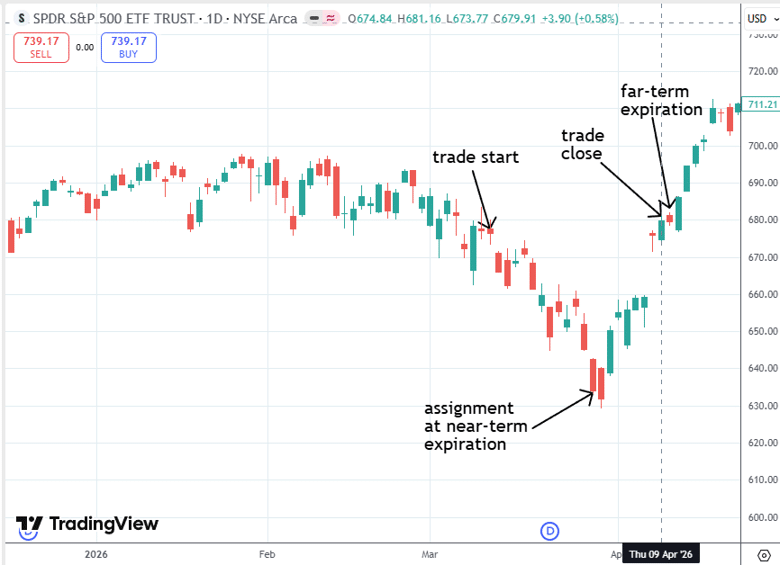
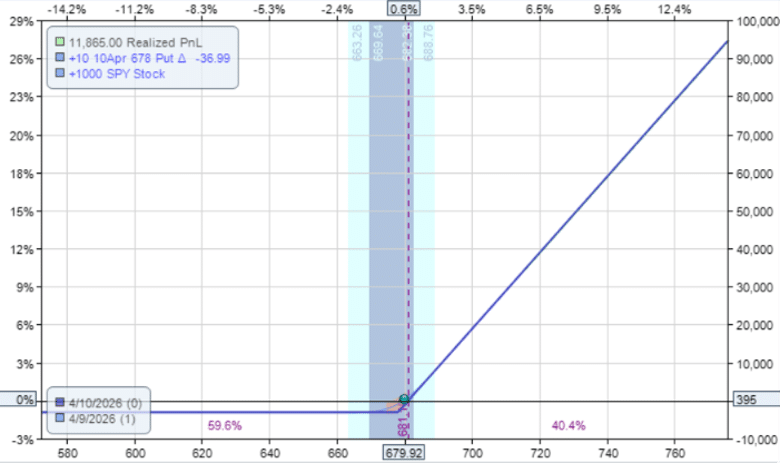
On April 9th, SPY made a V-shape recovery…
SPY is at $679.92, and the long put option is priced at $1.50 per share.
The trader decides to close out the position at this time with the following positive profit:
Calendar initial debit: -$3030
Assigned 1000 shares: -$678,000
Sell 1000 shares at market: $679,920
Sell 10 contracts long put options: $1,500
Net P&L: $390
What if the trader does nothing until the final expiration?
If SPY is below the strike price of the long put at the far-term expiration, the long puts will be auto-exercised to sell the shares at $678 per share.
The resulting P&L would be the max loss on the calendar:
Calendar initial debit: -$3030
Assigned 1000 shares: -$678,000
Exercise long put to sell 1000 shares: $678,000
Net P&L: -$3030
If SPY is above the strike price, then the long puts will expire worthless.
The trader keeps 1000 shares of SPY.
On expiration April 10th, SPY closes at $679.46, which is above the strike price of the long put options.
So the long puts expire worthless.
Final P&L would be…
Calendar initial debit: -$3030
Assigned 1000 shares: -$678,000
Value of 1000 shares: $679,460
Net P&L: -$1,570
Difference Between Stock-Settled And Cash-Settled Calendars
The point to this whole story is that a stock-settled calendar will be risk-defined all the way up to the expiration of the far-dated option as long as the trader does not leg out of the position.
This is true regardless of whether there was an early assignment of shares, a forced assignment at expiration, or auto-exercise of the long options.
However, this is not true of cash-settled calendars.
Their risk profile changes once the short options disappear at the near-term expiration.
Therefore, always close out cash-settled calendars in full before the near-term expiration.
SPX At Expiration
On the near-term expiration on March 27th, SPX closed at 6,369.
The short put strike is at $6780.
Therefore, the trader must pay the $41,100 loss.
Because $6780 – $6369 = $411 points = $41,100 per contract
The $41,100 debit will be charged to the account immediately.
The trader still has the remaining long put option, which has a value of $419 per share, or $41,900.
If the trader were to sell this long put right away, the current P&L would be within the calendar’s initially defined risk, aside from any potential overnight gap risk.
Initial calendar debit: -$3080
Debit paid at near-term expiration: -$41,100
Sell long put: $41,900
Net P&L: -$2,280
The broker can not assume that the trader would do this.
If the trader does nothing, the long put can expire worthless.
Once the near-term expiration is reached, the trader is left with only one long put, which has a risk that far exceeds the initial risk of the calendar…
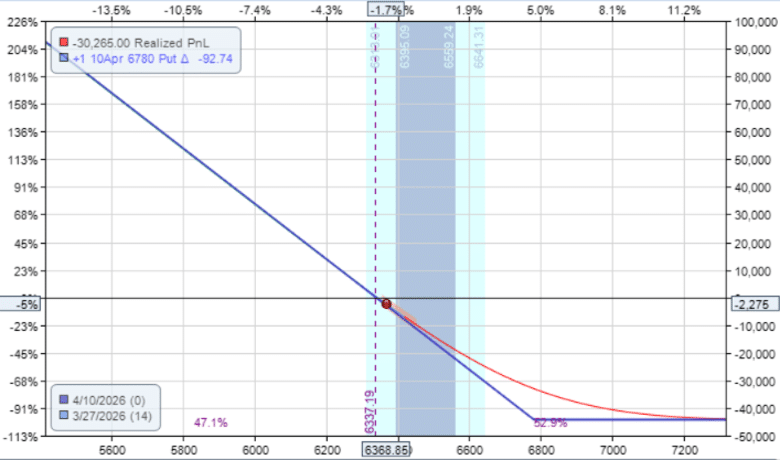
The long put cannot be guaranteed to hedge the loss on the short option once the near-term expiration is reached.
We also cannot exercise the long put at this time because index options cannot be exercised early.
Look what happens if the trader does nothing.
SPX closed at 6817 on April 10th (the far-dated expiration).
Because this is above the strike price of 6780, the long put option expires worthless.
Initial calendar debit: -$3080
Debit paid at near-term expiration: -$41,100
Long put expires worthless: $0
Net P&L: -$44,180
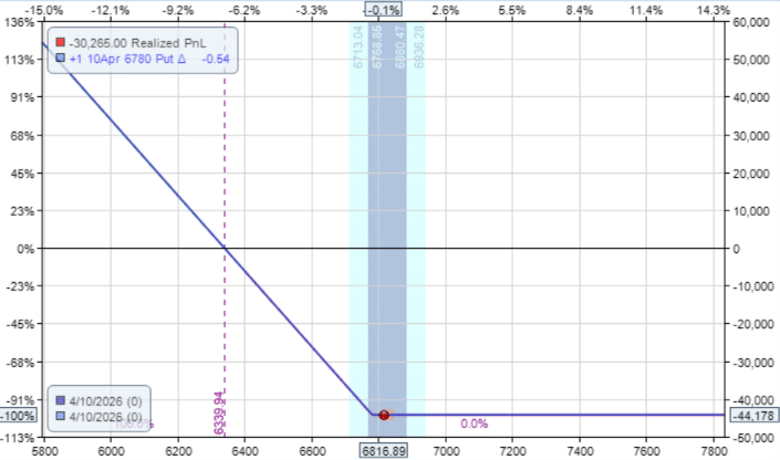
The trader just lost more than $44,000 on a calendar he thought had a maximum risk of $ 3,000.
The practical rule is simple: always close cash-settled index calendars in full before the near-term expiration.
Treat them as two separate trades — the short option and the long option — and make sure you’re never left holding only one leg past the short expiration.
FAQ
Why Can I Trade Calendar Spreads On SPY But Not SPX?
SPY is a stock-settled ETF — when a short put is assigned, you receive actual shares which are hedged by your long put.
SPX is cash-settled — when the short put settles in the money, you pay a cash loss immediately, and the broker cannot guarantee you’ll exercise your long put to offset it.
Because of this settlement asymmetry, some brokers treat the short leg of an SPX calendar as a naked short option and margin it accordingly, which can require $50,000–$100,000 or more in buying power even for a trade with a theoretical maximum risk of a few thousand dollars.
What Is The Maximum Risk On An SPX Calendar Spread?
If managed correctly — meaning the entire position is closed before the near-term expiration — the maximum risk is the initial debit paid, just like any other calendar spread.
However, if the short option expires in the money and the trader does nothing, the defined-risk nature of the calendar breaks down.
The cash settlement debit is charged immediately at near-term expiration, and the remaining long option may expire worthless at the far-term expiration, resulting in a total loss far exceeding the initial maximum risk.
What Happens If My Short SPX Option Expires In The Money?
The loss on the short option is charged to your account in cash at the near-term expiration settlement.
You are left holding only the long put option, which now has a completely different risk profile from the original calendar.
If you sell the long put immediately after settlement, your net P&L will typically be close to the calendar’s original defined maximum risk.
If you do nothing and the long put expires worthless, your loss will be the full cash settlement debit plus the original calendar debit — potentially a very large loss on what appeared to be a low-risk trade.
Is An SPX Calendar Spread Riskier Than An SPY Calendar Spread?
In theory, no — both have the same initial defined risk equal to the debit paid.
In practice, an SPX calendar is riskier because of the cash settlement mechanics at near-term expiration.
With SPY, assignment of shares and exercise of long puts create a natural hedge that persists through the far-term expiration.
With SPX, that hedge breaks down the moment the short option settles, requiring active management to close the position at or before the near-term expiration.
Which Brokers Allow Calendar Spreads On SPX?
Interactive Brokers allows cash-settled index calendars for accounts with sufficient margin buying power and appropriate options approval level.
Brokers that restrict SPX calendars typically do so because they treat the short leg as a naked option for margin purposes — requiring capital that most retail accounts don’t have.
If your broker allows naked short options with sufficient buying power, they will generally allow SPX calendars as well.
Conclusion
SPY and SPX calendars behave similarly in price risk initially, but they differ in post-expiration mechanics due to physical versus cash settlement.
As we saw, if the trader did nothing, the SPY calendar’s risk is capped at its initial defined risk throughout the entire trade, including through the expiration of the far-dated option.
This is not true of the SPX calendar.
It lost its initially defined-risk calendar status as soon as the short option expired at the near-term expiration, leaving the trader with a long option that has a completely different risk profile than that of the initial calendar.
The same settlement principles apply to double calendar spreads — see our double calendar guide for how this plays out in a two-strike structure.
Hence, some brokers treat the two legs of a cash-settled calendar as separate trades: a short option and a long option.
The short option is treated as a naked short option and is margined accordingly.
If an account is not allowed to trade naked short options or does not have sufficient margin buying power to do so, it cannot trade cash-settled calendars.
Want to Trade Calendar Spreads With a Systematic Approach?
Calendar spreads — on both stock-settled ETFs and cash-settled indices — are covered in detail in Options Income Mastery, including exactly when to close, how to manage assignment, and how to use them as part of a complete income portfolio.
We hope you enjoyed this article on calendar spreads on indices.
If you have any questions, please send an email or leave a comment below.
Trade safe!
Disclaimer: The information above is for educational purposes only and should not be treated as investment advice. The strategy presented would not be suitable for investors who are not familiar with exchange traded options. Any readers interested in this strategy should do their own research and seek advice from a licensed financial adviser.