






Most investors think of a tail-risk investment as something that simply buys put options on the S&P 500 and waits for a crash.
The problem with that approach is straightforward: protective puts cost money.
If the market continues rising or moves sideways, the puts can expire worthless and steadily drag down the portfolio.
The Alpha Architect Tail Risk ETF (CAOS) takes a different approach.
It combines several option positions designed to participate in the equity market during normal conditions while maintaining a strategic allocation to protective puts intended to produce large gains during a rapid market decline.
With an inception date of August 14, 2013, it was originally a mutual fund and converted to an ETF on March 6, 2023.
The fund uses three important components:
- SPX options to obtain market exposure
- Long-dated, out-of-the-money SPX protective puts for tail-risk protection
- A collateral portfolio, including box spreads, to generate income while supporting the options positions
Under normal circumstances approximately 20% of the fund’s capital is allocated to gaining exposure to the S&P 500 Index, while roughly 1% to 10% is allocated to protective options.
The protective puts are more than 40 days to expiration and strikes at least 5% below the current S&P 500 Index level.
With SPX at 7650, 5% out-of-the-money would be at around 7265, which is near delta-16 for an 40 DTE option.
Being this far out-of-the-money, the CAOS ETF profits more from a large black swan event rather than a slow grinding down market.
Protective puts provide convexity during a market crash.
In other words, they may gradually lose value under normal market conditions, but can increase substantially in value when the market experiences a sharp decline.
Contents
- Is It Better To Buy-And-Hold CAOS, Or Buy It Tactically?
- Why Does It Use Box Spreads?
- How Well Does The CAOS ETF Perform?
- Can The CAOS ETF Be A Replacement For Protective Long Puts?
- How Much More Does The Long Put Decay In Comparison To CAOS?
- Who Is This ETF Best Suited For?
- Conclusion
Is It Better To Buy-And-Hold CAOS, Or Buy It Tactically?
That is a personal decision.
Some investors will simply hold a portion of CAOS all the time in their portfolio.
Others may choose to enter a CAOS position based on the prevailing market regime, such as when volatility becomes elevated or appears likely to rise.
Why Does It Use Box Spreads?
A box spread is essentially a synthetic fixed-income position created from options that returns similar to risk-free interest rates.
It combines four options in such a way that the market exposure of the underlying is largely eliminated.
This low-risk income helps offset the cost of protective puts.
How Well Does The CAOS ETF Perform?
Its strategy combines tail-risk protection with other positions intended to offset the cost of that protection.
As a result, CAOS can generate positive returns in normal markets.
It doesn’t simply bleed premium like a continuously held long-put hedge.
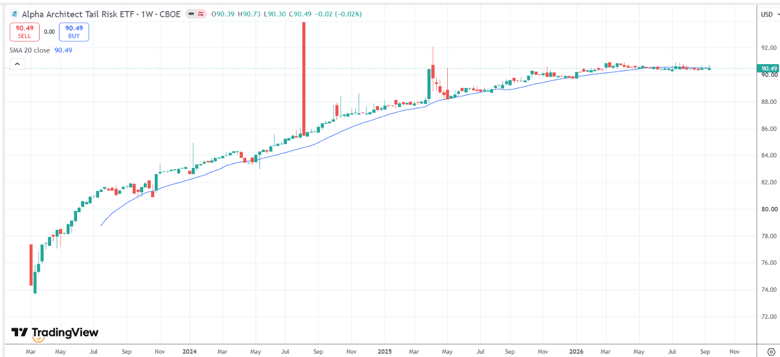
Year 2024: $82.87 to $87.54, annual return of 5.64%
Year 2025: $87.35 to $89.78, annual return of 2.78%
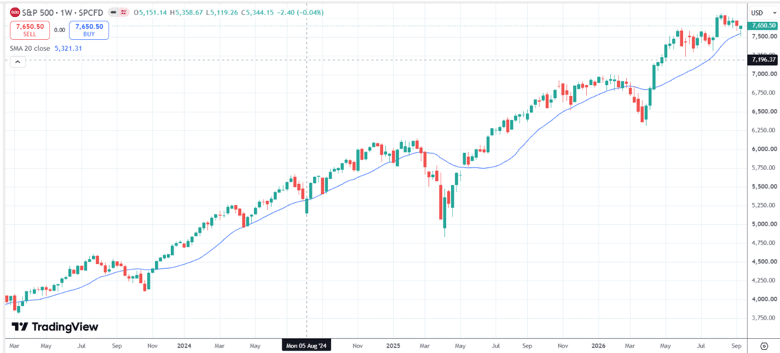
In comparison, the SPX returned 23% and 16% during the years 2024 and 2025 respectively.
The spike increase in value of CAOS on August 5th, 2024 was due to the 3% drop in SPX due to rapid unwinding of yen-funded positions.
Can The CAOS ETF Be A Replacement For Protective Long Puts?
No, it cannot.
They work differently.
On a dollar-per-dollar basis, long puts provide much better portfolio protection.
Suppose that on August 2, 2024 (at the close), an investor purchased one contract of the October 18th SPX $4200-strike put for $19.70 per share.
At 5-delta and 77 days to expiration, this put was deep out of the money.
The position required a net capital outlay of $1,970.
Now compare this with an investor who purchased 23 shares of CAOS at $85.63 per share.
The total capital required would be similar at $1,970.
The single long put investor gains $3290 the next day (at the close) during the August 5th sell-off.
The CAOS closed at $87.30, giving the investor a gain of only $38.
To provide the same kind of protection as the long put, the investor would have needed 1970 shares, or a capital outlay of $168,691.
That’s quite a lot.
Clearly, buying long puts is the most direct way to obtain downside protection.
However, it can be expensive to maintain.
If the market does not decline sufficiently before the options expire, the puts can lose most or all of their value.
The investor therefore faces a persistent theta and volatility drag while waiting for a crash.
How Much More Does The Long Put Decay In Comparison To CAOS?
Let’s continue the scenario with the same two investors (the one with the single long put and the one with the 23 shares of CAOS).
They continue to hold their position for another month.
On September 3rd, the long put lost about 60% of its initial value even with 45 days still till expiration.
The investor lost -$1,210.
The CAOS closed at $86.01.
No decay at all.
In fact, a positive gain of $8.74 to be precise.
Who Is This ETF Best Suited For?
CAOS suits investors who want tail-risk protection without the persistent theta drag of holding long puts outright.
It works best as a tactical allocation, increasing exposure during elevated-risk regimes and reducing it when markets are calm.
It is not designed as a standalone investment.
Conclusion
CAOS should not be thought of as a substitute for a conventional long-put portfolio hedge.
It may therefore be better understood as a tactical tail-risk strategy or alternative defensive allocation.
The CAOS ETF could also perhaps be a safe-haven for some investors to move money to when the market is amidst chaos – hence its name.
We hope you enjoyed this article on the CAOS ETF.
If you have any questions, please send an email or leave a comment below.
Trade safe!
Disclaimer: The information above is for educational purposes only and should not be treated as investment advice. The strategy presented would not be suitable for investors who are not familiar with exchange traded options. Any readers interested in this strategy should do their own research and seek advice from a licensed financial adviser.