








Whenever I hear of a new strategy, I bring out Option Net Explorer and manually run through a few historical trades and examine the results.
It is a good way to get a feel for the trade and see if it is a strategy worth pursuing.
We are going to do a more extensive backtest, running at least 100 trades.
The more data points, the more accurate the resulting stats are going to be.
The question we want to answer is whether it makes sense to transform a double calendar into a risk-free iron condor, which was a strategy presented by Steve Burnich in his interview with Theta Profits.
Contents
- The Strategy
- Backtest Results
- Backtest Trade Examples
- Backtest Statistics
- Win Rates
- Expectancy
- Frequently Asked Questions
- Related Strategies Worth Understanding
- Conclusion
The Strategy
Steve’s strategy initiates a double calendar at the start of a trading session.
The short put option and the short call option are positioned around the 30 to 40-delta on the option chain.
Their expiration is around 9 DTE, but could be anywhere from 5 to 15 days till expiration.
The long option expiration is typically the next trading day, which could be on a Monday with the time spread spanning the weekend.
A GTC (good-till-cancel) order is placed that will transform the double calendar into an iron condor by rolling the long options of the calendar to the same expiration as the short options but further away from the money to form a 5-point spread on each side.
The limit order is used to ensure that the order is triggered only when it is able to get a big enough credit such that the resulting iron-condor is risk-free.
This means that even if the iron-condor takes a max loss, the net overall P&L of the trade would still be positive.
If the order is not triggered near the end of the first day, he will have to decide whether to hold the double calendar to see if it gets transformed the next day.
If the order is triggered, the iron condor is held until expiration day.
Since he trades only SPX, the position is typically allowed to remain open until expiration, when the SPX options are cash-settled.
However, he may use his discretion to exit the position early on expiration day if the circumstances warrant it.
The double calendar is not risk-free to begin with.
It needs to achieve a certain amount of profit before it can be transformed.
We want to know what is the typical profit that is needed.
Is it better to just take the profit or gamble it on the iron condor?
Does this strategy have a positive expectancy in the long run?
Since it appears that Steve is doing 20-contracts for each trade on SPX, and entering on a daily basis.
At this size and frequency, it certainly looks like Steve himself has confidence in the strategy.
Backtest Results
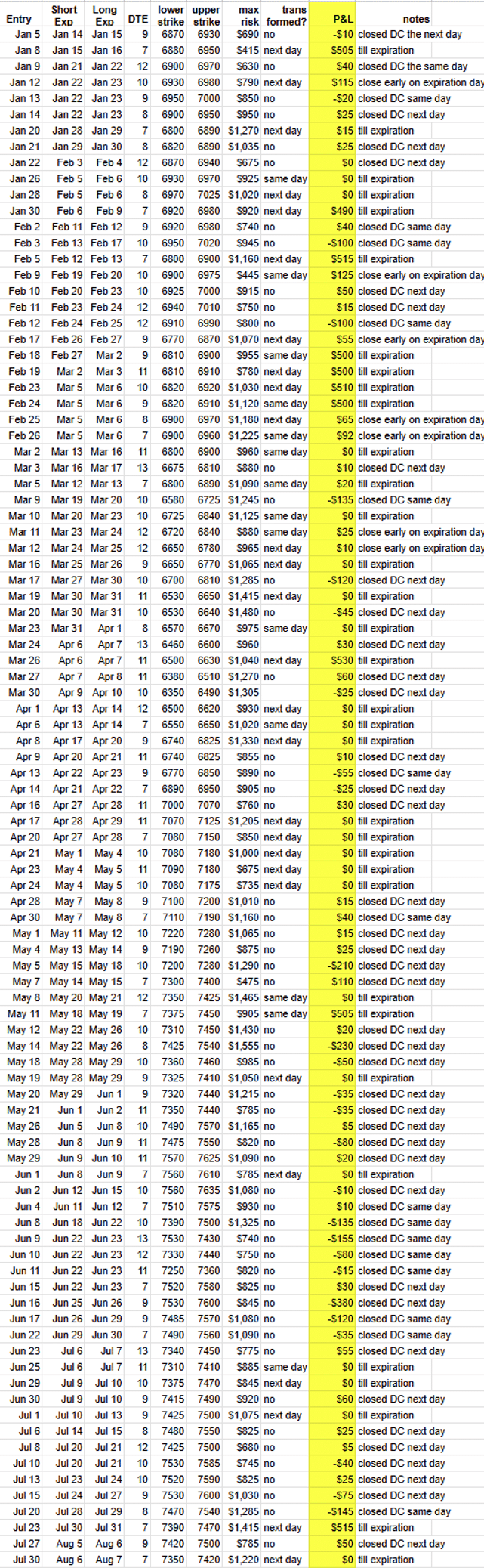
For our backtests, we did one contract to keep the math simpler.
Backtest Trade Examples
To understand what that table of numbers means, let’s look at our first backtest trade as an example…
Date: Jan 5th, 2026 at 15 minutes after the open
Price: SPX @ $6898
Sell to open one contract Jan 14th SPX $6870 put
Buy to open one contract Jan 15th SPX $6870 put
Sell to open one contract Jan 14th SPX $6930 call
Buy to open one contract Jan 15th SPX $6930 call
Net Debit: -$690
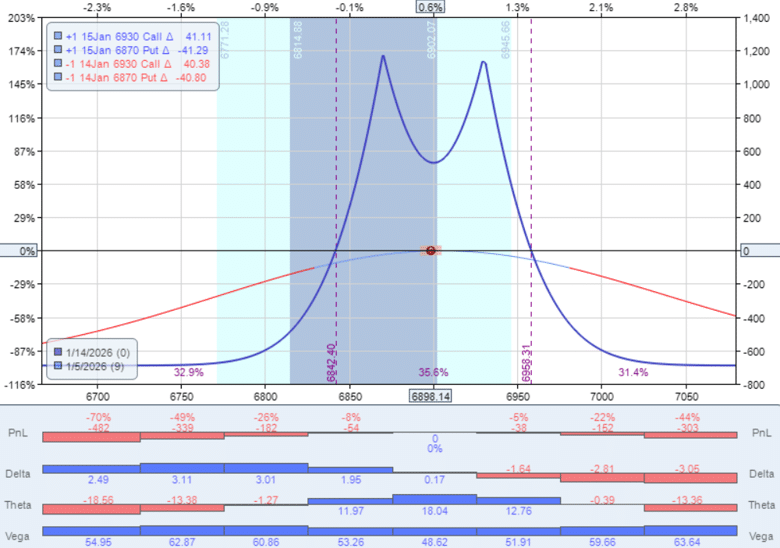
It was not able to transform to a risk-free iron condor on the first or second day.
We made a discretionary decision to close the trade near the end of the second day since the price of SPX was starting to go outside the profit tent.
The double calendar was closed with a profit and loss of -$10.
Backtest trade #2 was able to transform into a risk-free iron condor.
It started out as…
Date: Jan 8thh, 2026 at 15 minutes after the open
Price: SPX @ $6912
Sell to open one contract Jan 15th SPX $6880 put
Buy to open one contract Jan 16th SPX $6880 put
Sell to open one contract Jan 15th SPX $6950 call
Buy to open one contract Jan 16th SPX $6950 call
Net Debit: -$415
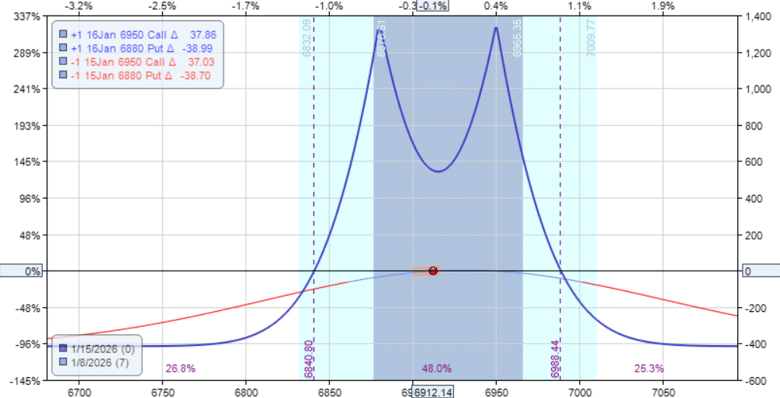
The order to transform this double calendar to an iron condor with 5 point spreads is to sell the long options of the double calendar and buy the long options of the iron condor.
Sell to close one contract Jan 16th SPX $6880 pu
Buy to open one contract Jan 15th SPX $6875 put
Sell to close one contract Jan 16th SPX $6950 call
Buy to open one contract Jan 15th SPX $6955 call
For this to become a risk-free iron condor the credit received for this order must be…
$415 + $500 = $915
The $415 is to recover the cost of the double calendar and the extra $500 is the credit to overcome the max loss of the iron condor, which is $500 since each spread is $5 wide.
The GTC (good till cancel) order is set as a limit order to trigger when a credit of $9.15 per share (or higher) is received.
In this example, the order has not been triggered on the same day.
Near the end of the session, the trader has to decide whether to hold the calendar overnight, or to close it.
Since the calendar is well centered…
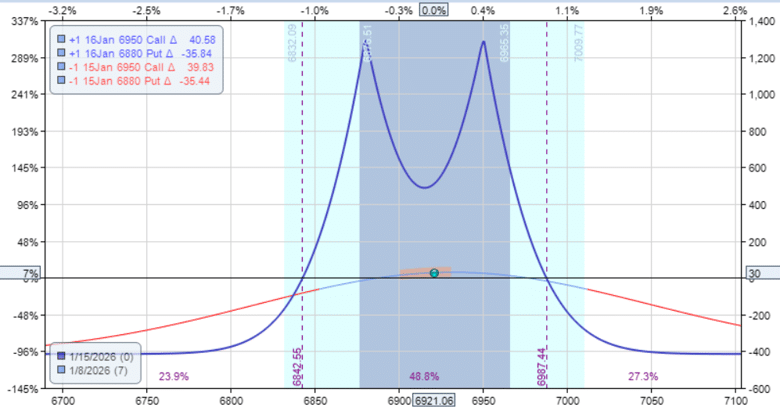
Let’s hold overnight to see if the transform order can be triggered the next day.
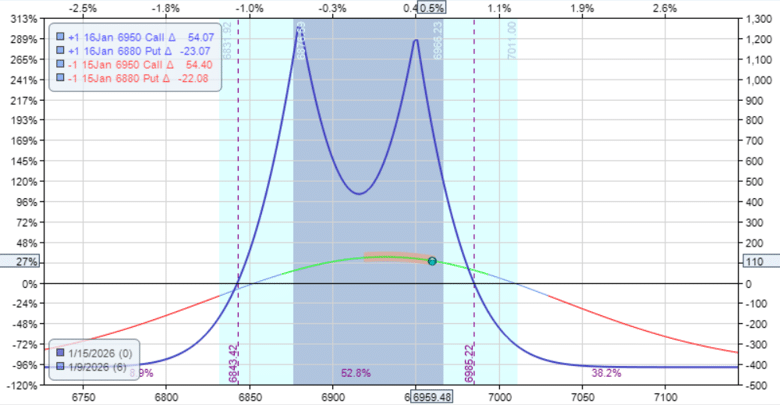
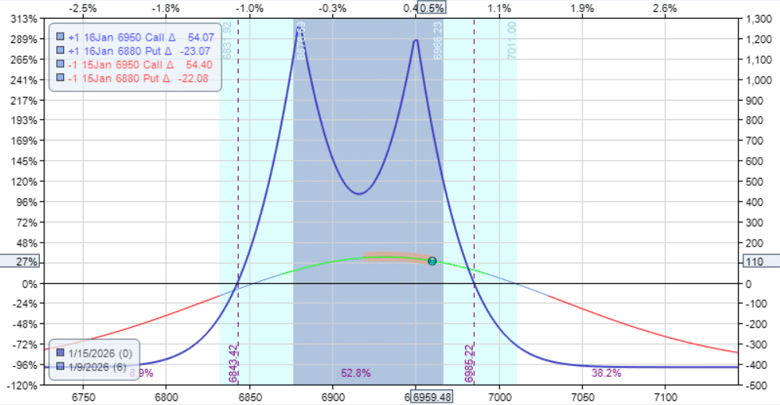
The next day, Jan 9th about two hours after the open, the calendar was showing a profit of $110, or $27% return on risk…
It was at that point that the order filled resulting in a risk-free iron condor.
Held till expiration, the iron condor expired at max profit.
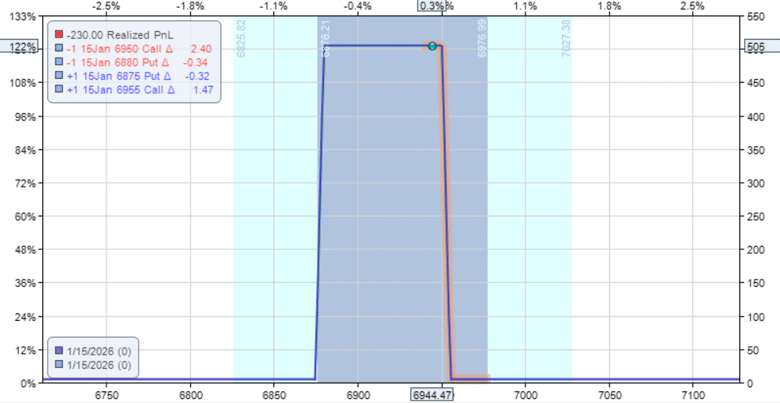
Resulting in $505 net profit for the trade.
Backtest Statistics
After doing this for 100 trades, 41 of them were able to transform into risk-free iron condors.
Of those 41, fourteen of them (about one-third) transformed on the same day the calendar was initiated.
The rest transformed on the next day.
If it did not transform by then, we closed the double calendar at near the end of the second day for whatever P&L it had.
All of the 41 risk-free condors were held till expiration day.
Most of them we let cash-settled at expiration, where it either took max profit or max loss on the iron condor.
A max loss on the iron condor meant that the net P&L of the trade ended up as zero.
But remarkably, 10 of the risk-free condors hit max profit – that’s nearly a quarter of them.
For seven of the 41 risk-free iron condors, we chose to close the position early on expiration day because SPX had moved to a level where it was unlikely to fall back into the iron condor.
In those cases, we simply took whatever credit remained in the condor rather than holding it through expiration.
The net accumulated P&L of all 100 backtest trades was $3687, which averages out to a profit of $37 per trade.
With roughly $1000 of capital used per trade, it is about 3.7% return per trade.
Win Rates
There were 48 wins, 29 losses, and 23 break-even.
The average win being $136 and the average loss being -$98.
Not counting break-even trades, the win rate is 48%.
If we had put in the GTC for just a bit extra credit (which is what Steve tends to do), then the P&L of zero would have been P&L of $5 even when the condor took max loss.
In that case, the 23 break-even would have counted as a small win, resulting in a win rate around 70%.
Expectancy
Based on the net accumulated profits of $3687 being positive, this is certainly a positive expectancy strategy, which means that it is expected to win over the long run.
We can also estimate its expectancy by combining the win rate, average win, and average loss.
Win rate: 48%
Average win: $136.19
Loss rate: 29%
Average loss: $98.28
Breakeven rate: 23%
The expectancy per trade is:
(Win rate × Average win) − (Loss rate × Average loss)
= (0.48 × $136.19) − (0.29 × $98.28)
= $65.37 − $28.50
= +$36.87 per trade
This matches the overall result: $3,687 ÷ 100 trades = $36.87 per trade.
Frequently Asked Questions
What Profit Does The Double Calendar Need To Have Before It Could Be Transformed?
When a double calendar successfully transformed, we also tracked how much profit it had built up first.
We left those figures out of the table above for brevity, but on average, the double calendar needed to reach roughly 10% profit before the transformation could trigger, which is consistent with the typical take-profit target for double calendars.
Why Not Simply Take The Profit From The Double Calendar And Move On?
You certainly can.
If we had booked the calendar profits and exited the trade at the time the transformation happened, the net accumulated P&L of the 100 trades would have been $2270.
This shows that extending the trade to risk-free condors increased our profits to $3,687 due to the potential of hitting max profits on the condors.
Instead Of Holding The Risk-Free Iron Condor Until Expiration, Could We Close It Early To Lock In Profits?
We tested this approach by closing the risk-free iron condor whenever SPX appeared to be moving outside and away from the condor.
Of course, this was somewhat discretionary and can vary from trader to trader.
The result was a net profit of $3,392, compared with $3,687 when the condors were held to expiration day.
Although closing early allowed us to lock in profits before the condor potentially expired worthless, the strategy also caused us to miss out on some maximum-profit opportunities.
Sometimes SPX moved outside the condor, prompting an early exit, only to reverse course later and finish inside the condor at expiration, where we would have collected the maximum profit.
It only takes one or two such instances to make holding the condor to expiration worthwhile.
Can You Show Me The Math?
This is not a commonly asked question, but okay.
The average profits that are in the calendars at the time of transformation is about $100.
Are you willing to spend that $100 on a gamble with the condor?
The gamble is that you get an extra $400 if SPX expires within the condor (and keep your original $100).
You lose that $100 if SPX expires outside.
The likelihood of expiring inside the condor (at least from this backtest) is roughly 25% (to make the math easier).
Yes, I would take that gamble.
Take the example of four runs.
Three of them I would lose my $100.
The fourth run, I would win an additional $400.
My net gain is $100 over the four runs.
Or $25 per run over the long run.
This is a statistically favorable gamble.
The math:
Expected Value = (25%×$400) + (75%×−$100) = +$25
As long as that number is positive, you will win in the long run.
So it is worthwhile to extend trade into the risk-free iron condor and hold trade till expiration.
The break-even win rate is 20%.
In fact, you’re getting $400 of potential profit for risking $100, which is a 4:1 payoff-to-risk ratio.
With that payoff, you only need to win 1 out of 5 times to break even.
To be more precise, since 10 out of the 41 iron condors reach max profit in our backtest, the exact win rate on the iron condors in this one experiment is 24% (still above the necessary break-even probability).
How Does This Strategy Compare To Discretionary Double Calendar Trading?
In fact, one member of our community manually paper-traded the same exact double calendars used in our experiment.
Instead of transforming them, he took profits, exited positions, and made adjustments at his discretion.
His results of net accumulated profits of $3525 were slightly less but similar to those of our experiment (recall that it was $3687).
A distinction is that transformation to iron condors uses less mental capital since there is no adjustment involved.
Transformation happens via a GTC order.
Once the transformation has happened, there is no more risk.
You don’t have to monitor the trade or lose any sleep over it.
Furthermore, once the transformation happens, it frees up the buying power that was initially used by the double calendar.
What Was Different Between The First Example Trade Which Did Not Transform Versus The Second Trade Which Did?
There are many factors that contribute to whether it could be transformed or not.
One factor could be the cost of the double calendar.
The first trade cost $690.
The second trade cost $415.
This gives the second trade a better reward to risk ratio of 3 as seen by the shape of the expiration graph where the peak profit is near $1200 with a max loss around $400.
The double calendar is able to achieve a better reward-to-risk when the calendars are in backwardation.
That is when the implied volatility of the short option is higher than the implied volatility of the long option.
Can Looking At Backwardation Be An Edge To Enhance Transformation Rate?
It may very well be.
Steve uses a proprietary software called Flux that shows the amount of backwardation in the calendar and tries to enter them when calendars are at an increased backwardation by scanning for different strikes and expirations.
So that is probably giving him an extra edge that we are not seeing in our backtest, which is why his transformation rate of 60% is higher than our transformation rate of 41%.
Aren’t You Simply Using The Profits From The Double Calendar To Buy An Iron Condor?
This is correct.
It is taking profits from the original double calendar and using those profits to finance a new iron condor.
While it is true that after it is transformed into the iron condor, the net P&L can no longer go below zero.
But the “losses” of the iron condor is simply taking away from the “profits” of the double calendar.
However, the setup is such that it minimizes the amount of profits that is needed in order to perform the transformation.
That is why the spread on the iron condor is so narrow at 5 points wide.
And the strikes of the double calendar are somewhat close to the money which increases theta so that it can reach the transformation point as soon as possible.
Even though it is using profits from one trade to fund another, it is doing it in a systematic way such that the losses from the iron condor can not exceed the profit achieved by the double calendar.
Furthermore, it is reusing the short options, saving on commissions by not needing to exit and re-enter them.
Related Strategies Worth Understanding
This strategy builds on two foundational structures — double calendars and iron condors.
If you’re not yet familiar with either, reading our dedicated guides before attempting this strategy is strongly recommended:
- Double Calendar Spreads: The Complete Guide — mechanics, strike selection, and management
- Iron Condors: The Complete Guide — including the 21 DTE and 50% profit rules that inform the management decisions in this article
- Calendar Spreads — the single-strike version that underlies the double calendar structure
- Adjusting Iron Condors — for when the condor component of this strategy needs management
Conclusion
Based on the empirical evidence from our backtest, we can conclude that this quasi-systematic strategy has demonstrated positive expectancy and profitability.
One of the appealing aspects of the strategy is its simplicity.
We don’t need to rely on technical analysis to predict market direction, nor do we need to constantly monitor the Greeks and make adjustments to the position.
Once the double calendar reaches the required profit level and is transformed into a risk-free iron condor, the trade becomes relatively hands-off.
So, yes.
It does make sense to transform profitable double calendars into risk-free iron condors and hold them to expiration.
Past results do not guarantee future performance.
And remember this is only one backtest.
The reader is encouraged to run their own similar backtest.
Want to Trade These Strategies With Guided Support?
The double calendar to risk-free iron condor transformation is an intermediate-to-advanced strategy that rewards patience and systematic execution.
Options Income Mastery covers the foundational income strategies — including iron condors and calendar spreads — with the exact entry rules and management framework that makes systematic income trading consistent over time.
Learn more about Options Income Mastery →
We hope you enjoyed this article on transforming double calendars into risk-free iron condors.
If you have any questions, please send an email or leave a comment below.
Trade safe!
Disclaimer: The information above is for educational purposes only and should not be treated as investment advice. The strategy presented would not be suitable for investors who are not familiar with exchange traded options. Any readers interested in this strategy should do their own research and seek advice from a licensed financial adviser.