






In Part 1, we saw how a conditional order can be used to enter a vertical spread when the underlying reaches a predetermined price.
The same concept can also be used for risk management.
Rather than using a conditional order to initiate a new trade, a trader can use one to automatically deploy a hedge when an existing position comes under pressure.
This can be particularly valuable during a sudden market move, when the trader may not be in front of the computer to manually place the hedge.
Contents
Example: Reactive Put Debit Spread Hedge
Suppose we have established a delta-neutral iron condor on SPY.
The iron condor is designed to profit as long as SPY remains relatively range-bound and does not make a large move in either direction.
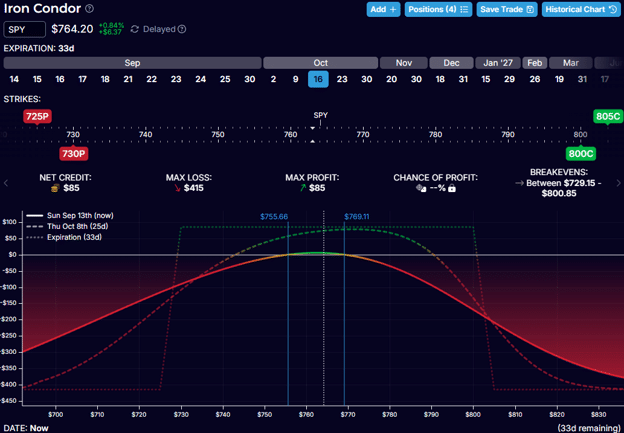
Suppose SPY is currently trading at $764, and we become concerned that a significant decline could hurt the position.
We would like to reactively hedge the iron condor if SPY falls to $750.
The problem is that a sudden market selloff could occur when we are away from the computer.
Rather than relying on manually entering the hedge after the decline has already occurred, we can use a conditional order to automatically submit a put debit spread when SPY reaches our predetermined price.
The hedge we want to establish a bear put debit spread:
Buy one contract Oct 16th SPY $750 put
Sell one contract Oct 16th SPY $748 put
This $2-wide debit spread would look like this by itself…
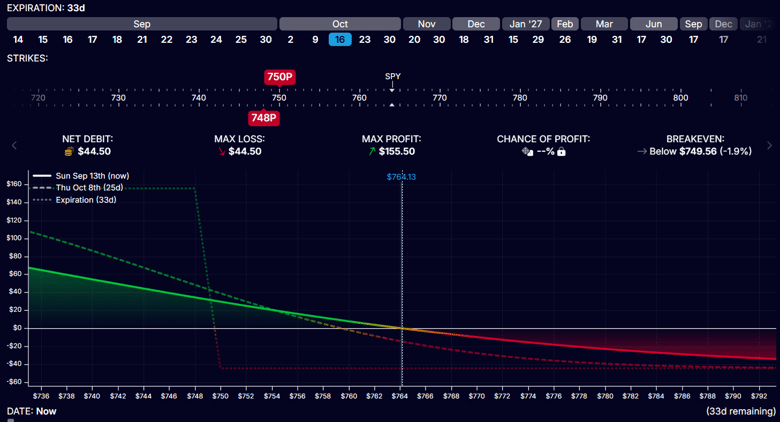
This debit spread at the current time is modelled to be trading around $0.45 per share, or $45 per spread.
When the debit spread is combined with the iron condor, we will have the following…
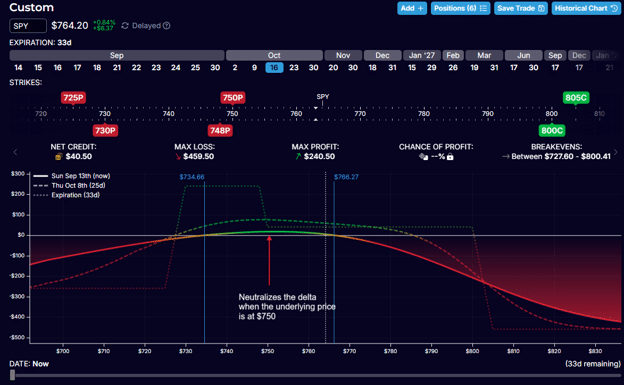
When combined with the existing iron condor, the debit spread is intended to offset some or all of the iron condor’s negative delta if SPY declines toward $750.
Note how the selection of the strikes of the debit spread give a flat T+0 line when the underlying price is at $750.
To put this conditional order into ThinkOrSwim, we set up the put debit spread order similar to before…
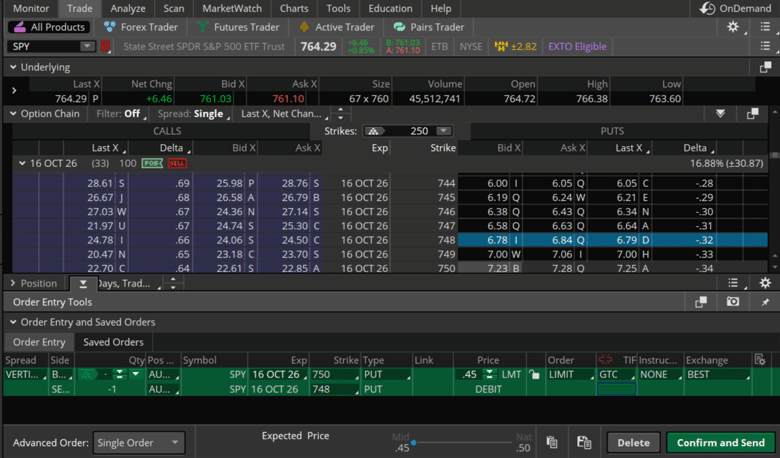
While the mid-price is showing $0.45 debit for the spread at the current time, we should not expect the spread to still cost $0.45 if SPY actually falls to $750.
At $750, the $750 put is approximately at the money, while the $748 put is just out of the money.
The spread will therefore be worth considerably more than it is when SPY is at $764.
Furthermore, a sharp market decline will often be accompanied by an increase in implied volatility.
Since higher implied volatility generally increases the value of options, the cost of the put debit spread could rise substantially during a selloff.
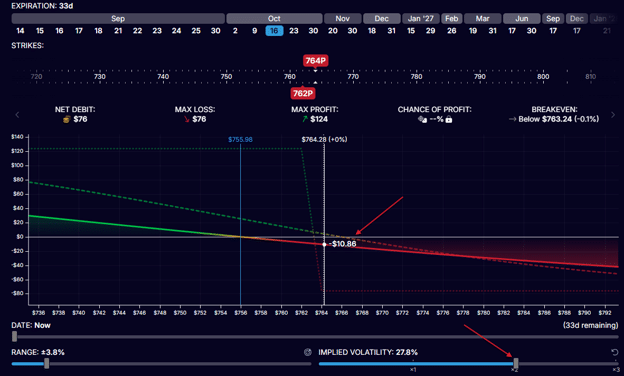
Let’s model out what a $2-wide at-the-money put debit spread would cost if SPY came within at-the-money of the spread.
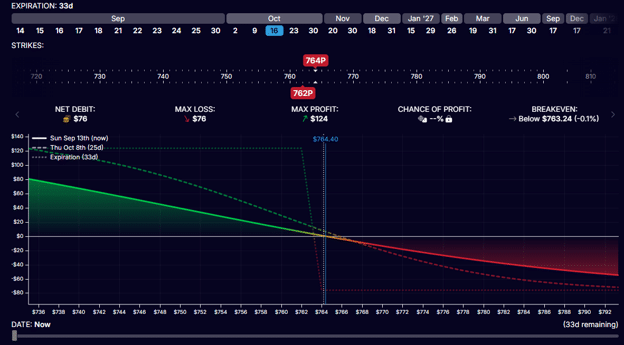
OptionStrat models the spread at approximately $0.76 when SPY reaches $750, assuming implied volatility remains unchanged.
As the market drops and volatility doubles, we see that the spread cost would increase by another $0.10.
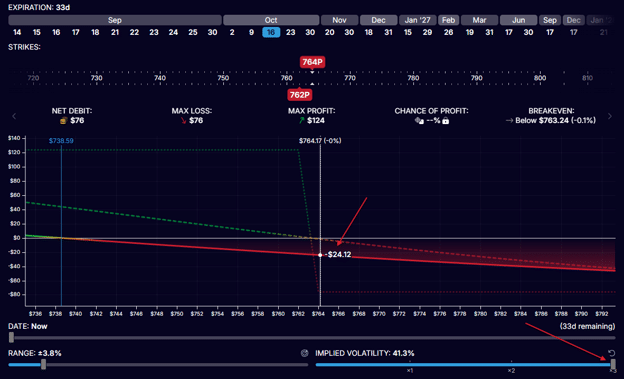
And if it was truly a black swan event where there is a lot of fear, a tripling of volatility would cause the debit spread cost to increase by $0.24…
Since our objective is protection during a sharp selloff, we don’t want to set the limit price so aggressively that the hedge fails to execute precisely when we need it.
Therefore, we are going to give it a lot of leeway to get filled.
We are willing to pay as much as $1.00 to buy this debit spread – pricing $0.76 for an at-the-money spread and addition $0.24 for cost due to increased volatility.
This $2-wide spread has $200 as the maximum payoff of the spread.
The $100 debit paid to enter the position must be subtracted to determine the actual maximum profit of the spread.
In our case, the max profit on the spread would be $100 and the max risk would be $100.
That’s okay.
You would not want to set the limit price to be $1.90 for example.
Because you would be paying so much for the hedge that there is no profit potential left in the hedge at all.

Setting a limit order price of $1.00 for the spread does not mean that we are going to pay $1.00 for the spread.
If the condition is triggered, the $1.00 limit order will be submitted.
We will pay the prevailing market price if the spread is available at $1.00 or less.
The order seeks execution at the specified price or better.
For example, if SPY reaches $750 and the spread is trading at $0.82 when the conditional order is submitted, it could be filled around $0.82 rather than $1.00, assuming the market is available at that price.
If the spread is trading at $1.05, however, our $1.00 limit order will not fill at $1.05.
It will remain working, waiting for the spread to become available at $1.00 or less, or until the order is canceled or expires according to its time-in-force instructions.
The $1.00 limit price is to set a maximum price that we are willing to pay on the hedge.
Now that we have set the GTC Limit price, click the Settings icon
to set the Order Rules…
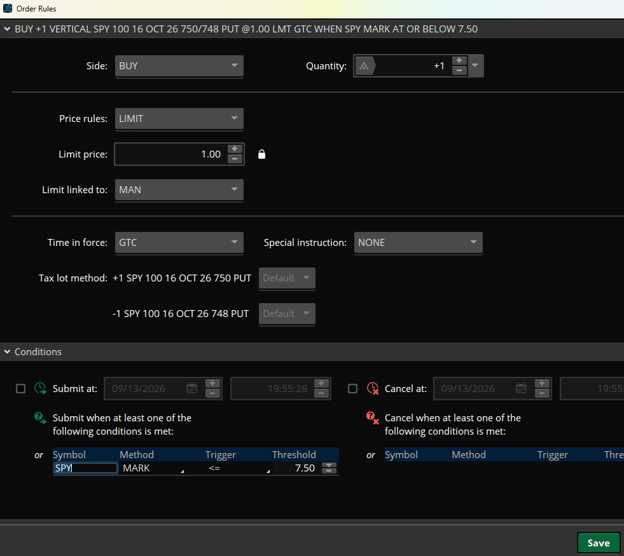
Note how in this example, we used the less than or equal conditional for the Trigger.
And then we go ahead to complete our order.
FAQ
Why Would The Hedge Spread Cost More At The Trigger Point Than When I Set It Up?
Two reasons.
First, as SPY falls from $764 to $750, the $750 put moves from out-of-the-money to approximately at-the-money, making it more expensive.
Second, sharp market declines are typically accompanied by rising implied volatility — which increases the value of all options, including your hedge.
This is why the OptionStrat modelling shows the spread cost rising from $0.45 (current) to as much as $1.00 at the trigger price under a high-volatility scenario.
Setting your limit too low risks the hedge not filling precisely when you need it most.
What Happens If My Conditional Hedge Never Triggers?
If SPY never falls to $750, the conditional order simply sits working in your Monitor tab.
It does not affect your existing iron condor and does not use any additional margin (a working conditional order does not reserve buying power until it triggers).
If the iron condor expires or is closed before the trigger is ever hit, cancel the conditional hedge order at the same time.
Should I Use A Debit Spread Or A Long Put For The Hedge?
A debit spread (buying one put and selling a further OTM put) is generally preferable to a long put for hedging an iron condor because the sold put partially offsets the cost of the hedge.
A long put alone would be more expensive and would cost significantly more to fund in a high-volatility environment.
The trade-off is that the debit spread has a capped maximum payoff — but for the purpose of partially offsetting iron condor delta, the spread is usually sufficient.
Can I Use This Same Technique On The Upside?
Yes — the same conditional order technique can be used to deploy a bear call debit spread if the iron condor’s upside is threatened.
Simply set the trigger as “greater than or equal to” the price level where you want the hedge to activate (the mirror image of the downside trigger), and set up the bear call debit spread accordingly.
The same IV expansion consideration applies on the upside, though to a lesser extent since call option IV typically rises less dramatically than put IV during market moves.
Does This Work On Platforms Other Than ThinkorSwim?
Conditional orders are available on Interactive Brokers TWS as well, through the “Conditional” order type in the order entry panel.
The mechanics are similar — you specify the trigger condition on the underlying and the order that should be submitted when the condition is met.
The specific interface differs from ThinkorSwim, but the conceptual approach is identical.
Most other retail platforms do not support conditional multi-leg options orders.
Summary
A conditional vertical spread serves two distinct purposes in systematic options trading.
In Part 1, we used it to enter a new bull put credit spread on CRM only after price confirmed the bullish thesis by moving above $250 — removing the need to sit at the computer waiting for a manual entry signal.
In this article, we used it to pre-position a defensive hedge on an existing iron condor, set to deploy automatically if SPY falls to $750.
The key nuances:
The hedge spread will cost more at the trigger point than it does when you set it up — because the underlying will have moved and IV will likely be higher.
Model this in advance and set your limit accordingly.
A limit price of $1.00 on a $2-wide spread leaves meaningful profit potential in the hedge while still covering even the high-volatility scenario.
The “less than or equal to” condition (vs “greater than or equal to” in Part 1) is the correct trigger direction for a downside hedge.
GTC ensures the order stays active until either the condition is met or you cancel it.
Together, these two techniques allow an options income trader to be more systematic and less reactive, with both entries and risk management handled in advance rather than under pressure.
We hope you enjoyed this article on triggering a conditional vertical spread hedge.
If you have any questions, please send an email or leave a comment below.
Trade safe!
Disclaimer: The information above is for educational purposes only and should not be treated as investment advice. The strategy presented would not be suitable for investors who are not familiar with exchange traded options. Any readers interested in this strategy should do their own research and seek advice from a licensed financial adviser.